





Acer vs Skytech: Overview
Comparing Acer and Skytech helps you determine which brand is best suited for your needs in Prebuilt PC. Both brands offer strong choices depending on your budget and key feature requirements.
Key Features & Comparison
Evaluate factors such as build quality, warranty, customer satisfaction, and total value before making your final purchase choice between Acer and Skytech.
Features
Feature implementation highlights the philosophical rift between an OEM and a boutique builder. Acer builds an enclosed, proprietary ecosystem led by software suites like PredatorSense or NitroSense. These centralized dashboards provide users with granular fan curve controls, thermal monitoring, automated component overclocking profiles, and synchronized RGB lighting management natively linked to the motherboard’s firmware. Additionally, Acer frequently implements specialized hardware conveniences on their chassis, such as fold-out headset cradles, hot-swappable drive bays, or proprietary EMI-shielded component covers, reflecting an integrated consumer electronics approach to PC manufacturing.
Skytech diverges by minimizing bloatware and leaning into standard third-party hardware features. Because Skytech avoids custom board fabrication, users benefit from standard retail motherboard features, including comprehensive UEFI BIOS interfaces, standard ARGB 3-pin and 4-pin headers, robust standard VRM cooling, and widespread PCIe expansion slots. While Skytech lacks a singular, unified software suite like PredatorSense—requiring users to rely on the respective motherboard and GPU manufacturers' utilities for tuning—the elimination of invasive background software ensures a lean Windows environment out of the box. Skytech systems also tend to feature standard retail power supplies with 80-Plus Gold ratings and fully modular cabling, whereas Acer frequently equips units with exact-wattage, proprietary-pinned OEM power supplies with limited overhead.
Performance
In real-world performance benchmarks, both brands can be configured with identical tier-one silicon from Intel, AMD, and NVIDIA, yet their sustained compute capabilities often diverge due to thermal management and power limits. Skytech generally holds a performance advantage in prolonged gaming sessions and multi-threaded rendering workloads. Because Skytech utilizes standard high-airflow cases (frequently featuring full-mesh front panels) paired with standard AIO liquid coolers or large tower air coolers, their systems maintain lower junction temperatures. This headroom allows modern CPUs and GPUs, governed by algorithms like AMD Precision Boost Overdrive or Intel Thermal Velocity Boost, to sustain their maximum boost clocks without running into aggressive thermal throttling thresholds.
Acer’s performance output, conversely, can occasionally be constrained by chassis airflow and OEM BIOS power profiles. While high-end Predator Orion systems feature sophisticated liquid cooling and FrostBlade fans, entry-to-mid-tier Nitro desktops often employ compact, restrictive cases with limited intake perforations and basic downward-blowing stock coolers. Under synthetic thermal loads, these configurations may experience higher operating temperatures, prompting the motherboard’s firmware to downclock components or aggressively ramp up fan curves to audible extremes. While Acer delivers perfectly competitive baseline frame rates for casual and moderate gaming, Skytech generally extracts more sustained performance efficiency from equivalent silicon due to superior chassis ventilation and less restrictive power targets.
Design
The aesthetic and physical design philosophies of these two manufacturers cater to distinctly different consumer preferences. Acer commits heavily to an aggressive, industrial "gamer" aesthetic, defined by custom-molded ABS plastic fascias, angular geometric contours, dark matte finishes, and prominent predatory branding. High-tier chassis like the Predator Orion series boast sophisticated multi-zone tempered glass side panels, integrated carrying handles, and internal thermal compartmentalization designed to isolate heat zones. However, this bespoke engineering often results in cramped internal layouts, limited cable-routing clearance behind the motherboard tray, and proprietary front-panel connector pinouts that lock the user into the original enclosure.
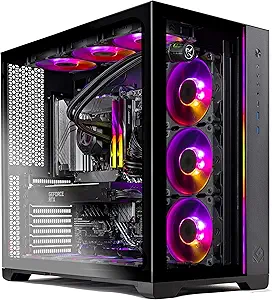
Skytech favors the modern, minimalist enthusiast design language characterized by panoramic tempered glass panels, showcase "aquarium" dual-chamber configurations, and high-airflow mesh frontages. Their cases are engineered with standardized interior geometry, providing ample room for multi-fan radiators, vertical GPU mounting, and generous cable management channels with rubber grommets and tie-down points. The visual appeal of a Skytech system relies predominantly on coordinated addressable RGB lighting diffused through component fans and RAM heat spreaders rather than molded exterior plastics. For buyers seeking a clean, showcase-style desk centerpiece with effortless interior access, Skytech offers superior design versatility, whereas Acer appeals to those who favor a unified, branded, console-adjacent appliance look.