Acer vs CyberpowerPC: Overview
Comparing Acer and CyberpowerPC helps you determine which brand is best suited for your needs in Prebuilt PC. Both brands offer strong choices depending on your budget and key feature requirements.
Key Features & Comparison
Evaluate factors such as build quality, warranty, customer satisfaction, and total value before making your final purchase choice between Acer and CyberpowerPC.
Features
Acer’s feature profile is characterized by tightly controlled hardware-software ecosystems, headlined by the proprietary PredatorSense and NitroSense management suites. These software utilities offer deep, low-overhead monitoring, automated fan curve profiling, and granular RGB control directly tied to the system’s motherboard architecture. High-end Predator models also feature integrated hardware luxuries, such as pop-out headphone cradles, hot-swappable drive bays, and custom liquid cooling loops engineered directly for the chassis footprint. However, these features are frequently tethered to non-standardized hardware interfaces, complicating software-level modifications and limiting feature expansiveness to what Acer explicitly supports within its BIOS and software ecosystem.
In contrast, CyberpowerPC delivers a feature set defined by platform transparency and motherboard-level freedom. Because the company builds with non-proprietary motherboards, users gain access to fully unlocked consumer BIOS environments, facilitating robust XMP/EXPO memory profiles, precise voltage tuning, and unconstrained fan curve adjustments. Lighting and telemetry are controlled via standard ARGB headers and third-party software suites, avoiding proprietary lock-in. While CyberpowerPC lacks the proprietary hardware integration of Acer, it compensates with modern connectivity options—including uninhibited PCIe expansion, multiple standard M.2 NVMe slots, and non-restricted power delivery features that accommodate future-generation peripherals and expansions.
Performance
From a raw throughput perspective, both brands offer high-tier configurations pairing modern Intel or AMD processors with NVIDIA RTX or AMD Radeon GPUs, but they diverge sharply in thermal management and sustained power limits. Acer often tunes its systems with conservative power profiles and tailored dynamic boost intervals to maintain stability within compact or proprietary acoustic envelopes. While high-end Predator Orion models with dual- or triple-fan liquid cooling perform exceptionally well under multi-threaded loads, entry-level Nitro systems often rely on modest downdraft air coolers and restricted intake designs that can induce thermal throttling during prolonged gaming sessions or intensive rendering tasks.
CyberpowerPC typically realizes higher sustained clock speeds out of identical silicon due to its utilization of high-airflow, standardized ATX cases and mainstream all-in-one (AIO) liquid coolers or tower air sinks. With standard motherboard VRM designs and unrestricted power targets enabled in the BIOS, CyberpowerPC machines can push CPU boost frequencies for longer periods without hitting thermal ceilings. The trade-off lies in component variance; because CyberpowerPC sources parts from various board partners dynamically based on inventory, minor performance discrepancies and acoustic variations can exist across units of the identical SKU, whereas an Acer system offers strict, uniform benchmarking consistency.
Design
Acer’s industrial design language is bold, aggressive, and highly distinctive, setting its systems apart from the conventional PC landscape. The Predator line features angular, armored chassis aesthetics with heavily stylized front fascias, sculpted tempered glass, and integrated structural elements like carrying handles and chassis wheels on ultra-tower variants. While striking and structurally robust, this internal design frequently utilizes custom motherboard form factors, non-standard front I/O wiring, and proprietary power supply designs (such as custom 12V-only rails). This engineering approach optimizes factory assembly and cable routing for the original layout, but it actively impedes long-term customization and interior tinkering.
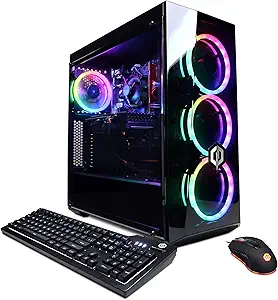
CyberpowerPC adheres to contemporary custom-build aesthetics, prioritizing minimalist glass-and-steel mid-towers, panoramic dual-chamber designs, and front-to-back airflow dynamics. Systems feature standard ATX, Micro-ATX, and Mini-ITX form factors, offering exceptional interior visibility, clean cable routing channels, and standard mounting brackets for radiators and case fans. While CyberpowerPC’s chassis designs may feel less uniquely identity-driven than Acer's bespoke enclosures, their architectural standardization ensures effortless maintenance, superior dust management through magnetic filters, and the absolute freedom to replace every individual component down to the chassis itself over the lifespan of the machine.
Compare current retail pricing, active promotions, and verified stock availability directly from authorized stores: