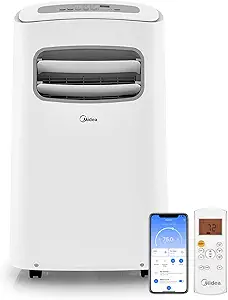
GE vs Midea: Overview
Comparing GE and Midea helps you determine which brand is best suited for your needs in Air Conditioners. Both brands offer strong choices depending on your budget and key feature requirements.
Key Features & Comparison
Evaluate factors such as build quality, warranty, customer satisfaction, and total value before making your final purchase choice between GE and Midea.
Customer Support & Warranty
GE benefits from decades of established infrastructure across North America, resulting in a more accessible and reliable customer support ecosystem. Their standard warranty covers parts and labor for one full year, but where GE truly excels is its extensive network of certified technicians and readily available replacement components. Should an issue arise, securing warranty repairs, diagnosing operational faults, or finding aftermarket parts is typically straightforward and fast. Consumers also gain peace of mind from GE’s direct-to-consumer phone lines and comprehensive digital troubleshooting manuals, which tend to be more thoroughly localized than those of overseas-headquartered competitors.
Midea, while a dominant global manufacturer that actually produces appliances for many third-party labels, has historically had a more fragmented customer service presence in Western retail markets. Their standard manufacturer warranty generally matches the industry-standard one-year limited coverage on the full unit, occasionally extending up to five or ten years on the compressor for specific inverter-driven systems. However, warranty fulfillment often relies on third-party service contractors or direct unit replacements rather than in-home technician dispatches. While Midea's warranty terms are robust on paper, consumers may experience slower response times and more bureaucratic friction when navigating complex claims compared to the more seamless domestic footprint of GE.
Energy Efficiency
Midea is an industry pioneer in bringing cutting-edge DC inverter technology to mass-market window and portable air conditioners, most notably through their revolutionary Midea U-shaped platform. By replacing traditional, power-hungry single-speed compressors with variable-speed inverters, Midea units dynamically modulate their cooling output rather than cycling abruptly on and off. This design achievement enables several of their flagship models to achieve CEER (Combined Energy Efficiency Ratio) ratings well exceeding 15.0, comfortably securing Energy Star Most Efficient designations. For homeowners operating air conditioning over prolonged summer stretches, Midea's engineering drastically reduces electrical draw and delivers tangible utility savings.
GE has responded with its own line of high-efficiency inverter models, but their broader catalog still leans heavily into traditional rotary compressors, particularly among entry-level and mid-tier units. Standard GE window and portable units hover around standard Energy Star benchmarks with CEER values typically between 11.0 and 12.0. While these legacy configurations are dependable, cost-effective to produce, and meet modern regulatory standards, they consume measurably more power over extended duty cycles. GE’s newer Profile and advanced inverter lines bridge this gap effectively, yet across the entirety of their product portfolios, Midea retains a distinct technical advantage in overall thermodynamic efficiency and electrical frugality.
Noise Level
Midea fundamentally transformed consumer expectations regarding air conditioner acoustics with its patented U-shaped window unit architecture. By utilizing the window pane itself as a sound barrier, Midea isolates the noisy compressor on the exterior side of the window, leaving only the quiet blower fan inside the living space. Coupled with ultra-smooth variable-speed inverter operation, these units can register noise levels as low as 32 to 42 decibels on low speeds—comparable to a quiet whisper or a muted library. Even in standard portable and non-U window designs, Midea leverages advanced fan blade geometry and dampening materials to keep acoustic disruption remarkably low.
GE produces competitive quiet-series air conditioners, including certain Profile models engineered with sound-dampening insulation, but their conventional units generally operate within the louder 50 to 60 decibel range. Traditional single-speed compressors in GE’s mainstream lineup generate noticeable acoustic spikes when kicking on and off, which can easily interrupt sleep or background conversation in small rooms. While GE's higher-end models employ dual-motor configurations to separate internal and external airflow paths for quieter operation, Midea’s mechanical innovations deliver a consistently superior low-noise experience across a wider price band.
Cooling Performance
Cooling performance is where GE leverages its formidable engineering heritage, emphasizing raw, aggressive heat extraction and robust airflow dynamics. GE units are tuned for rapid pulldown capability, featuring high-volume blowers and multi-directional louver designs that disperse cold air swiftly and deeply across medium to large rooms. When dealing with extreme ambient temperatures and intense solar heat loads, a traditional GE air conditioner provides relentless and predictable thermodynamic output, making it exceptionally reliable in climates prone to severe, high-humidity heat spikes where moving maximum cubic feet of air per minute (CFM) is paramount.
Midea approaches cooling through continuous thermal equilibrium and precise climate moderation. Rather than producing dramatic temperature swings via aggressive cycling, Midea’s inverter systems quickly pull a room down to the set temperature and then settle into a continuous micro-adjusting cooling mode. This steady operation excels at consistent, uninterrupted dehumidification, eliminating the clammy feel that can occur when conventional compressors shut off while the fan continues to run. While Midea provides exceptionally refined comfort and steady temperature maintenance, GE holds an edge in sheer volumetric airflow velocity and initial thermal shock output under peak thermal load.