










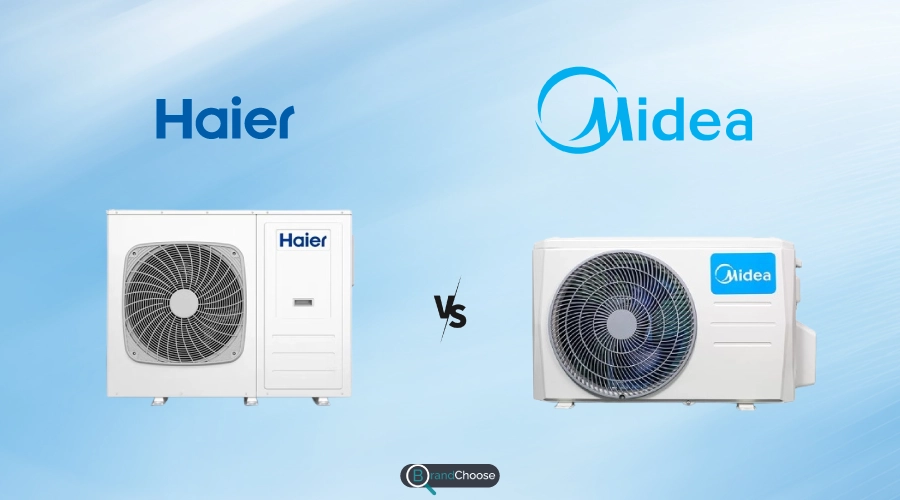
Choosing between Midea and Haier? When choosing an air conditioner, Midea and Haier are two top brands known for reliable, feature-rich, and affordable cooling solutions. Below is a breakdown of their key differences to help you decide which brand best suits your needs.
Customer Support & Warranty
When evaluating the post-purchase landscape for air conditioners, the warranty structures and customer support ecosystems of Haier and Midea reveal distinct operational philosophies and logistics networks. Haier benefits significantly from its integration with GE Appliances in key markets like North America, giving it an inherited infrastructure of established regional service depots, readily available OEM replacement parts, and a mature logistics pipeline. In terms of warranty engineering, Haier typically provides a standard one-year comprehensive limited warranty on parts and labor for window and portable units, expanding up to a 5-to-10-year warranty specifically covering the compressor on their mini-split and ductless systems. This tiering reflects high component reliability—particularly regarding their DC inverter technology—while shielding the brand from the high labor costs associated with sealed-system refrigerants. Customer support is accessible via centralized multi-channel platforms (phone, web portal, and smart diagnosis via the SmartHQ app), resulting in generally lower turnaround times for certified technician dispatches compared to direct-import competitors.
Midea, operating as the world’s largest single manufacturer of HVAC hardware, adopts a more tiered, component-specific warranty framework that is technically robust but occasionally hindered by support logistics. For its flagship U-shaped window units and consumer inverter mini-splits, Midea frequently backs its hardware with a standard one-year limited system warranty paired with an industry-competitive 5-to-10-year warranty on the compressor assembly. Technically, Midea’s engineering resilience is top-tier; their systems integrate internal failure-code telemetry that simplifies problem identification. However, the practical trade-off lies in third-party service fulfillment. Because Midea historically operated primarily as an OEM fabricator for other major labels, its direct-to-consumer North American and European warranty resolution pipelines rely heavily on fragmented third-party contractor networks. Consequently, consumers filing warranty claims often experience longer response latency for physical technician visits and occasional supply chain bottlenecks when acquiring proprietary replacement parts, such as custom control boards or inverter drive modules.
Ultimately, the choice between Haier and Midea regarding support infrastructure hinges on field availability versus raw warranty coverage limits. Haier emerges with a competitive advantage in customer service practicality and dispatch velocity due to its expansive legacy service network, making labor claims and component replacements less friction-heavy for the average homeowner. Midea matches or occasionally exceeds Haier in upfront component coverage durations—especially when units are registered through extended promotional channels—and provides superior self-diagnostic features via its mobile app interface. However, Midea demands greater consumer patience if an in-warranty sealed-system failure occurs, making Haier the safer bet for expedited customer service, while Midea appeals to buyers comfortable with diagnostic-driven, component-focused warranty protections.
Energy Efficiency
🔹 Midea : Energy efficiency is a strong suit for both brands, but Midea takes the lead with its impressive ENERGY STAR® certification across many models. Thanks to the inclusion of inverter technology, Midea’s air conditioners save over 35% more energy, making them an excellent choice for environmentally conscious users who want to cut down on electricity costs.
🔹 Haier : Meanwhile, Haier also excels in energy efficiency with many models earning ENERGY STAR® certification. The addition of the SmartHQ™ App allows users to track energy consumption, which provides a clear understanding of their AC’s efficiency. Though not quite as energy-saving as Midea’s units, Haier’s air conditioners still offer great performance with a focus on cost-effective cooling.
🏆 Winner: Midea – Superior energy savings with inverter technology.
Noise Level
A quiet operation is essential for many users, especially those placing air conditioners in bedrooms or offices.
🔹 Midea : Is generally known for its quiet performance, particularly in split systems that run at low noise levels, meeting industry standards. Their window ACs operate at an exceptionally quiet noise level, as low as 32dBA and is up to 9 times quieter than standard units.
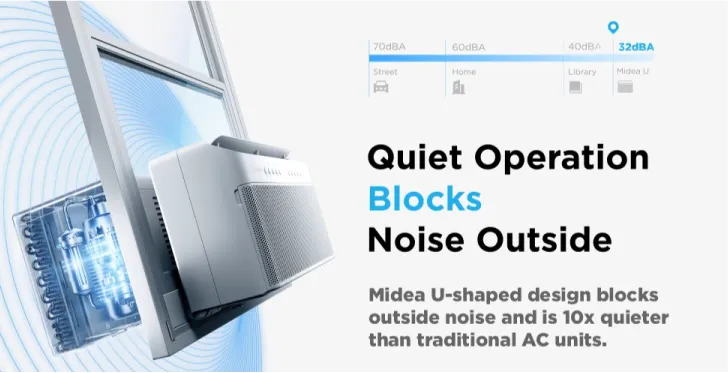
🔹 Haier : On the other hand, Haier offer an average noise level typical of many air conditioners, though they do have a Ultra-Quiet feature in some premium models with noise levels as low as 42 dB.
However, in general, Haier’s air conditioners can be a bit louder in quieter rooms, though still acceptable for most everyday settings.
🏆 Winner: Midea – Exceptional performance and best for quiet rooms.
Cooling Performance
When evaluating cooling performance between Haier and Midea, the primary engineering difference lies in how their proprietary inverter systems regulate thermal output. Midea has firmly established itself as a leader in technical efficiency through its Quattro Inverter compressor technology. This system excels at rapid heat dissipation and hyper-precise temperature maintenance, allowing Midea units to achieve exceptionally high Seasonal Energy Efficiency Ratio (SEER) ratings. Midea's engineering emphasizes continuous, low-frequency operation, which prevents the micro-fluctuations in room temperature that often plague lesser inverter units. In contrast, Haier implements its own Triple Inverter Plus architecture, engineered with a heavy focus on stability under extreme ambient heat. Haier air conditioners often incorporate robust outdoor condensers capable of sustained high-static pressure, making them remarkably capable of delivering rated BTU outputs even when exterior temperatures push past 115°F (46°C)—conditions where standard units typically begin to derate.
The brands also diverge significantly in their airflow dynamics and thermal distribution features. Midea frequently leads with innovative air-delivery designs, such as their "Breezeless" series, which utilizes thousands of micro-holes on the louvers to diffuse cold air evenly, eliminating the harsh, direct drafts that cause discomfort while maintaining a high CFM (cubic feet per minute) rate. Additionally, Midea's widespread integration of "Follow Me" remote-sensing technology acts as a secondary thermostat, ensuring localized cooling precision directly where the occupant sits. Haier focuses its technical efforts on high-velocity displacement and structural cleanliness to ensure consistent output over time. Features like "Supersonic Cooling" can pull down an ambient room temperature within minutes by maximizing fan blower speeds. Furthermore, Haier’s "Self-Clean" evaporator technology freezes and thaws the internal coils to flush away accumulated debris; this preserves airflow velocity and thermal transfer rates over years of service, minimizing the performance degradation often caused by fouled heat exchangers.
From a practical consumer perspective, the trade-offs come down to specialized efficiency versus extreme-condition resilience. Midea is the superior choice for consumers seeking quiet, steady, and energy-conserving cooling performance that provides uniform comfort across standard residential conditions. However, the sheer mechanical complexity of Midea's electronic expansion valves and finely calibrated airflow vanes can make them sensitive to improper installation or inconsistent power supplies. Haier, while occasionally delivering slightly louder fan operational noise at maximum output and relying on a more traditional draft-style airflow pattern, offers an over-engineered, heavy-duty cooling package. It is the more forgiving and aggressive performer in challenging geographic climates subject to punishing heatwaves, making Haier the preferred workhorse where raw thermal pull-down capability overrides nuanced climate modulation.
Conclusion
Midea excels in performance, smart features and energy efficiency.
They are ideal for those seeking long-term saving, while not the cheapest option.
For those focused on affordability, Haier is a reliable choice.
They have solid energy efficiency and features, but don’t quite match Midea in performance and innovation.
The best choice depends on your priorities!
Compare current retail pricing, active promotions, and verified stock availability directly from authorized stores:







