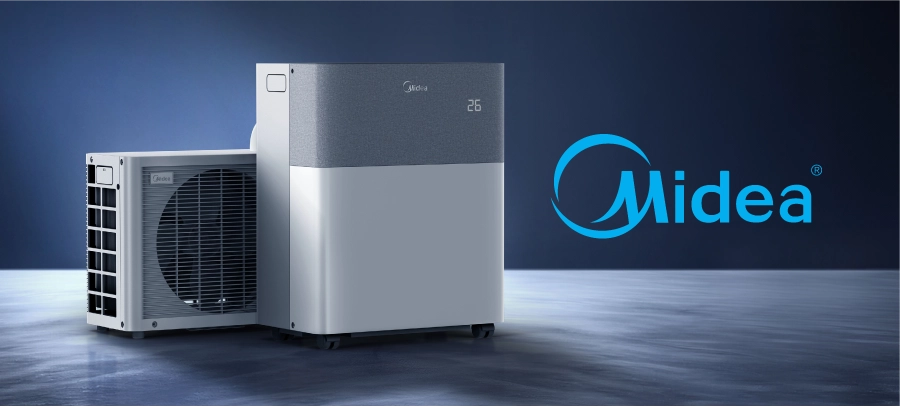
Hisense and Midea are two of the biggest names in air conditioning, offering affordable and feature-packed cooling solutions. But which brand is the better choice for your needs?
This easy-to-read comparison breaks down key factors like affordability, energy efficiency, noise levels, features, and more—helping you make a quick and informed decision.
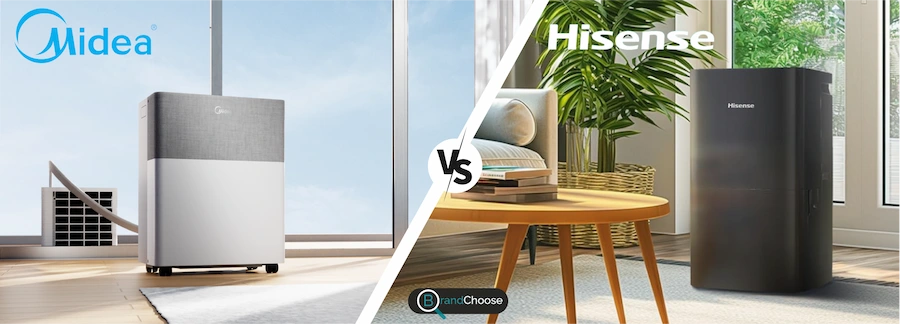
Customer Support & Warranty
When assessing the post-purchase ecosystem of consumer air conditioning, warranty coverage and technical support infrastructure often dictate long-term ownership satisfaction just as much as seasonal energy efficiency. Midea generally holds an engineering and service advantage in this category, largely due to its immense manufacturing scale as an original design manufacturer (ODM) for numerous global brands. On consumer mini-split units, Midea frequently offers aggressive warranties—often up to 5 to 10 years on the inverter compressor and parts, provided the unit is installed by a certified professional. For window and portable units, Midea backs its innovative engineering, such as its patented U-shaped inverted system, with standard one-year limited coverage. In contrast, Hisense predominantly adheres to a standard 1-year comprehensive parts-and-labor warranty across its portable and window lines, with select mini-split models extending compressor coverage to 5 years. While Hisense builds robust components, Midea's deeper supply-chain integration means that sourcing proprietary replacement parts, such as variable-speed fan motors or integrated main logic boards, tends to be more straightforward for independent technicians than sourcing Hisense components.
The practical trade-offs become more apparent when interacting with each brand's customer service channels. Hisense provides dedicated telephone support and online ticketing, but consumers occasionally report friction regarding field technician deployment and replacement approvals, frequently requiring users to handle in-warranty returns directly through the retailer rather than on-site repairs for mid-tier units. Midea’s smart ecosystem, powered by its SmartHome app infrastructure, offers a slight technical advantage by integrating self-diagnostic error codes that can directly streamline support claims. However, because Midea’s presence in certain Western retail markets has surged faster than its localized network of authorized service providers, customers in rural or non-metro areas may experience delays in getting field technicians assigned for their higher-end mini-split installations. Overall, Midea delivers a marginally superior technical warranty for fixed systems and faster access to internal sub-assemblies, while Hisense maintains a viable, albeit basic, warranty apparatus that relies more heavily on retail swap-outs for entry-level window and portable units.
Energy Efficiency
Energy efficiency is a crucial factor, as it impacts long-term electricity costs.
🔹Hisense air conditioners typically have decent SEER ratings, with many models featuring inverter technology for better energy savings.
🔹Midea, however, has an edge in this area, with its U-shaped inverter window ACs and Eco Mode settings reducing power consumption significantly. Some Midea models also qualify for Energy Star® certification more frequently than Hisense.
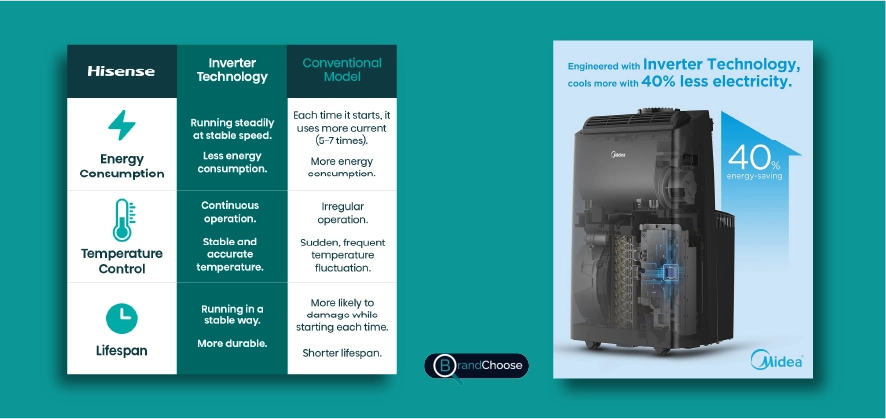
Best for Energy Savings: Midea
Noise Level
Noise levels can significantly impact comfort, especially for bedrooms and offices.
🔹Hisense air conditioners deliver reasonable noise control, with most models operating in the 35-45 dB range. While not disruptive, the sound may be noticeable in quieter environments, especially at higher fan speeds. Generally they are acceptable for home use.
🔹Midea takes the lead with more refined noise-reduction technology. Many of their models feature whisper-quiet operation, with noise levels as low as 20-30 dB, making them ideal for bedrooms and quiet spaces. This is thanks to advanced compressor and fan designs that minimize sound without compromising performance.
Best for a Quiet Environment: Midea
Cooling Performance
When evaluating cooling performance, Midea holds a distinct engineering advantage over Hisense, largely driven by its proprietary inverter technology and advanced heat exchanger designs. Midea’s air conditioners—particularly its U-shaped window units and high-tier mini-splits—utilize the Quattro inverter compressor, which modulates operating speeds with micro-adjustments rather than full power cycling. This architecture allows Midea units to achieve target temperatures up to 30% faster from a cold start and maintain room temperatures within an ultra-tight margin of ±0.5°F. Furthermore, Midea’s high-density louvered fin coils paired with expanded cross-flow fan diameters produce airflow throws reaching well over 20 feet, ensuring deep air penetration and eliminating stubborn hot pockets in open-concept floor plans.
Hisense delivers strong, punchy cooling performance that is engineered to maximize raw output at a more accessible price point, but it relies on more conventional cooling mechanics. Powered by reliable, albeit standard, rotary and twin-rotary compressors, Hisense units excel at high-volume air displacement through features like their "Super Cool" mode, which temporarily overrides standard parameters to blast maximum BTUs into a room. However, Hisense's compressor modulation lacks the granular precision seen in Midea’s catalog; the cooling curve experiences slightly wider temperature oscillations of ±1.5°F to ±2°F as the system cycles down. In sustained ambient conditions exceeding 95°F, Hisense units demonstrate capable heat extraction, though they sacrifice acoustic performance and overall energy efficiency to sustain that maximum cooling load compared to Midea's more adaptable variable-speed systems.
From an analytical standpoint, the practical trade-offs center on precision and heat endurance versus upfront value. Midea is the superior performer for consumers who require rapid, whisper-quiet thermal regulation and steady performance in climates characterized by prolonged, extreme heat waves where high Seasonal Energy Efficiency Ratio (SEER2) and Combined Energy Efficiency Ratio (CEER) ratings matter. Hisense remains a competitive, high-capacity alternative for secondary living zones or budget-focused installations, delivering robust, immediate cooling power, but consumers must accept slightly higher thermal drift, less sophisticated airflow distribution modes, and lower prolonged heat-stress efficiency.
Conclusion
While both brands offer great value, Midea wins by a slight margin for those who prioritize efficiency, advanced features, and long-term savings. Its superior energy performance, quieter operation, and smart technologies make it a stronger long-term investment. That said, Hisense still delivers solid performance, making it a reliable choice for cost-conscious buyers.