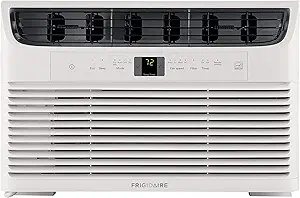
GE vs Frigidaire: Overview
Comparing GE and Frigidaire helps you determine which brand is best suited for your needs in Air Conditioners. Both brands offer strong choices depending on your budget and key feature requirements.
Key Features & Comparison
Evaluate factors such as build quality, warranty, customer satisfaction, and total value before making your final purchase choice between GE and Frigidaire.
Customer Support & Warranty
When evaluating customer support infrastructure and warranty provisions, both GE Appliances (operating under Haier's parentage) and Frigidaire (under Electrolux) offer competitive standard coverages that typically consist of a one-year limited manufacturer warranty on parts and labor. Frigidaire edges ahead slightly on select high-tier room air conditioners by extending sealed refrigeration system coverage up to five years, protecting vital components such as the compressor, condenser, and evaporator coils. In contrast, standard GE residential room units generally consolidate their coverage strictly within the primary 12-month window, reserving extended sealed-system warranties for their commercial or PTAC (Packaged Terminal Air Conditioner) product lines. Consumers investing in higher-capacity or inverter-driven models from Frigidaire often benefit from this additional layer of mechanical protection against catastrophic refrigerant leaks.
In terms of practical customer service delivery, GE leverages an expansive domestic technical service fleet—GE Factory Service—which provides a tangible advantage in direct repair availability and turnaround times across metropolitan and suburban areas. Frigidaire relies heavily on third-party certified repair networks, which can result in inconsistent service response times depending on the consumer's geographic location. However, Frigidaire offsets this with an intuitive digital claims system and readily available direct-to-consumer replacement parts. GE's customer communication channels, augmented by its SmartHQ platform integration, facilitate remote diagnostic capabilities that allow support agents to troubleshoot firmware or mechanical faults digitally before dispatching a technician, marking a superior technical resolution pipeline for smart-enabled units.
Energy Efficiency
Energy efficiency across modern air conditioner portfolios is dictated largely by the implementation of variable-speed inverter compressors, and both manufacturers have aggressively upgraded their lineups to meet stringent Energy Star standards. Frigidaire has established an exceptional benchmark with its modern inverter-driven window and portable air conditioners, achieving Combined Energy Efficiency Ratios (CEER) exceeding 15.0 in its top-tier models. By continuously modulating motor frequency rather than relying on cycling start-stop sequences, Frigidaire units significantly reduce inductive power surges and maintain steady-state thermal loads with minimal wattage draw, resulting in measurable long-term utility savings during sustained summer operation.
GE counters with its specialized lineup of inverter-driven systems, particularly in its Profile and select standard series, which boast similarly stellar CEER metrics and comprehensive Energy Star Most Efficient ratings. GE's primary engineering strength lies in its ecosystem integration; its proprietary SmartHQ energy management tools provide real-time kilowatt-hour tracking, dynamic scheduling, and geolocation-based automated shutoffs that actively mitigate user-induced inefficiencies. While Frigidaire frequently takes the lead in raw thermodynamic efficiency per dollar on standalone hardware, GE offers a more sophisticated software-driven energy conservation suite that helps users optimize operating cycles based on peak utility pricing tiers.
Noise Level
Acoustic performance in room air conditioners hinges on compressor isolation, fan blade aerodynamics, and structural dampening. Frigidaire’s premium quiet-line and inverter units excel in dampening low-frequency mechanical hums, operating at noise floors as low as 42 to 45 decibels (dBA) on low fan settings. Their multi-speed tangential or squirrel-cage blowers distribute airflow smoothly across the chassis, mitigating high-frequency air shear and turbulence. Even when their variable-speed compressors ramp up under high thermal demand, Frigidaire utilizes vibration-absorbing grommets and sound-attenuation blankets around the compressor shell to maintain a remarkably unobtrusive, white-noise profile suited for bedroom environments.
GE achieves comparable acoustic excellence, particularly with its specialized ultra-quiet and "U-shaped" or offset-chassis designs, which mechanically isolate the noisy compressor outside the window frame while allowing the window sash to seal off indoor air delivery. In these specialized configurations, GE can drop ambient indoor sound levels down to roughly 40 dBA, virtually eliminating direct compressor noise transmission. However, across standard entry-level, non-inverter window units, GE models tend to exhibit slightly higher vibrational feedback through the window frame and a more pronounced metallic relay click during thermodynamic cycling compared to Frigidaire's standard mechanical assemblies.
Cooling Performance
Thermodynamic throughput and dehumidification efficacy represent core benchmarks for cooling performance, and both manufacturers demonstrate robust mechanical engineering across their BTU spectra. Frigidaire units are particularly renowned for their rapid initial pull-down capability and exceptional moisture removal rates. Utilizing high-efficiency rotary compressors paired with micro-grooved internal copper tubing and louvered aluminum fins, Frigidaire maximizes heat transfer efficiency. Their high-capacity models often remove several pints of moisture per hour more than equivalent competitors, making them distinctly advantageous in high-humidity climates where latent heat load reduction is vital for human comfort.
GE approaches cooling performance with an emphasis on precision thermal regulation and comprehensive air delivery architecture. Incorporating high-velocity auto-swing louvers and directional airflow baffling, GE units excel at eliminating hot spots in irregularly shaped or open-concept floor plans, pushing conditioned air further into the living space. Furthermore, GE’s dual-sensor and remote-sensing thermostat capabilities allow the unit to monitor ambient conditions from the consumer’s actual seating position rather than solely at the chassis intake grille, preventing premature temperature cutoff and ensuring an exceptionally uniform, stable room temperature throughout extended operational cycles.
Compare current retail pricing, active promotions, and verified stock availability directly from authorized stores: