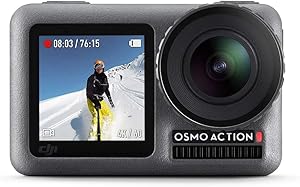

Leica vs DJI: Overview
Comparing Leica and DJI helps you determine which brand is best suited for your needs in Video Cameras. Both brands offer strong choices depending on your budget and key feature requirements.
Key Features & Comparison
Evaluate factors such as build quality, warranty, customer satisfaction, and total value before making your final purchase choice between Leica and DJI.
Features
DJI undeniably leads in feature density, technological novelty, and workflow automation. Products like the DJI Ronin 4D integrate a cinema camera, motorized 4-axis stabilization, long-range wireless video transmission, and automated LiDAR focusing into a single cohesive platform. Even DJI's consumer-facing cameras, such as the Osmo Pocket 3, incorporate sophisticated automated tracking (ActiveTrack), direct wireless audio pairing, and dynamic automated movement routines that require zero operational overhead. DJI's software ecosystem consistently introduces aggressive firmware enhancements, sophisticated ProRes RAW integration, and intelligent shooting modes that democratize complex cinematic camera movements without requiring an expansive crew or secondary support accessories.
Leica, conversely, implements a feature set characterized by minimalist restraint, deliberate omission, and absolute purity of purpose. Rather than saturating the operator with algorithmic tracking and motor controls, Leica cameras focus on essential, uncompromised production tools, such as clean internal 10-bit and 12-bit recording, calibrated L-Log profiles, professional timecode synchronization interfaces, and full-size HDMI outputs. Features are integrated only if they uphold the tactile integrity of the camera body and optical workflow. While a Leica operator will not find automated panning modes or AI-based subject re-framing, they are provided with a distraction-free user interface, rock-solid baseline firmware, and seamless interoperability within the expansive L-Mount optical alliance.
Performance
In terms of optical performance, dynamic range, and sensor rendering, Leica maintains an elite status that is exceptionally difficult to replicate digitally. Equipped with top-tier full-frame sensors and paired with some of the finest glass ever manufactured, Leica cameras resolve fine detail with a dimensional, natural roll-off into highlight clipping and deep, clean shadow transitions. The color science out of a Leica camera is celebrated for skin tone accuracy and nuanced chromatic subtlety, requiring minimal post-production manipulation to achieve a polished, gallery-grade image. The optical clarity, minimal chromatic aberration, and distinct depth separation achieved by Leica glass remain benchmarks for high-end cinematic presentation.
DJI, however, counters Leica's pure optical superiority with unmatched mechanical stabilization and computational focus efficiency. Even with class-leading in-body image stabilization (IBIS), a handheld Leica camera cannot rival the fluid motion produced by DJI's physical three-axis and four-axis gimbal systems, which actively counteract rotational and vertical Z-axis shake. Furthermore, DJI’s LiDAR-based autofocus systems outperform traditional contrast or phase-detection tracking in challenging lighting environments, allowing manual cinema lenses to pull focus automatically and with pinpoint accuracy. While DJI’s color science and sensor fidelity—even on the impressive Zenmuse X9—lean slightly more clinical and digital than Leica’s organic rendition, DJI reliably captures stable, usable, and sharply focused footage in production scenarios where a traditional camera would falter without an entire support rig.
Design
Leica’s design language is an exercise in industrial perfectionism, functional minimalism, and enduring heritage. Milled from solid blocks of magnesium alloy and aluminum, Leica video-capable cameras offer a level of structural rigidity, weather-sealing, and tactile feedback unmatched by mass-production hardware. Physical dials rotate with satisfying, calibrated resistance, buttons deliver a defined tactile response, and the sleek, utilitarian chassis adheres to the "Das Wesentliche" (the essential) ethos. This timeless design is engineered to withstand decades of intensive field use, functioning as both an ergonomic extension of the filmmaker's hands and an aesthetically refined status symbol that commands respect on any commercial set.
DJI’s design aesthetic, by contrast, is aggressively utilitarian, modular, and performance-driven. Fabricated primarily from carbon fiber, structural composites, and heat-dissipating aluminum alloys, DJI hardware is designed around balance, airflow, and multi-component synergy. The Ronin 4D and related cinema gear resemble advanced aerospace instruments rather than conventional cameras, featuring swappable monitor mounts, modular battery expansion ports, integrated cooling channels, and ergonomic top handles with built-in control joysticks. While DJI products lack the monolithic, heirloom feel of a Leica body and possess a more industrial, gadget-forward aesthetic, their ergonomic layouts are meticulously optimized for physical endurance, dynamic balance, and rapid reconfiguration in demanding field environments.