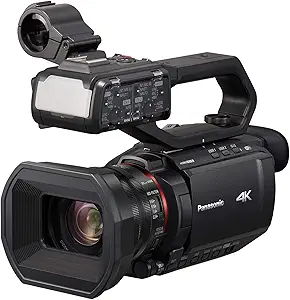
Sony vs Panasonic: Overview
Comparing Sony and Panasonic helps you determine which brand is best suited for your needs in Video Cameras. Both brands offer strong choices depending on your budget and key feature requirements.
Key Features & Comparison
Evaluate factors such as build quality, warranty, customer satisfaction, and total value before making your final purchase choice between Sony and Panasonic.
Features
Sony’s feature suite is heavily anchored by its industry-leading artificial intelligence and sensor readout capabilities. The standout technical achievement in Sony video cameras is their real-time tracking autofocus, which utilizes AI-based subject recognition to lock onto eyes, faces, vehicles, and animals with unmatched precision. Furthermore, Sony cinema cameras feature groundbreaking electronic variable neutral density (ND) filters—a proprietary technology that allows seamless exposure changes without shifting shutter angle or aperture. Their S-Cinetone color profile provides a dependable, broadcast-ready aesthetic out of the box, while extensive custom metadata recording allows for advanced gyro stabilization processing in post-production via Catalyst Browse.
Panasonic counters with an astonishing array of video-centric features rarely found at comparable price points. While Sony often requires external monitors for advanced tools, Panasonic natively integrates vector scopes, waveform monitors, synchro scan to eliminate LED flicker, and genuine shutter angle control. Additionally, Panasonic dominates in recording formats: cameras like the GH6 and S5IIX offer internal Apple ProRes 422 HQ, 5.8K open-gate recording (allowing complete flexibility in vertical and horizontal reframing), and direct recording to external solid-state drives via USB-C. For filmmakers working with vintage or specialty glass, Panasonic provides native anamorphic de-squeeze options, giving it a distinct edge in cinematic flexibility over Sony’s more rigid framework.
Performance
In real-world performance, Sony cameras are exceptional regarding pure processing speed, dynamic range, and high-sensitivity shooting. Backed by their back-illuminated (BSI) and stacked Exmor R/RS CMOS sensors, Sony devices offer rapid readout speeds that minimize rolling shutter distortion to negligible levels. In extreme low-light environments, Sony’s implementation of dual-base ISO (frequently offering base sensitivities like ISO 800 and 12,800) delivers exceptionally clean imagery where Panasonic can show digital noise. The reliability of Sony’s autofocus performance in low-contrast conditions or at wide-open apertures gives operators the confidence to pull off complex tracking shots completely solo, reducing production overhead.
Panasonic challenges this with class-leading thermal stability and stabilization performance that Sony cannot match. Thanks to well-engineered heat-dispersion designs—often utilizing whisper-quiet internal fans—Panasonic cameras virtually eliminate overheating limits, recording continuously in demanding 10-bit modes until battery depletion. Furthermore, Panasonic’s Dual I.S. 2 (combining in-body and lens stabilization) represents the gold standard of mechanical stabilization, often delivering gimbal-like smoothness that allows run-and-gun filmmakers to work handheld without camera shake. In terms of color fidelity, Panasonic's V-Log/V-Gamut pipeline provides a generous, predictable 14+ stops of dynamic range that responds exceptionally well to aggressive grading in post-production suites.
Design
Sony’s design strategy reflects a relentless drive toward compact, modular efficiency. Their bodies, such as the FX3 and A7S III, feature durable magnesium alloy chassis with integrated 1/4"-20 mounting threads directly on the body, eliminating the mandatory weight and bulk of external cages. The physical layouts emphasize muscle memory, with strategically placed video record buttons, front tally lamps, and assignable custom controls. However, Sony’s pursuit of miniaturization sometimes leads to trade-offs, such as more cramped button spacing and touchscreen displays that, while functional, generally offer lower resolutions and peak brightness compared to Panasonic's monitoring interfaces.
Panasonic approaches physical ergonomics with a cinema-first, tactile methodology that seasoned camera operators appreciate. Lumix bodies tend to be slightly heftier, featuring deeper, more comfortable handgrips that reduce fatigue during extended handheld shooting. Their physical interfaces include dedicated dials for drive modes, clearly defined video switches, and prominent audio status buttons. A hallmark of Panasonic’s superior physical engineering is their multi-angle articulating screens, which frequently tilt up and flip out simultaneously to prevent HDMI and microphone cables from obstructing the display. Coupled with full-sized HDMI Type-A ports across virtually their entire lineup, Panasonic's hardware is inherently optimized for rugged, professional field rigs.