













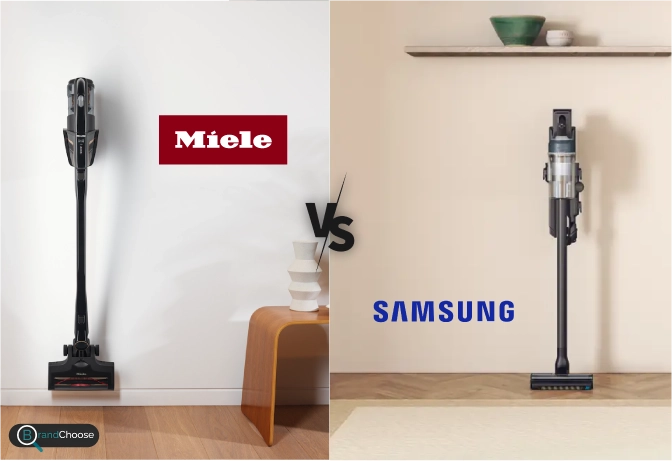
When premium meets smart, you get a matchup like Miele vs Samsung.
Miele is a gold standard in vacuum durability and filtration — think decades of engineering aimed at absolute precision. Samsung, by contrast, pushes boundaries in innovation, offering sleek cordless vacuums with smart sensors, docking stations, and digital control.
Whether you’re drawn to timeless craftsmanship or cutting-edge tech, this battle’s got both power and personality.
Features
In terms of feature sets, Samsung emphasizes electronic automation and modern ergonomics designed to streamline the cleaning routine. The hallmark of Samsung’s lineup is the All-in-One Clean Station, a docking pedestal that charges the vacuum while utilizing Air Pulse technology to automatically evacuate the dustbin into an enclosed bag, dramatically minimizing airborne dust exposure. Furthermore, Samsung equips its units with intuitive LCD digital displays that show runtime status, error alerts, and charging levels, alongside advanced connectivity that links to the SmartThings app for diagnostics and maintenance reminders. Their multi-surface roller brushes frequently incorporate active anti-tangle mechanisms, dual-brush rollers for simultaneous hard floor and carpet sweeping, and integrated LED illumination to expose fine particulates in dark corners.
Miele approaches functionality from an engineering perspective focused on air control, mechanical precision, and allergen containment. Rather than relying on smart app integration, Miele excels with mechanical features like stepped rotary suction controls, foot-pedal adjustments, and electrobrush height settings tailored to specific pile depths. Miele’s crown jewel is its multi-stage AirClean filtration system, which combines multi-ply, self-sealing dust bags with certified HEPA post-motor exhaust filters to trap 99.95% of lung-damaging particles and micro-allergens. Even on its cordless Triflex line, Miele introduces physical modularity with its patented 3-in-1 design, allowing users to shift the motor unit between the handle, the base, or use it as a handheld. While Samsung provides modern digital convenience, Miele delivers mechanically superior utility engineered to optimize airflow dynamics.
Performance
Performance metrics reveal a stark contrast between Samsung’s reliance on high-speed digital brushless motors and Miele’s mastery of continuous motor power and static suction. Samsung’s HexaJet motors spin at exceptionally high RPMs to produce impressive suction ratings up to 210 to 280 Air Watts in their flagship models. This delivers exceptional pick-up rates on hard flooring, tiles, and low-pile rugs, easily lifting surface debris, pet hair, and fine dust. However, because Samsung’s premier offerings are battery-operated, this peak performance is constrained by battery drain; running on 'Jet' mode often depletes the battery in under ten minutes, meaning real-world cleaning must typically be performed at medium suction levels that can struggle with deep-seated grit in thick carpets.
Miele, conversely, sets the industry benchmark for deep-cleaning efficacy through its corded canister machines driven by high-output Vortex motors. These vacuums generate relentless sealed suction and high CFM (cubic feet per minute) airflow that remains constant from the moment the bag is empty to the moment it is full. When paired with an electrically driven brush head like the SEB 228 or 236, Miele physically agitates carpet fibers down to the backing, pulling out compacted dirt and deeply embedded pet dander that cordless sticks cannot reach. Even Miele’s cordless Triflex series delivers substantial torque and heavy-duty agitation, though its runtimes mirror typical cordless limits. For deep, restorative home cleaning, Miele holds an undeniable advantage, while Samsung excels at agile, daily surface maintenance.
Design
The visual and ergonomic design paradigms of both brands reflect their broader corporate identities. Samsung embraces an ultra-contemporary, high-end consumer electronics aesthetic. The Bespoke Jet series features sleek, matte finishes in sophisticated interior-decor colorways, slender profiles, and an integrated Clean Station that resembles an artful domestic pedestal rather than an appliance. Weighing roughly 5 to 6 pounds in the hand, Samsung sticks prioritize lightweight maneuverability, swivel steering, and ergonomic trigger layouts that relieve wrist strain during rapid cleaning sessions. The modular click-in batteries and wall-free storage solutions speak to modern urban apartments and homes where appliances are openly displayed rather than tucked away in utility closets.
Miele’s design ethos is grounded in German industrial ergonomics, prioritizing structural rigidity, impact resistance, and fluid motion over lightweight minimalism. Miele canisters feature thick, high-grade ABS plastic casings that effortlessly absorb collisions with baseboards and furniture without cracking. Their signature dynamic caster wheels spin 360 degrees on steel axles, providing effortless tracking behind the user. On their cordless Triflex models, the design is deliberately utilitarian and functional, prioritizing mechanical latching systems over fragile plastic snap-tabs. While Miele machines are noticeably heavier and demand dedicated storage space in a closet, every button, wand extension, and latch operates with a distinct, reassuring tactile click that communicates long-term durability rather than disposable technology.
Conclusion
Miele and Samsung offer two elite cleaning experiences, each tailored to different lifestyles. Miele is the legacy performer, engineered to deliver deep cleans for decades. Samsung is the smart choice for modern, connected living. Whether you value endurance or innovation, the best vacuum is the one that matches your rhythm.








