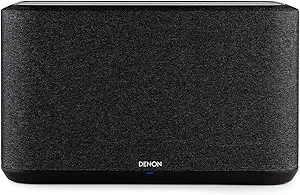
Denon vs Acoustic Audio: Overview
Comparing Denon and Acoustic Audio helps you determine which brand is best suited for your needs in Speakers. Both brands offer strong choices depending on your budget and key feature requirements.
Key Features & Comparison
Evaluate factors such as build quality, warranty, customer satisfaction, and total value before making your final purchase choice between Denon and Acoustic Audio.
Product Selection
Denon and Acoustic Audio approach product selection with fundamentally different target demographics and engineering philosophies. Denon focuses heavily on connected home audio ecosystems, offering sophisticated network-enabled smart speakers, premium soundbars, and high-performance components integrated into their proprietary HEOS multi-room platform. While Denon's speaker lineup is relatively curated rather than sprawling, each offering—ranging from compact wireless units like the Denon Home 150 to Atmos-capable soundbar arrays—is deeply integrated with advanced streaming protocols, voice assistant compatibility, and receiver synchronization, making their catalog ideal for modern whole-home digital media environments.
Conversely, Acoustic Audio (by Goldwood) adopts a broad, utilitarian approach centered primarily on architectural, installation, and multi-channel system components. Their catalog is packed with budget-conscious in-ceiling speakers, in-wall surround setups, outdoor rock speakers, and passive subwoofers, alongside entry-level 5.1 home theater-in-a-box packages. While Acoustic Audio offers substantial variety for contractors and budget DIYers looking to wire entire basements, patios, or commercial spaces on a minimal budget, they lack the sophisticated standalone wireless speakers and network streaming integration that define Denon’s catalog.
Affordability
When analyzing financial entry barriers, Acoustic Audio clearly leads in upfront affordability, offering some of the lowest price-per-driver metrics in the consumer speaker market. A consumer can frequently purchase an entire 5.1-channel in-wall speaker bundle or a multi-pack of weather-resistant outdoor speakers from Acoustic Audio for less than the cost of a single entry-level wireless speaker from Denon. This extreme value proposition appeals strongly to budget-restricted homeowners who prioritize broad room coverage and functional surround sound over audiophile-grade components or specialized digital processing.
Denon operates within the mid-to-high-tier consumer audio bracket, where pricing reflects advanced internal amplification, Class-D tuning, extensive licensing (such as Dolby Atmos and high-resolution audio codecs), and sophisticated software support. While a Denon soundbar or multi-room wireless speaker commands a significant premium over Acoustic Audio's offerings, the cost is justified by integrated amplification, wireless streaming convenience, regular firmware updates, and build refinements. The trade-off is clear: Acoustic Audio delivers bare-bones acoustic hardware at minimal cost, whereas Denon requires higher investment for turnkey, feature-rich audio solutions.
Quality/Durability
In terms of construction materials and structural longevity, Denon demonstrates a distinctly superior standard of engineering. Denon speakers utilize rigid, resonance-damped enclosures, custom-engineered heat sinks, premium acoustic cloth, and high-grade electronic crossovers designed to minimize thermal distortion and chassis vibration over years of heavy use. Their motorized and active components are thoroughly stress-tested, and their software ecosystem is backed by regular security and operational updates, ensuring that network-dependent features remain viable long after purchase.
Acoustic Audio products, by virtue of their aggressive price point, rely on lighter-weight ABS plastic housings, basic stamped-steel baskets, and cost-effective passive crossover networks. While their architectural and outdoor speakers frequently feature moisture-resistant polypropylene cones and butyl rubber surrounds that survive adequately in benign outdoor environments, the long-term resilience of their internal wiring and budget bracket hardware falls short of industrial-grade standards. For indoor architectural installations where speakers remain undisturbed inside drywall, Acoustic Audio provides adequate durability, but Denon far exceeds them in mechanical refinement and component-level reliability.
Sound Quality
The acoustic performance gap between the two brands is stark, defined by divergent acoustic voicing and driver quality. Denon leverages decades of Japanese audio engineering to produce a balanced, warm, and highly accurate soundstage with low total harmonic distortion (THD). Equipped with precision soft-dome tweeters, well-tuned mid-bass drivers, and sophisticated digital signal processing (DSP), Denon speakers articulate subtle vocal micro-details, maintain mid-range clarity, and deliver tight, controlled low-frequency extension that excels across both critical music listening and cinematic playback.
Acoustic Audio provides functional, high-output audio that prioritizes loudness and coverage over linear fidelity and tonal nuance. Many of their systems exhibit a typical V-shaped sound profile characterized by accentuated high frequencies from basic mylar or piezo tweeters and boomy, loose bass that lacks tight transient response. While perfectly adequate for background ambient music in a patio setting or basic multi-channel cinematic effects in an entry-level home theater, Acoustic Audio cannot match the imaging depth, dynamic headroom, or transparent mid-band resolution that Denon reliably delivers.