Samsung vs Kenmore: Overview
Comparing Samsung and Kenmore helps you determine which brand is best suited for your needs in Refrigerators. Both brands offer strong choices depending on your budget and key feature requirements.
Key Features & Comparison
Evaluate factors such as build quality, warranty, customer satisfaction, and total value before making your final purchase choice between Samsung and Kenmore.
Features
In terms of feature sets, Samsung is widely recognized as an industry pioneer, integrating sophisticated digital ecosystems into everyday food preservation. The marquee Family Hub platform transforms the refrigerator door into an interactive command center, providing internal inventory cameras, meal-planning apps, and seamless integration with the SmartThings automation platform. Beyond smart connectivity, Samsung incorporates modular storage innovations such as the FlexZone drawer, which allows users to convert compartment temperatures from deep chill to soft freeze, as well as hands-free auto-filling water pitchers infused with flavor infusers, catering directly to lifestyle-oriented convenience.
Kenmore approaches functionality from a more utilitarian perspective, focusing on physical utility and mechanical reliability over high-end digital interfaces. Signature features like the Grab-N-Go door-in-door compartment offer rapid access to everyday items without releasing interior cold air, while the GeniusCool and CleanFlow air filtration systems focus on keeping the internal atmosphere odor-free and balanced. Kenmore refrigerators seldom feature complex touchscreens or Wi-Fi diagnostics on standard models, choosing instead to maximize usable cubic footage with multi-tiered sliding freezer baskets, spill-proof glass shelving, and straightforward dual-evaporator systems that get the fundamental job done without a learning curve.
Performance
Performance analytics reveal distinct engineering approaches to the core challenge of thermal stability and humidity regulation. Samsung relies heavily on its proprietary Twin Cooling Plus (and in higher tiers, Triple Cooling) architecture, which utilizes dedicated evaporators and fans for the refrigerator and freezer compartments. This structural separation prevents cross-compartment odor transfer and maintains an optimal 70% humidity level in the fresh food cavity to prolong produce life. However, certain Samsung models have experienced documented reliability issues with their in-door ice-maker defrost cycles, leading to frost accumulation that can diminish system efficiency over extended periods.
Kenmore delivers robust, dependable core cooling performance, historically driven by the proven mechanical platforms of its contracted OEM partners. When built on LG or Whirlpool backbones, Kenmore units equipped with multi-flow air delivery distribute chilled air evenly across every shelf, effectively preventing hot spots even when fully loaded. Temperature recovery after frequent door openings is swift, and Kenmore’s standard in-door or freezer-mounted ice systems generally present fewer electronic sensor failures than Samsung’s more complex assemblies. While Kenmore may lack micro-climate precision controls in lower-tier units, its overall thermal consistency and low failure rates in basic cooling functions make it a steady performer.
Design
From an aesthetic and industrial design standpoint, Samsung sets the benchmark for contemporary kitchen minimalism. The brand popularized flat-panel doors, recessed pocket handles, and fingerprint-resistant Tuscan and Black Stainless finishes. Samsung’s Bespoke line represents a major design breakthrough, allowing homeowners to customize interchangeable colored glass or steel door panels to match evolving kitchen decor. Inside, premium LED runway lighting, stainless steel back walls (Metal Cooling), and razor-thin bezels create an upscale, European-inspired interior that elevates the visual experience of organizing food.
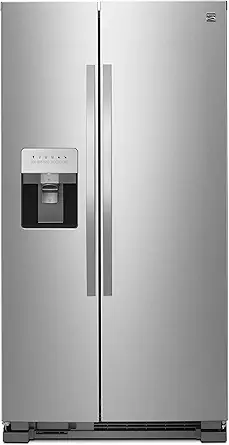
Kenmore adheres to a more conservative, enduring design language that blends smoothly into traditional and transitional American kitchens. Featuring gently curved contours, external pocket or bar handles, and standard commercial-grade stainless steel finishes, Kenmore prioritizes functional ergonomics over architectural minimalism. Interior layouts are engineered for heavy-duty family use, incorporating sturdy white plastics, wide gallon-sized door bins, and high-visibility clear drawers. While Kenmore lacks the high-fashion modularity and sleek flush-mount profiles of Samsung’s flagship offerings, its layouts maximize physical storage efficiency and withstand the physical rigors of busy households.