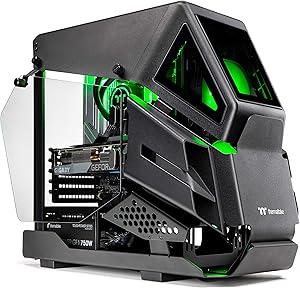
Omen vs Thermaltake: Overview
Comparing Omen and Thermaltake helps you determine which brand is best suited for your needs in Prebuilt PC. Both brands offer strong choices depending on your budget and key feature requirements.
Key Features & Comparison
Evaluate factors such as build quality, warranty, customer satisfaction, and total value before making your final purchase choice between Omen and Thermaltake.
Features
HP Omen differentiates itself through a unified, proprietary software ecosystem anchored by the Omen Gaming Hub. This centralized control suite offers streamlined overclocking profiles, network prioritization engines, dynamic lighting control, and integrated hardware telemetry that is exceptionally accessible to novice users. However, this level of corporate integration comes at the cost of hardware flexibility. While modern Omen rigs have transitioned away from older proprietary form factors, their motherboards often feature restricted BIOS configurations, fewer secondary expansion slots, and customized front-panel I/O headers that complicate aftermarket motherboard or power supply replacements.
Thermaltake counters this with exceptional hardware transparency and enthusiast-grade utility. Because their systems are assembled using standard consumer-tier motherboards from vendors like ASUS, MSI, or ASRock, users benefit from fully unlocked, feature-rich UEFI BIOS environments that enable granular DRAM sub-timing adjustments, broad fan curve customization, and unconstrained PCIe lane bifurcation. Furthermore, Thermaltake rigs shine in external and internal connectivity, regularly shipping with high-end ARGB controllers, premium Touro-style chassis brackets, and standard ATX modular power supplies that require no adapter cables or specialized mounting hardware for future upgrades.
Performance
In real-world gaming and compute benchmarks, both brands field identical top-tier silicon configurations, spanning modern Intel Core, AMD Ryzen, and NVIDIA GeForce RTX platforms, yet their thermal execution sets them apart. HP's flagship Omen 45L achieves impressive performance metrics largely due to its innovative "Cryo Chamber" technology, an externalized liquid-cooling radiator compartment isolated from the main internal chamber. This unique engineering triumph ensures that higher-tier Omen systems maintain sustained boost clocks during heavy rendering and extended 4K gaming sessions without incurring excessive thermal throttling, though mid-tier iterations like the 25L still suffer from restricted airflow limitations.
Thermaltake systems provide uniformly sustained, high-tier performance across their entire catalog thanks to high-volume airflow mechanics and robust closed-loop liquid coolers. Because Thermaltake builds with massive open-mesh panels, tempered glass configurations designed for chimney-effect airflow, and top-tier retail AIOs (All-In-Ones), heat dissipation is swift and continuous. This thermal headroom prevents power-limit throttling under prolonged multithreaded loads, yielding slightly higher average framerates and noticeably lower component temperatures across demanding titles, making Thermaltake the more consistent choice for competitive overclockers and sustained heavy-duty productivity workloads.
Design
From an aesthetic and structural perspective, HP Omen projects a minimalist, modern, and mature industrial design language. Rather than relying on loud, angular gamified accents, Omen cases feature clean vertical lines, brushed metallic or deep matte surfaces, and understated interior compartmentalization. The tempered glass side panels are cleanly integrated with tool-less entry mechanisms, and the interior cable management is tightly harnessed for clean aesthetics through the window. It is a discreet design that blends seamlessly into sophisticated home offices or contemporary gaming battlestations without drawing aggressive visual attention.
Thermaltake embodies an expressive, enthusiast-centric design philosophy characterized by bold geometric shapes, panoramic tempered glass showcases, and dramatic RGB illumination. Platforms like the wall-mountable Core P3 series or the vertical, prism-like Tower 100/500 series break radically away from conventional monolithic box designs, treating the internal hardware as an art piece. The construction materials feel distinctly heavy-duty and mechanical, showcasing exposed liquid cooling tubes, vibrant ARGB liquid reservoirs, and custom internal brackets. While Thermaltake's aesthetic can occasionally feel polarizing or bulky, its structural transparency offers unmatched physical accessibility for maintenance and visual flair.
Compare current retail pricing, active promotions, and verified stock availability directly from authorized stores: