MSI vs Thermaltake: Overview
Comparing MSI and Thermaltake helps you determine which brand is best suited for your needs in Prebuilt PC. Both brands offer strong choices depending on your budget and key feature requirements.
Key Features & Comparison
Evaluate factors such as build quality, warranty, customer satisfaction, and total value before making your final purchase choice between MSI and Thermaltake.
Features
In terms of feature sets and software ecosystems, MSI offers a comprehensive, highly integrated digital environment driven by the MSI Center software suite. This platform allows granular control over system telemetry, AI-driven performance modes, integrated graphics card overclocking, and Mystic Light synchronization across internal and peripheral hardware. MSI systems also frequently incorporate cutting-edge connectivity options natively integrated into their motherboards, including high-speed Wi-Fi 6E/7, dedicated 2.5G/10G LAN ports, and advanced front-panel USB Type-C configurations. Because MSI controls both the firmware and motherboard manufacturing, their prebuilts often boast deeper hardware-level diagnostic tools, automated driver update suites, and tailored power delivery profiles out of the box.
Thermaltake counters this with superior physical and thermal feature sets rather than software dominance. The centerpiece of almost any Thermaltake LCGS prebuilt is its advanced cooling setup, often incorporating thick radiators, high-static-pressure Riing fans, and, in higher-tier configurations, transparent hard-tube custom liquid cooling loops that are virtually unheard of from mass-market brands like MSI. However, Thermaltake’s software ecosystem, specifically TT RGB Plus, is historically more resource-intensive and less streamlined than MSI Center. Where Thermaltake decisively wins is its uncompromised adherence to standardized retail components; users receive fully functional, unlocked off-the-shelf retail motherboards, power supplies with multi-rail safety and braided cables, and expansive drive mounting options without any proprietary form factors or wire harnesses.
Performance
From a pure compute standpoint, both MSI and Thermaltake offer configurations spanning the latest Intel Core and AMD Ryzen processors paired with high-end NVIDIA GeForce RTX and AMD Radeon graphics cards. However, how these components perform under sustained loads highlights their engineering differences. MSI maximizes compute output through aggressively tuned power limit profiles and integrated thermal engineering, like their Silent Storm Cooling chambered designs. In compact chassis, MSI systems can run hot, occasionally triggering thermal throttling under artificial stress tests, but in standard form factors, their factory overclocks and tight memory timings deliver exceptionally low latency and high sustained frame rates tailored for competitive esports and high-refresh AAA gaming.
Thermaltake’s performance profile shines most brightly under sustained, high-wattage multi-threaded workloads and 4K gaming, largely due to its cooling-first DNA. By utilizing massive chassis with unrestricted airflow panels and high-capacity liquid cooling solutions, Thermaltake prebuilts consistently maintain lower operating temperatures and higher sustained boost clocks on both the CPU and GPU. This thermal headroom prevents acoustic ramp-ups, making Thermaltake systems notably quieter during heavy workloads than many compact MSI configurations. For users who intend to push their hardware via manual overclocking, Thermaltake provides the baseline thermal stability needed to extract peak silicon efficiency without risking thermal degradation.
Design
Aesthetic and structural design reveals the starkest contrast between the two manufacturers. MSI tends to alternate between sleek, minimalist designs in their modern Codex and Infinite series, and aggressive, angular, spaceship-inspired aesthetics in their flagship Aegis line. MSI’s proprietary chassis often incorporate custom front fascia, localized RGB accents, and engineered dual-chamber thermal layouts that physically isolate the power supply, graphics card, and processor. While striking and purpose-built, these proprietary chassis can sometimes feature tighter internal clearances, making deep-cleaning difficult and limiting the physical size of future GPU upgrades due to clearance constraints.
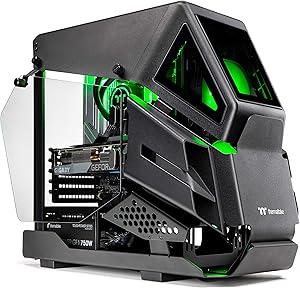
Thermaltake, by comparison, treats its prebuilt PCs as architectural display pieces. Utilizing their world-renowned chassis portfolio—including the open-frame Core P-series, the panoramic glass Tower series, and the high-airflow View series—Thermaltake PCs are engineered for visual impact. Thick tempered glass panels, pristine cable routing, and prominent placement of liquid cooling reservoirs give their systems a bespoke, hand-crafted aesthetic typical of premium boutique system integrators. Additionally, the interior layouts of Thermaltake chassis are exceptionally spacious, providing unmatched ease of access for routine maintenance, thermal repasting, and effortless future component swaps.