





ViewSonic vs Alienware: Overview
Comparing ViewSonic and Alienware helps you determine which brand is best suited for your needs in Monitors. Both brands offer strong choices depending on your budget and key feature requirements.
Key Features & Comparison
Evaluate factors such as build quality, warranty, customer satisfaction, and total value before making your final purchase choice between ViewSonic and Alienware.
Affordability
When evaluating affordability, ViewSonic maintains a distinct competitive edge by offering a vast, democratized catalog tailored to budget-conscious consumers, educational environments, and mainstream office workers. The brand engineers monitors across virtually every sub-$500 price bracket, successfully integrating core display technologies like IPS panels, basic HDR processing, and high-refresh-rate gaming panels into aggressively priced SKUs. ViewSonic minimizes premium aesthetic flourishes and ultra-specialized hardware to keep initial purchase costs low, making high-resolution displays, such as 4K productivity hubs and entry-level 144Hz displays, accessible to everyday buyers without a punishing price barrier.
Alienware, as Dell's dedicated high-performance gaming marque, operates almost entirely on the opposite end of the fiscal spectrum. Its portfolio caters strictly to premium and enthusiast tiers, commanding significant retail premiums for top-of-the-line specifications, cutting-edge QD-OLED or ultra-fast Fast IPS matrices, and bespoke industrial design. While ViewSonic focuses on providing practical performance per dollar, Alienware focuses on raw performance maximization, where engineering investments in advanced thermal architectures, custom cooling fans, and proprietary RGB ecosystems inflate the MSRP. Consequently, Alienware cannot compete with ViewSonic on pure price accessibility, targeting instead a demographic where cost is secondary to halo-tier performance.
Customer Support & Warranty
Alienware benefits immensely from the robust enterprise and consumer service backbone of its parent corporation, Dell Technologies. Alienware displays generally include a 3-year premium warranty package that sets a high benchmark in the monitor industry, notably offering Advanced Exchange Service, which ships replacement panels before defective units are returned. Furthermore, Alienware pioneered comprehensive warranty coverage that explicitly covers OLED burn-in on their QD-OLED monitors, providing immense peace of mind to enthusiasts adopting sensitive organic display panels. Technical support is readily available via structured 24/7 channels with reliable hardware diagnostic workflows.
ViewSonic offers a highly competitive standard limited warranty, typically spanning three years for parts and labor, alongside a reliable zero-dead-pixel policy on select premium professional lines like the ColorPro series. Their customer service pipeline operates well within industry standards, providing ticketed technical support, RMA processing, and web resources for firmware and driver management. However, ViewSonic's support infrastructure lacks the white-glove immediacy and seamless cross-shipping capabilities standard with Alienware’s tier-one Dell framework. For standard office models, turnaround times for repair or replacement depend on regional return logistics, making it slightly more cumbersome than Alienware's enterprise-level responsiveness.
Picture Quality
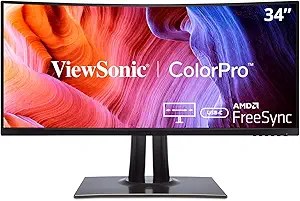
ViewSonic approaches picture quality with an emphasis on color accuracy, broad panel variety, and productivity-oriented tuning. Their professional ColorPro line features factory calibration with Delta E < 2, extensive coverage of Adobe RGB, DCI-P3, and sRGB color gamuts, as well as integrated hardware calibration LUTs that satisfy digital artists, photographers, and video editors. Even in their mainstream and entry-level gaming monitors, ViewSonic implements respectable static contrast and uniform backlighting, although budget models frequently suffer from limited peak brightness, standard edge-lit local dimming, and typical IPS glow, which dampens high dynamic range performance in dark viewing environments.
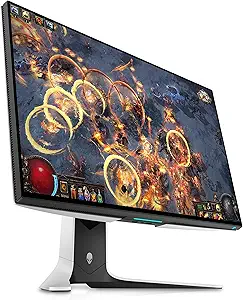
Alienware delivers benchmark-grade picture quality tailored specifically toward immersive visual impact, gaming, and cutting-edge display fidelity. By leading the charge in curved and flat QD-OLED implementations alongside ultra-fast IPS panels, Alienware monitors boast near-infinite contrast ratios, per-pixel local dimming, and true deep blacks that ViewSonic’s predominantly LCD-based catalog cannot match. Furthermore, Alienware’s wide color gamuts frequently exceed 99% DCI-P3 with extraordinary color volume and luminance reproduction, transforming HDR content into a transformative experience. For critical color grading, certain ViewSonic models provide specialized calibration tools, but for contrast, motion clarity, and dynamic visual pop, Alienware is technically superior.
Build Quality & Durability
Alienware monitors are engineered with an unmistakable, futuristic aesthetic known as the 'Legend' design language, emphasizing heavy, premium chassis construction and structural rigidity. The materials utilize high-grade matte plastics, reinforced internal metal subframes, and exceptionally sturdy, counterbalanced stands that suppress desk wobble completely. Additionally, because Alienware pushes panel physics with extreme refresh rates and OLED technologies, their internal thermal engineering is top-tier, incorporating internal graphite heat sinks, sophisticated multi-vent air channels, and ultra-quiet cooling fans designed to prolong component life and mitigate long-term panel degradation.
ViewSonic adopts a more utilitarian, function-first approach to hardware construction that prioritizes lightweight efficiency and cost-effective tooling. While their professional ColorPro monitors feature brushed metal accents, excellent ergonomic stands, and hood attachments, their broader portfolio makes extensive use of standard-grade plastics and lighter structural housings. ViewSonic monitors are durable workhorses built to survive long-term office and general use, but they lack the heavy-duty density and tactile refinement of Alienware hardware. The trade-off is practical: ViewSonic designs are less imposing, fit more easily into tight spaces or standard VESA monitor arms, and avoid the polarizing gamer-centric aesthetics that characterize Alienware.