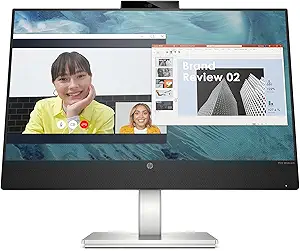
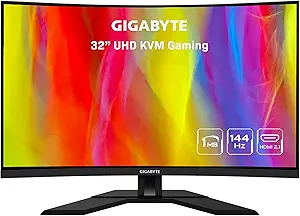
HP vs GigaByte: Overview
Comparing HP and GigaByte helps you determine which brand is best suited for your needs in Monitors. Both brands offer strong choices depending on your budget and key feature requirements.
Key Features & Comparison
Evaluate factors such as build quality, warranty, customer satisfaction, and total value before making your final purchase choice between HP and GigaByte.
Affordability
When evaluating affordability, HP and Gigabyte target distinctly different market segments with tailored value propositions. HP dominates the budget productivity and home-office tiers, offering standard Full HD and budget QHD monitors at exceptionally accessible price points. HP's scale allows it to streamline basic IPS panels, minimizing non-essential gaming hardware to deliver rock-bottom pricing for everyday office workers and students. Conversely, Gigabyte is renowned for revolutionizing the budget-to-midrange gaming monitor market by aggressively undercutting legacy gaming manufacturers. Instead of competing on the ultra-cheap office spectrum, Gigabyte maximizes value by offering high-refresh-rate 1440p and 4K displays equipped with modern connectivity like USB Type-C and integrated KVM switches at prices previously reserved for entry-level gaming gear.
The trade-offs between the two brands directly reflect these structural design choices. With HP, lower costs on baseline models often mean sacrificing ergonomic flexibility, fast panel response times, and premium gaming features in exchange for straightforward reliability and lower financial barrier to entry. Gigabyte, on the other hand, provides higher feature density per dollar for power users, content creators, and gamers who need high bandwidth interfaces, adaptive sync, and wide color gamuts without paying boutique gaming premiums. Ultimately, budget-conscious consumers seeking simple daily utility will find HP unbeatable on price, whereas consumers measuring affordability by high-performance specifications and versatility will see far greater return on investment from Gigabyte.
Customer Support & Warranty
HP possesses a massive global infrastructure that gives it a distinctive edge in enterprise deployment and mainstream customer service. Backed by decades of consumer electronics distribution, HP provides localized technical assistance, a vast library of automated troubleshooting tools, and consistent replacement part access worldwide. Most consumer-grade HP monitors include a standard one-year to three-year limited warranty, with premium commercial lines like HP Z Displays offering robust three-year advanced exchange services. This expansive logistical backbone translates into smoother returns, predictable turnarounds, and accessible phone or live-chat assistance, especially for corporate fleets and institutional buyers.
In contrast, Gigabyte primarily operates through PC hardware channels, which can make its customer support experience somewhat more fragmented. Gigabyte generally backs its monitors with a competitive three-year limited warranty, often including zero bright-dot policies for select premium panels. However, their Return Merchandise Authorization (RMA) process historically requires users to ship products to regional service centers, occasionally resulting in longer diagnostic and replacement timeframes. While Gigabyte’s enthusiast community forums and software utility patches provide active grassroots support, users prioritizing seamless corporate-backed warranty fulfillment and rapid logistics will typically enjoy a more frictionless experience with HP.
Picture Quality
Picture quality exposes a philosophical divide between HP's focus on color neutrality for productivity and Gigabyte's emphasis on high-dynamic rendering and motion fluidity. HP monitors, particularly their Z and Envy series, prioritize color accuracy right out of the box, offering factory-calibrated sRGB and Rec. 709 profiles with low Delta E values. These panels utilize stable IPS matrices that deliver wide viewing angles, clean text rendering, and uniform backlight distribution, making them exceptional for document processing, graphic design, and video editing where color stability under typical office ambient lighting is crucial.
Gigabyte distinguishes itself by pushing contrast, color saturation, and panel speed. Spanning high-performance IPS, high-contrast VA, and advanced QD-OLED models, Gigabyte displays offer deep black levels, wide DCI-P3 color gamuts, and high dynamic range performance with HDR certification. Combined with rapid pixel response times and minimal ghosting artifacts at 144Hz to 240Hz refresh rates, Gigabyte produces a far more immersive visual experience for gaming, entertainment, and fast-moving media. While baseline Gigabyte monitors might require user adjustment to tone down aggressive contrast curves or edge-sharpening, their ceiling for dynamic visual presentation clearly exceeds HP's mainstream lineup.
Build Quality & Durability
HP’s industrial design is characterized by structural minimalism and understated resilience designed to withstand the wear of busy office environments. Using durable, matte-textured plastics and sturdy, low-profile bases, HP displays are engineered to resist fingerprints, scuffs, and thermal stress over years of continuous desktop operation. Commercial HP tiers frequently incorporate robust internal power supplies, efficient passive cooling designs, and exceptionally smooth counterbalanced ergonomic stands that allow full height, tilt, swivel, and pivot adjustments without wobbling or mechanical degradation.
Gigabyte builds its monitors with aggressive gaming aesthetics that integrate thicker plastic cowls, dynamic venting patterns, and robust metal-reinforced stand assemblies. The chassis engineering accommodates intensive thermal management, housing internal logic boards that drive high-refresh scaler chips and integrated KVM controllers without thermal throttling. While the structural integrity of Gigabyte stands is solid and offers full ergonomic articulation on most enthusiast models, the aesthetic styling relies more heavily on gamer motifs and functional bulk compared to HP’s sleek simplicity. Both brands maintain low component failure rates, but HP excels in clean, unified mechanical packaging, whereas Gigabyte delivers durable performance hardware built to handle continuous, high-draw graphical loads.