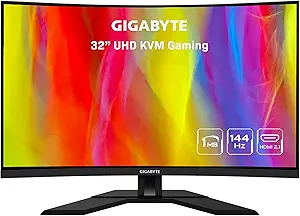
GigaByte vs BenQ: Overview
Comparing GigaByte and BenQ helps you determine which brand is best suited for your needs in Monitors. Both brands offer strong choices depending on your budget and key feature requirements.
Key Features & Comparison
Evaluate factors such as build quality, warranty, customer satisfaction, and total value before making your final purchase choice between GigaByte and BenQ.
Affordability
When evaluating affordability, Gigabyte consistently positions itself as a market disruptor, offering aggressive price-to-performance ratios across its monitor lineup. The brand excels in the budget to mid-range gaming sectors, often equipping monitors in the sub-$300 category with premium specifications such as 1440p resolutions, high refresh rates (165Hz and above), and integrated KVM switches that are rarely found at these price points. By leveraging cost-effective panel sourcing and streamlining cosmetic elements, Gigabyte democratizes competitive gaming features, making them highly accessible to everyday enthusiasts and value-conscious shoppers who prioritize raw specifications over luxury finishes.
In contrast, BenQ maintains a higher baseline pricing strategy that reflects its specialized sub-brands, such as the esports-focused ZOWIE and the color-critical DesignVue (PD) and PhotoVue (SW) series. While BenQ does offer entry-level office monitors under its GL and GW lines that are competitively priced, their higher-tier models command a distinct premium due to proprietary engineering and niche optimization. Buyers pay extra for tailored technologies like DyAc+ backlight strobing in ZOWIE displays or factory hardware calibration and uniform brightness technologies in professional units. Consequently, while Gigabyte wins on sheer feature density per dollar, BenQ justifies its higher acquisition costs through purpose-built functionality aimed at distinct professional and competitive niches.
Customer Support & Warranty
Gigabyte generally provides a standard three-year limited warranty covering parts and labor across most of its monitor portfolio, supplemented by a zero bright dot policy on select premium models. However, the brand's post-purchase experience and customer support operations have garnered mixed feedback within the consumer hardware community. Support processes, including RMA (Return Merchandise Authorization) turnarounds, can occasionally be sluggish, and navigating technical assistance via their online portal often requires patience. For buyers encountering panel defects such as backlight bleed or dead pixels, resolution pathways can sometimes involve rigid verification procedures before replacements or repairs are authorized.
BenQ, conversely, provides a more robust and responsive customer care infrastructure that reflects its longstanding presence in the enterprise and display-specific markets. Most BenQ monitors also feature a comprehensive three-year warranty with cross-regional RMA support that is generally regarded as more efficient and user-friendly. In specialized segments like professional imaging, BenQ often provides superior coverage terms, including strict panel performance guarantees and white-glove replacement services. Their direct customer support channels, detailed troubleshooting documentation, and regional repair facilities provide a more dependable post-purchase safety net compared to Gigabyte's broader, more generic component support ecosystem.
Picture Quality
Gigabyte leans heavily into vibrant, fast-paced visuals tailored for multimedia and gaming, utilizing modern IPS and VA panels capable of wide color gamuts (often exceeding 90% DCI-P3). Their displays frequently deliver punchy saturation, deep contrast on their curved VA models, and commendable motion clarity on their newer IPS and OLED offerings. However, out-of-the-box color accuracy can be hit-or-miss, frequently requiring manual calibration to tame oversaturated profiles or correct minor gamma shifts. Furthermore, while their HDR support is widely advertised with certifications like VESA DisplayHDR 400, these entry-level HDR implementations lack localized dimming and peak luminance, resulting in a somewhat superficial HDR presentation.
BenQ approaches picture quality with surgical precision, dividing its panel engineering according to distinct operational requirements. For creative professionals, the DesignVue and PhotoVue monitors deliver industry-leading color fidelity with pre-calibrated Delta E values below 2, true 10-bit color depth, and extensive coverage of Adobe RGB and Rec. 709 spectrums, accompanied by sophisticated uniformity compensation. On the other end of the spectrum, BenQ's ZOWIE gaming monitors deliberately trade wide viewing angles and hyper-vibrant saturation for unmatched dynamic clarity, utilizing fast TN or optimized Fast-IPS panels with minimal motion blur. Across all lines, BenQ excels in advanced backlight regulation and eye-care technologies, offering superior color stability, finer image processing, and a more refined viewing experience.
Build Quality & Durability
Gigabyte’s monitor construction emphasizes functional utility, resulting in chassis designs that are lightweight and primarily composed of standard matte plastics. While their ergonomic stands on mid-range models offer commendable height, tilt, and swivel adjustments, some budget iterations feature more rigid plastic bases that can transmit desk vibrations and exhibit minor creaking under pressure. Thermal management is generally adequate, but long-term durability can vary depending on panel variance, with some users reporting edge-lit bleeding or slow firmware behavior over extended periods. Overall, Gigabyte builds products that are mechanically sound for everyday desktop use, though they lack the dense, premium structural feel of higher-end boutique displays.
BenQ demonstrates superior industrial design and structural rigor, engineering displays that are notably sturdy and built to withstand rigorous daily use. Their professional and gaming lines incorporate robust, reinforced metal internal skeletons, heavy-duty counterbalanced stands, and seamless articulation mechanisms that provide smooth, wobble-free adjustments. The ZOWIE series, designed specifically for the rigors of LAN tournaments and constant travel, features exceptionally rugged bezels and resilient plastic housings, while the professional PD and SW monitors integrate high-grade shielding hoods and premium tactile controls. BenQ's meticulous attention to component longevity, effective passive heat dissipation, and superior physical assembly make their monitors a more durable long-term investment.