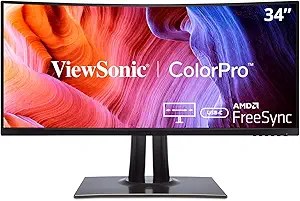




Dell vs ViewSonic: Overview & Brand Philosophy
When selecting a desktop monitor, Dell and ViewSonic represent two of the most enduring and respected names in visual display technology, each driven by distinct engineering philosophies. Dell has systematically built a reputation as the corporate and professional gold standard. Focusing heavily on modern workplace dynamics, ergonomics, and seamless ecosystem integration, Dell approaches monitor manufacturing with an emphasis on minimalist aesthetics, uniform panel quality, and comprehensive enterprise manageability. From everyday office setups to color-critical design suites, Dell's product portfolio is engineered to act as a dependable, highly polished centerpiece of personal productivity.
Conversely, ViewSonic traces its heritage back to the early days of CRT displays and continues to champion accessible, versatile visual technology. While maintaining a robust presence in corporate and educational sectors, ViewSonic embraces a more performance-per-dollar, feature-rich philosophy. The brand aggressively targets budget-conscious creatives, competitive gamers, and classrooms through specialized lineups such as the ColorPro and ELITE series. ViewSonic prioritizes panel responsiveness, color calibration flexibility, and broad feature sets at competitive price points, often democratizing advanced display technologies faster than its more conservative corporate rivals.
Key Differences & Technological Comparison
The technological differentiation between Dell and ViewSonic is largely evident in their panel sourcing, industrial design, and target audience specialization.
Panel Technology and Color Accuracy: Dell’s premier lineup, particularly the UltraSharp family, relies heavily on high-tier IPS panels, including advanced IPS Black technology developed by LG Display. This gives Dell monitors exceptional contrast ratios (often reaching 2000:1) and pristine factory color calibration out of the box with Delta E < 2 ratings. ViewSonic counters in the creative sector with its ColorPro series, which focuses on hardware-level color calibration, uniform luminance, and extensive color gamut support (Adobe RGB, DCI-P3). However, ViewSonic's lower- and mid-tier models exhibit slightly more variability in panel uniformity compared to Dell's consistently tight quality control.
Gaming Performance: While Dell serves the enthusiast gaming market through its dedicated Alienware sub-brand and G-Series monitors (frequently utilizing cutting-edge QD-OLED panels), its mainline Dell-branded monitors lean strictly toward productivity with standard 60Hz to 120Hz refresh rates. ViewSonic, through its Omni and ELITE series, offers high-refresh-rate IPS and Fast-IPS panels (ranging from 144Hz to 240Hz+) at significantly more accessible price points. ViewSonic typically includes gamer-centric firmware features such as black stabilization, customizable crosshairs, and rapid pixel response overdrives without requiring consumers to pay an enthusiast-tier premium.
Ergonomics, Connectivity, and Build Quality: Dell is widely considered the industry benchmark for stand design and mechanical ergonomics. Dell stands feature smooth, counterbalanced height, tilt, swivel, and pivot mechanisms coupled with integrated cable management. Furthermore, Dell leads in single-cable productivity solutions, outfitting many displays with 90W+ USB-C Power Delivery, daisy-chaining DisplayPort MST capabilities, and integrated RJ45 Ethernet hubs. ViewSonic provides functional, sturdy ergonomics on higher-tier models, but its entry-to-mid-range displays frequently utilize plastic-heavy builds, external power bricks, and stands with limited tilt-only adjustability.
Pros & Cons Comparison
Dell Monitors
- Pros:
- Industry-leading factory calibration, particularly in UltraSharp and professional models.
- Superior build quality with premium materials, sturdy bases, and top-tier ergonomics.
- Robust productivity features, including integrated USB-C/Thunderbolt hubs and KVM switches.
- Exceptional Premium Panel Exchange warranty and enterprise customer support.
- Cons:
- Higher cost per spec compared to direct budget competitors.
- Mainline productivity displays rarely offer high refresh rates suitable for mixed-use gaming.
- Styling is conservative and office-focused, which may not appeal to all users.
ViewSonic Monitors
- Pros:
- Outstanding value proposition across budget, creative, and gaming categories.
- ColorPro series delivers professional-grade hardware calibration tools at accessible prices.
- Extensive port variety, including legacy inputs (VGA/DVI) on select utility models alongside modern ports.
- Strong gaming performance with fast response times and high refresh rates at entry-level price tiers.
- Cons:
- Noticeable panel variance and backlight bleed in lower-tier budget models.
- Ergonomic adjustability is often omitted or limited on lower-priced displays.
- On-screen display (OSD) menus and navigation buttons can feel clunky and unintuitive.
Performance, Durability & Value Analysis
In terms of longevity and real-world durability, Dell holds a clear advantage due to rigorous component testing and uniform structural engineering. Dell's internal power supplies, thermal management, and premium plastics resist degradation, making them staple investments that reliably last 5 to 10 years in enterprise deployments. Backing this hardware is Dell’s industry-standard 3-year Advanced Exchange Service, which includes a zero-bright-dot guarantee on UltraSharp panels. This commitment mitigates consumer risk and solidifies Dell’s reputation as the safer, albeit more expensive, long-term asset.
ViewSonic represents an exceptional upfront value proposition, particularly for users with fixed budgets who refuse to sacrifice core performance metrics. While their entry-level monitors feature lighter-weight casings and simple tilt stands, the internal display panels themselves perform reliably over years of daily operation. For creative professionals, ViewSonic’s ColorPro line offers 95% of the performance found in specialized studio monitors at nearly half the cost. Although customer support and warranty turnaround times can be more friction-heavy than Dell's enterprise services, ViewSonic delivers superior raw specifications per dollar spent.
Final Verdict: Which Brand Should You Choose?
Choose Dell if you prioritize premium build quality, pristine color accuracy out of the box, and a clutter-free desk environment. Dell is the definitive choice for corporate professionals, programmers, remote workers needing full USB-C docking hub capabilities, and digital artists who demand dependable panel uniformity without the need for manual recalibration. If your budget accommodates a slight premium in exchange for best-in-class ergonomics and ironclad warranty coverage, Dell remains the undisputed leader in productivity monitors.
Choose ViewSonic if you are maximizing your return on investment or require a hybrid setup that spans gaming, multimedia, and content creation without breaking the bank. ViewSonic is the smarter purchase for budget-conscious creators, students, and competitive gamers who prioritize refresh rate, low input lag, and vibrant color output over luxury materials or integrated docking stations. If you want high-tier visual performance and are comfortable with more pragmatic chassis designs, ViewSonic delivers unmatched market value.
Affordability
When assessing affordability in the monitor space, ViewSonic consistently emerges as a high-value champion, particularly for budget-conscious consumers, educational institutions, and entry-to-mid-tier gamers. ViewSonic’s pricing strategy focuses on delivering aggressive spec-per-dollar ratios, often integrating features like high refresh rates, IPS panels, and basic color calibration at price points noticeably lower than Tier-1 competitors. To achieve this cost advantage, ViewSonic often relies on cost-engineered chassis designs, utilizing lighter, basic plastics and less sophisticated ergonomics on their entry-level lines (such as the VA and VX series). While this means their budget offerings may lack premium aesthetic flair or advanced factory-calibration certificates, the underlying display panels offer robust performance, making ViewSonic an exceptionally affordable avenue for high-refresh gaming and daily productivity without demanding an exorbitant financial commitment.
Dell, by contrast, approaches affordability through the lens of total cost of ownership, enterprise durability, and premium quality control. While Dell’s entry-level S-series and E-series compete directly in the budget bracket, they generally carry a slight price premium over equivalent ViewSonic models. However, Dell justifies this margin through superior mechanical engineering, advanced ergonomic adjustability (pivot, tilt, and height), and uniform panel QC that minimizes issues like backlight bleed and dead pixels out of the box. Furthermore, in professional segments—exemplified by the Dell UltraSharp lineup versus ViewSonic’s ColorPro—Dell commands higher pricing due to integrated productivity hardware, such as robust USB-C power delivery hubs and daisy-chaining capabilities, backed by industry-leading advance exchange warranties. While Dell requires a higher initial capital outlay, the longevity and reduced operational friction represent a compelling, long-term value proposition.
Ultimately, the trade-off in affordability between the two brands centers on upfront frugality versus sustained holistic value. ViewSonic wins decisively on raw price-to-performance metrics, serving consumers who want modern panel specifications—such as 165Hz refresh rates or 4K resolution—at the lowest possible barrier to entry, even if it entails simpler stand designs and modest on-screen display interfaces. Dell is the superior investment for buyers willing to spend a modest 10% to 20% premium to secure enterprise-grade structural integrity, sophisticated desktop aesthetics, and peerless post-purchase support, making Dell the more economical choice over a multi-year deployment cycle despite ViewSonic’s immediate retail pricing advantage.
Customer Support & Warranty
When evaluating post-purchase reliability in the monitor market, Dell sets the enterprise benchmark with one of the most comprehensive and user-centric warranty ecosystems available. Most of Dell’s business, professional (UltraSharp), and gaming (Alienware) displays are backed by a three-year Advanced Exchange Service, which ensures a replacement unit is shipped out the next business day before the defective monitor is even returned, virtually eliminating workflow downtime. Crucially, Dell’s technical strengths are underpinned by its Premium Panel Exchange guarantee, which offers a free monitor replacement during the limited hardware warranty period even if only a single bright sub-pixel is defective. Dell’s global logistics framework, robust enterprise-grade service infrastructure, and streamlined digital support portal make RMA processing predictable and efficient, giving corporate IT departments and discerning creative professionals high operational confidence.
ViewSonic counters with an equally robust standard three-year limited warranty covering parts, labor, and the LCD backlight, frequently matching Dell's baseline duration for both consumer and professional lines like the ColorPro series. For select enterprise and creative models, ViewSonic also extends its "Express Exchange" program, offering expedited replacement units. However, ViewSonic’s dead pixel policy is generally more conservative compared to Dell’s aggressive zero-bright-dot coverage; their threshold for return authorization often requires a cluster of several non-performing pixels unless explicitly covered by a specialized sub-tier policy. While ViewSonic’s customer service portal and ticketing system are accessible and functional for everyday consumers, the administrative and logistics pipeline can occasionally lack the rapid turnaround velocity and direct tracking capabilities intrinsic to Dell's enterprise-scale customer care infrastructure.
The practical trade-offs largely favor Dell for mission-critical deployments and remote professionals where downtime carries a direct financial cost, thanks to their standard-setting pixel defect tolerances and dependable next-business-day hardware dispatch. ViewSonic provides solid, reliable post-purchase security that easily outpaces tier-three budget monitor competitors, making their coverage more than adequate for educational institutions, SMBs, and general desktop users seeking long-term hardware protection. However, power users who demand immediate fault resolution, guaranteed flawless panel replacements, and global servicing will find Dell's superior RMA engineering and warranty policies worth the occasional price premium over ViewSonic's consumer-oriented support model.
Picture Quality
When evaluating picture quality, Dell holds a distinguished edge in professional-grade color accuracy, panel uniformity, and overall image processing, primarily through its celebrated UltraSharp lineup. Dell sources premium IPS (In-Plane Switching) and IPS Black panels, the latter offering double the conventional contrast ratios up to 2000:1 for deeper, richer blacks that mitigate the traditional "IPS glow." Dell monitors typically undergo meticulous factory calibration, arriving with Delta E values below 2.0 and broad coverage across professional color gamuts such as DCI-P3, sRGB, and Adobe RGB. Their engineering emphasizes consistent luminance across the entire surface of the display, minimizing backlighting bleed and color shifts even at extreme viewing angles. While Dell's budget and general-office panels are more pedestrian in contrast and brightness, their mid-to-high-tier screens deliver a sharp, highly authentic, and artifact-free image ideal for graphic designers, video editors, and discerning productivity users.
ViewSonic counters Dell with a heavily bifurcated approach to visual performance, dividing its technical strengths between the high-end ColorPro series for digital creatives and the fast-paced ELITE and OMNI gaming series. ViewSonic’s ColorPro line rivals Dell in raw color fidelity, frequently incorporating hardware calibration support and uniform color technologies that yield impressive Delta E accuracy. However, across the broader consumer and gaming tiers, ViewSonic leans toward dynamic processing over absolute color neutrality, frequently tuning displays for punchier, more saturated visuals, enhanced black stabilization, and high refresh rates. While ViewSonic often integrates fast IPS and even VA (Vertical Alignment) panels that achieve naturally deeper contrast than Dell's entry-level models, their budget monitors can suffer from looser panel tolerances, leading to occasional backlight bleeding and less uniform edge illumination compared to Dell's tightly engineered chassis.
The practical trade-off between the two brands largely hinges on the intended use case and budget allocation. Dell provides a superior out-of-the-box visual experience characterized by clinical accuracy, exceptional text clarity, and refined contrast, making it the safer investment for users prioritizing natural image fidelity, digital media creation, and long hours of high-resolution productivity. Conversely, ViewSonic delivers exceptional picture-quality value per dollar, particularly for consumers who want competitive motion clarity paired with vibrant, dynamic colors for mixed media and gaming. While ViewSonic can match Dell at the summit with its ColorPro engineering, Dell demonstrates vastly superior consistency in panel quality, color calibration, and contrast management throughout its entire product catalog.
Build Quality & Durability
When evaluating engineering quality and structural integrity, Dell holds a commanding lead over ViewSonic, largely driven by its deep roots in the enterprise and corporate markets. Dell monitors—particularly within the UltraSharp and P-series lineups—are renowned for their premium materials, featuring rigid internal chassis, reinforced heavy-duty plastics, and extensive use of brushed aluminum finishes. Dell’s industrial design minimizes seam gaps and eliminates chassis creaking, while its stands are among the most robust in the industry, offering weighted cast-metal bases with smooth, fluid height, tilt, swivel, and pivot adjustments. In contrast, ViewSonic focuses on cost-effective utility, employing high-impact, matte ABS plastics across its popular Omni and budget ColorPro lines. While structurally adequate, ViewSonic’s lower-tier models often feature thinner panel housings that exhibit noticeable flex under torsion, accompanied by lighter stands that are more susceptible to desk-wobble during aggressive typing or movement.
From a durability and longevity standpoint, the technical differences become apparent in thermal management and internal component selection. Dell’s commercial-grade displays incorporate superior heat dissipation designs with generous, well-placed passive ventilation, which protects the internal power supply units (PSUs) and backlight arrays from prolonged thermal degradation—a major factor in preventing early panel failure and color shifting. ViewSonic’s higher-end displays, such as the professional VP-series, match this level of thermal care and component reliability, but their entry-to-mid-range offerings make trade-offs, occasionally relying on external power bricks and less insulated internal electronics that may show wear over extended duty cycles. However, ViewSonic earns technical praise for the durability of its ruggedized sub-lines, such as their commercial-grade touch displays and educational interactive flat panels, which are explicitly hardened for high-traffic physical interaction.
The practical trade-off between the two brands centers on investment versus intended lifecycle. Dell’s superior build quality commands a higher price tag, but it offers better long-term durability, higher drop-and-shock resistance in transit, and premium reliability backed by rigorous QA testing and a stellar dead-pixel exchange warranty. ViewSonic delivers exceptional value, strategically reducing chassis weight and material heft to pack high-end panel specs—like fast IPS refresh rates or wide color gamuts—into significantly more affordable packages. For stationary home offices or gaming setups where the monitor is mounted on a third-party VESA arm, ViewSonic’s minor compromises in stand rigidity and external plastic thickness are negligible. Conversely, for dynamic multi-user office environments, frequent repositioning, or commercial-grade longevity, Dell’s superior engineering and robust build ensure a longer, trouble-free lifespan.