Monoprice vs Energy: Overview
Comparing Monoprice and Energy helps you determine which brand is best suited for your needs in Home Theaters. Both brands offer strong choices depending on your budget and key feature requirements.
Key Features & Comparison
Evaluate factors such as build quality, warranty, customer satisfaction, and total value before making your final purchase choice between Monoprice and Energy.
Features
In terms of modern features and architectural flexibility, Monoprice holds a decisive technical advantage due to its broad and modern product ecosystem. Through its standard and Monolith tiers, Monoprice offers features typically reserved for boutique cinema brands: THX Ultra and Select certifications, XLR balanced connections on high-power multichannel amplifiers, customizable DSP configurations on subwoofers, and integrated upward-firing Dolby Atmos modules on select floorstanding and bookshelf units. This expansive portfolio allows builders to assemble everything from entry-level 5.1 setups to complex 9.2.4 object-based surround configurations, giving enthusiasts the granular control required for contemporary home audio formats.
Energy’s feature ecosystem, by comparison, is substantially more traditional and centralized around proprietary acoustic driver topologies rather than modern digital processing or high-channel expandability. Energy systems emphasize hardware-level engineering features such as Convergent Source Module (CSM) arrays and patented Ribbed Elliptical Surround technology, which mitigates driver distortion while maximizing cone excursion. However, Energy packages generally lack modern cinema enhancements like integrated elevation modules, advanced app-controlled subwoofer DSP, or expansive multi-channel amplification components. Energy delivers a tightly focused, plug-and-play acoustic feature set ideal for standard 5.1 decoders, but Monoprice significantly outpaces it for users demanding modern home theater feature integration.
Performance
Acoustic performance presents a compelling contrast between Monoprice's dynamic, cinema-first power and Energy’s smooth, highly dispersed sonic profile. Monoprice, especially within its Monolith family, is engineered for effortless dynamic headroom, low distortion at reference output levels, and profound low-frequency extension. Its ported subwoofers frequently achieve flat in-room frequency response down to infrasonic territory (sub-20Hz), delivering the visceral tactile impact demanded by modern film mixes. The midrange and high frequencies on Monoprice speakers remain linear and uncolored, tuned precisely to meet stringent THX targets, ensuring dialogue clarity remains pristine even through dense orchestral scores and explosive action scenes.
Energy counters with a performance profile that prioritizes natural vocal timbre and an exceptionally wide sweet spot, derived from its flat on-axis and smooth off-axis acoustic tuning. The patented Ribbed Elliptical Surround allows Energy's compact woofers to move with minimal distortion, offering punchy, highly articulate mid-bass that integrates smoothly with its matching subwoofers. While Energy's subwoofers lack the devastating output and sub-20Hz authority of Monoprice's Monolith series, Energy's satellite speakers provide an airy, cohesive soundstage that dissolves into the room for music and dialogue. For massive, visceral cinematic immersion, Monoprice dominates; for musical nuance and cohesive small-room reproduction, Energy holds its ground admirably.
Design
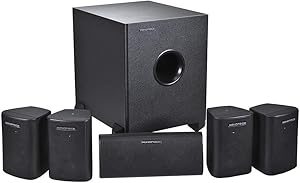
Aesthetic design and industrial build quality highlight different priorities for each brand. Monoprice largely adopts an unapologetically utilitarian, function-over-form industrial design. Many Monoprice enclosures, particularly the high-output Monolith subwoofers and floorstanders, are massive, heavy, and finished in functional vinyl wraps with heavy-duty MDF construction. While internal bracing and acoustic isolation are top-tier—resulting in dead, inert cabinets—the visual impact is stark, imposing, and clearly designed for dedicated media rooms or dark home theaters rather than high-concept living spaces where audio equipment must blend seamlessly into decor.
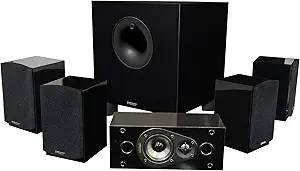
Energy, on the other hand, was engineered with domestic spaces and aesthetic refinement in mind. Its systems, such as the iconic Take Classic series, feature sophisticated high-gloss black piano finishes, sculpted front baffles, and compact, rounded enclosures that sit unobtrusively beside modern flat-panel displays. Energy achieves a higher degree of visual elegance and spouse-friendly appeal out of the box, with built-in keyhole slots and threaded inserts specifically designed for simple on-wall mounting. While Monoprice wins for heavy-duty structural dampening and thermal management in high-powered components, Energy offers a sleeker, more polished aesthetic for multi-purpose living environments.