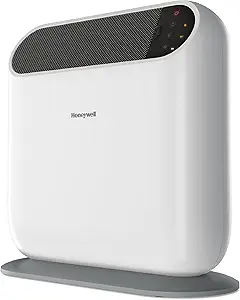

Honeywell vs Cadet: Overview
Comparing Honeywell and Cadet helps you determine which brand is best suited for your needs in Heaters. Both brands offer strong choices depending on your budget and key feature requirements.
Key Features & Comparison
Evaluate factors such as build quality, warranty, customer satisfaction, and total value before making your final purchase choice between Honeywell and Cadet.
Features
Honeywell portable heaters are engineered with an emphasis on interactive, end-user technology and multi-layered safety mechanisms. Modern Honeywell units frequently incorporate digital controls, programmable timers, electronic oscillation, and precise ambient thermostats. Many models also feature proprietary tech such as ThermaWave or 360-degree surround heat disbursement. Crucially, Honeywell excels in active safety features: their units are routinely built with 360-degree tip-over switches, cool-touch composite housings, thermal cut-off limiters, and motion-sensing shutoff systems (like their Safety Sentinel technology) designed specifically to mitigate the hazards of unattended mobile heating.
Cadet’s feature set is decidedly more utilitarian, prioritizing mechanical durability, electrical safety compliance, and architectural integration. Most Cadet wall units utilize commercial-grade, finned tubular or nichrome wire heating elements combined with centrifugal blower wheels for high-volume air delivery. Rather than touchscreens or remote controls, Cadet relies heavily on robust analog dials or compatibility with integrated wall-mounted line-voltage thermostats, although they have expanded into digital electronic wall thermostats for increased precision. Cadet's safety architecture is hardwired and internal, relying on primary high-temperature thermal limit cutouts that reset automatically, focusing on preventing electrical overloads within wall cavities rather than mitigating tipping risks.
Performance
In terms of thermal dynamics, Honeywell portable units are constrained by standard residential 120-volt, 15-amp electrical outlets, typically capping their power output at 1,500 watts (roughly 5,118 BTUs per hour). Within this operational envelope, Honeywell heaters perform admirably, especially in confined spaces such as home offices, bedrooms, or personal sitting areas. Ceramic and radiant Honeywell models offer near-instantaneous localized warmth, while their convection-based models effectively maintain comfortable microclimates over moderate square footage. However, their reliance on standard plug-in current limits their capacity to combat severe draftiness or serve as primary heat sources in sub-zero ambient conditions.
Cadet radically outperforms Honeywell in raw thermal capacity and sustained heat distribution due to its hardwired architecture, which routinely leverages 240-volt circuits alongside standard 120-volt models. Capable of generating anywhere from 500 up to 4,000 watts (yielding upwards of 13,000+ BTUs) on dedicated lines, Cadet heaters can effortlessly act as the sole thermal source for large living areas, basements, or drafty outbuildings. The fan-forced mechanism of wall units like the Cadet Com-Pak drives heated air down to floor level, establishing an efficient convection current that warms entire rooms uniformly without the thermal stratification often left behind by smaller floor-standing heaters.
Design
Honeywell’s design ethos is characterized by ergonomic modernism, portability, and contemporary aesthetic adaptability. Crafted primarily from high-impact, heat-resistant polymers, Honeywell heaters prioritize lightweight construction, integrated carrying handles, compact footprints, and internal cord wraps. Stylistically, they range from sleek, minimalist ceramic towers to unobtrusive low-profile disc heaters that blend into office decors. While this makes Honeywell units exceptionally easy to relocate and store off-season, their plastic-heavy chassis and exposed placement on floors can occasionally clash with premium interior finishes and introduce minor cord clutter into living spaces.
Cadet champions an understated, architectural design language intended to disappear into the background of a room. Built with heavy-gauge, powder-coated steel grilles and galvanized wall cans, Cadet products are engineered to withstand decades of physical wear, making them ideal for high-traffic hallways, rental properties, and family homes. Because they are recessed directly into stud bays or mounted flush along baseboards, they eliminate trip hazards, require zero floor footprint, and leave room layouts completely uninhibited. While lacking the modern curved aesthetics of Honeywell, Cadet’s industrial, minimalist metal profiles offer a clean, permanent look that suits long-term home design.
Compare current retail pricing, active promotions, and verified stock availability directly from authorized stores: