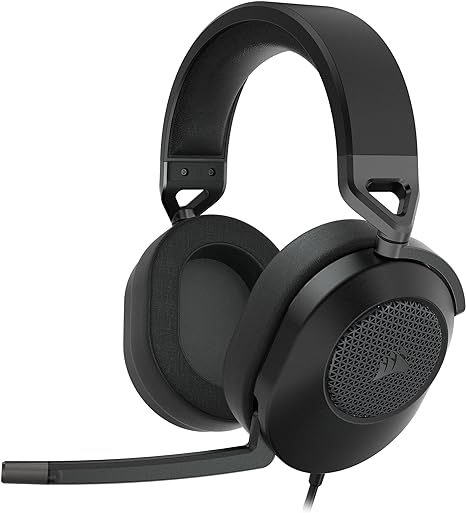
Corsair vs One Plus: Overview
Comparing Corsair and One Plus helps you determine which brand is best suited for your needs in Headphones & Earbuds. Both brands offer strong choices depending on your budget and key feature requirements.
Key Features & Comparison
Evaluate factors such as build quality, warranty, customer satisfaction, and total value before making your final purchase choice between Corsair and One Plus.
Features
The feature architecture of Corsair audio products is heavily anchored in software customization and competitive utilities. Powered by Corsair’s iCUE suite, users gain access to granular parametric equalization, RGB lighting synchronization, customizable side-tone monitoring, and advanced spatial technologies like Dolby Atmos. Hardware-wise, Corsair frequently includes broadcast-grade detachable omnidirectional or cardioid boom microphones, dedicated physical mute toggles, and dual-connectivity options incorporating simultaneous 2.4GHz Slipstream wireless and Bluetooth. These features cater precisely to communication clarity and seamless switching between a primary gaming rig and secondary mobile devices without compromising input latency.
OnePlus counters with an array of mobile-first, smart acoustic technologies designed to adapt dynamically to real-world environments. Its true wireless offerings feature sophisticated adaptive noise cancellation systems capable of suppressing up to 48dB of ambient noise, personalized audio profiles tuned via automated canal-calibration tests, and transparency modes for street awareness. OnePlus products integrate cutting-edge Bluetooth codecs such as LHDC 5.0 alongside Google Fast Pair and dual-device multipoint switching optimized for smartphones and tablets. While Corsair provides superior voice input control and desktop audio routing, OnePlus delivers an automated, context-aware feature set essential for travel, fitness, and modern mobile multitasking.
Performance
In terms of acoustic performance and latency, Corsair fine-tunes its high-density neodymium drivers (ranging from 50mm to custom 60mm units) to deliver expansive dynamic range, punchy low-end impact, and heightened treble clarity critical for gaming cue detection. The flagship Virtuoso series features high-resolution 24-bit/96kHz audio capability via wired USB connections, providing pristine fidelity that outperforms typical Bluetooth bandwidth. Furthermore, Corsair’s proprietary Slipstream wireless protocol ensures sub-millisecond transmission speeds, completely eliminating the lip-sync lag and audio delay that routinely plague competitive gaming and interactive media.
OnePlus, on the other hand, collaborates with premium acoustic engineers—such as Dynaudio for their flagship buds—to craft an expansive, consumer-pleasing sound signature marked by deep, textured sub-bass and crisp, articulate highs through dual-driver configurations. While OnePlus earbuds rely on Bluetooth, introducing inherently higher base latency than Corsair’s RF dongles, they implement specialized low-latency gaming modes (often dropping to around 54ms) when paired with OnePlus smartphones. In real-world listening, OnePlus offers superior sound isolation, vocal intimacy, and outdoor dynamic consistency, whereas Corsair holds the technical advantage in directional imaging, total harmonic distortion control at high volumes, and mic pickup fidelity.
Design
Corsair’s design language is defined by industrial ruggedness, substantial clamping forces, and high-end materials built for extended wear at a desk. Models like the Virtuoso Pro and SE exhibit machined aluminum ear cup plates, memory foam cushions wrapped in breathable microfibers or leatherette, and robust reinforced headbands that withstand twisting and dropping. While this results in exceptional build quality and premium aesthetics, it yields a significantly heavier profile that makes Corsair products impractical for transit, outdoor workouts, or casual mobile use. Physical tactile controls, including notched aluminum volume rollers and distinct tactile switches, reflect their workstation utility.
In stark contrast, OnePlus prioritizes minimalist elegance, ultra-lightweight ergonomics, and water-resistant durability. The company’s earbuds and accompanying charging cases feature sleek, rounded contours, dual-finish matte-and-metallic stems, and IP55/IPX4 ratings for dust and water resistance, rendering them impervious to sweat and rain. The tactile experience with OnePlus revolves around haptic pinch or touch-capacitive sensors on the stems, engineered to maintain a smooth, snag-free profile. Where Corsair utilizes metallic mass to project stationary luxury and durability, OnePlus achieves design excellence through miniaturization, featherlight comfort during all-day wear, and sleek, pocketable efficiency.