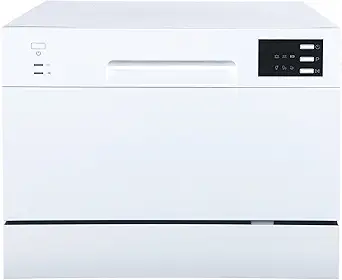
Homelabs vs SPT: Overview
Comparing Homelabs and SPT helps you determine which brand is best suited for your needs in Dishwashers. Both brands offer strong choices depending on your budget and key feature requirements.
Key Features & Comparison
Evaluate factors such as build quality, warranty, customer satisfaction, and total value before making your final purchase choice between Homelabs and SPT.
Features
In terms of feature sets and cycle selections, both brands deliver comprehensive washing options tailored to small footprint requirements, but their execution differs. hOmeLabs units typically feature six to seven core wash cycles—including Heavy, Normal, ECO, Glass, Speed, and Rinse—augmented by a specialized 24-hour delay start and a heated dry function. The control architecture on hOmeLabs models is decidedly modern, utilizing sleek touch-capacitive controls, clear LED cycle progress indicators, and rinse-aid low-level warnings that appeal to users who value immediate visual clarity and set-and-forget simplicity.
SPT counters with an expansive, utility-driven feature matrix that often includes higher-end cycle customizations rarely seen at entry-level price points. Several SPT models boast integrated heating elements capable of reaching higher wash temperatures for true sanitization, specialized fruit/vegetable wash cycles, and dual-zone wash arms designed to maximize water pressure across tight internal spaces. Additionally, SPT models frequently incorporate advanced error-detection codes on their digital displays and offer versatile water inlet options—such as built-in internal water reservoirs alongside traditional sink faucet adapters—providing greater operational flexibility for unconventional installations like RVs or off-grid environments.
Performance
Performance benchmarks reveal distinct operational priorities between the two manufacturers, particularly concerning thermal dynamics, cleaning power, and acoustics. hOmeLabs relies on an optimized hydraulic system paired with efficient spray arms that deliver dependable wash results against standard day-to-day soil loads, such as coffee stains, light grease, and starch residue. However, because hOmeLabs primarily employs residual condensation drying to conserve power and meet strict Energy Star metrics, users may notice lingering moisture on plastics and deep mug recesses unless an external rinse-aid agent is consistently utilized. Acoustic insulation in hOmeLabs countertop units is respectable, hovering around 50 to 55 dBA, ensuring quiet operation in compact living quarters.
SPT demonstrates superior cleaning torque when confronted with baked-on food remnants and heavy oils, largely owing to its high-temperature heating stages that aggressively dissolve proteins and animal fats. The mechanical pump pressure in SPT dishwashers tends to be marginally more assertive, yielding higher impingement force on plates and flatware. Furthermore, select SPT models utilize active fan-assisted drying systems in conjunction with heating elements, which significantly outperforms passive condensation drying on synthetic dishware. The trade-off manifests in energy draw and acoustic presence, as older or heavier-duty SPT models can run slightly louder and consume more peak wattage during water-heating cycles than their hOmeLabs counterparts.
Design
From an industrial design standpoint, hOmeLabs champions a sleek, minimalist aesthetic defined by clean lines, monochromatic finishes, and a clutter-free exterior. Their countertop units are engineered with a modern white or metallic silver casing, flush door latches, and an integrated electronic control strip that blends seamlessly into contemporary kitchen decors. Internally, hOmeLabs utilizes a durable, rust-resistant stainless steel interior cavity that enhances hygienic sanitization and thermal retention, complemented by a modular nylon-coated wire basket with smooth-gliding roller assemblies and a removable cutlery basket optimized for standard dinnerware profiles.
SPT adopts a more utilitarian, commercial-leaning design philosophy that prioritizes modular utility and mechanical resilience over contemporary styling. While SPT also employs all-stainless steel interiors across its standard and compact machines, its external chassis designs are more functional, featuring pronounced push-button interfaces, rugged recessed handles, and heavy-gauge steel framing built to endure frequent relocation. SPT's internal rack designs often provide more aggressive tining configurations, fold-down cup shelves, and dedicated spray arm clearance notches, allowing users to fit irregularly shaped cookware, oversized mixing bowls, or tall stemware that might struggle to clear the tighter interior dimensions of a hOmeLabs unit.
Compare current retail pricing, active promotions, and verified stock availability directly from authorized stores: