GE vs Frigidaire: Overview
Comparing GE and Frigidaire helps you determine which brand is best suited for your needs in Dishwashers. Both brands offer strong choices depending on your budget and key feature requirements.
Key Features & Comparison
Evaluate factors such as build quality, warranty, customer satisfaction, and total value before making your final purchase choice between GE and Frigidaire.
Features
In terms of internal features and cycle flexibility, GE offers a significantly more advanced technological ecosystem. One of GE’s standout engineering triumphs is its dedicated bottle wash jets, which are integrated directly into the upper rack to blast water deep inside tall drinkware, baby bottles, and travel mugs. Furthermore, GE dishwashers frequently incorporate hard-food disposers with stainless steel blades (Piranha Hard Food Disposers) alongside multi-stage filtration systems, minimizing clog risks from unrinsed plates. Higher-end GE models also feature upper and lower wash zones that allow users to run half-loads independently, smart Wi-Fi connectivity via the SmartHQ app for cycle monitoring, and antimicrobial Microban coating integrated into high-touch plastic surfaces to prevent bacterial buildup.
Frigidaire counters with functional, efficiency-focused feature sets that prioritize speed and even water distribution. The brand’s most notable mechanical asset is the OrbitClean (or Dual OrbitClean) wash arm, which utilizes a multidirectional rotating disc at the end of the main wash arm to deliver four times greater water coverage compared to standard single-pivot spray arms. Frigidaire also incorporates its proprietary EvenDry (or MaxBoost Dry) fan-assisted heating systems on stepped-up Gallery models, alongside a rapid 34-minute Quick Wash cycle that reliably cleans lightly soiled items in a hurry. While Frigidaire covers the functional essentials very well, it generally lacks the specialized third-rack configurations, fold-down tines, and targeted micro-jets that make GE’s interior racking significantly more adaptable to irregular cookware.
Performance
When evaluating cleaning efficacy, GE demonstrates an edge in dealing with stubborn, baked-on soils and unevenly distributed loads. The combination of high-powered wash arms, localized spray zones, and dedicated silverware jets ensures that food residue is blasted away from tight spaces with minimal redeposition. GE’s heating elements also elevate water temperatures significantly during sanitize and heavy-duty cycles, facilitating robust grease breakdown. In terms of acoustics, GE typically outperforms Frigidaire by engineering quieter wash packages, with many mid-tier and Profile models operating between 42 and 48 decibels (dBA), allowing them to run virtually unnoticed in open-concept living arrangements.
Frigidaire provides respectable everyday cleaning performance, particularly when paired with high-quality detergent and properly maintained filters, but it can struggle with high-starch residues and dried-on proteins if not pre-scraped. While the OrbitClean system ensures broad coverage, the pump motors in entry-level Frigidaire models are less aggressive than GE’s equivalents. Drying performance in standard Frigidaire units relies heavily on basic exposed heating elements, which can leave plastics damp unless upgraded to models featuring active fan drying. Furthermore, Frigidaire dishwashers tend to run louder across comparable price brackets, typically hovering between 49 and 55 dBA, which generates noticeable ambient kitchen noise during intensive wash and drain sequences.
Design
From an aesthetic and structural perspective, GE showcases a more polished, contemporary design language. The brand offers clean exterior facades featuring both traditional front-control consoles and modern hidden top-control interfaces with pocket or bar handles. GE’s Slate and Black Slate finishes provide a fingerprint-resistant, matte alternative to conventional stainless steel that integrates well into modern cabinet schemes. Internally, GE models feature rugged, ball-bearing rack glides that feel sturdy even when weighted down with heavy cast iron, along with deep tub designs that maximize vertical clearance for large platters and tall stemware on adjustable tiers.
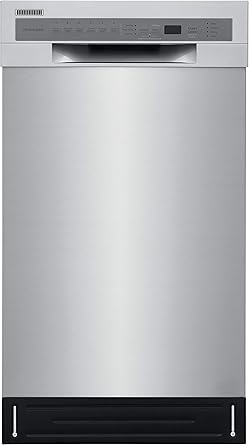
Frigidaire focuses on straightforward, pragmatic industrial design. Its stainless steel exteriors—particularly in the Gallery series—boast a reliable Smudge-Proof finish that resists fingerprints effectively, making it popular for family households with small children. However, the internal fit and finish of Frigidaire dishwashers reflect their budget orientation; the racking system uses lighter-gauge wire that can feel somewhat flimsy under full capacity, and plastic-tub interiors are far more prevalent in their lower-to-mid catalog compared to GE’s hybrid and full stainless-steel tubs. While Frigidaire successfully delivers a neat, unpretentious exterior look that blends into modern kitchens, GE delivers a noticeably more premium tactile feel throughout its handles, buttons, and interior layout.