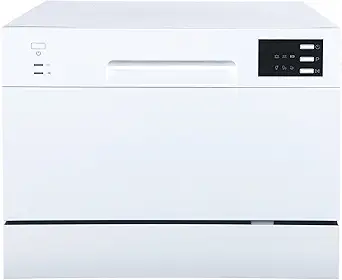
Danby vs SPT: Overview
Comparing Danby and SPT helps you determine which brand is best suited for your needs in Dishwashers. Both brands offer strong choices depending on your budget and key feature requirements.
Key Features & Comparison
Evaluate factors such as build quality, warranty, customer satisfaction, and total value before making your final purchase choice between Danby and SPT.
Features
In terms of cycle functionality and technical features, SPT typically takes a more aggressive approach to programming versatility. Even their baseline countertop models often feature six or more dedicated wash cycles, including heavy, normal, ECO, glass, speed, and a dedicated rinse cycle, frequently complemented by a high-temperature sanitize function. SPT is also notable for integrating flexible internal loading accessories, such as modular silverware baskets and folding tines, which maximize utility within micro-cavities. A significant innovation in select SPT models is the inclusion of built-in water tanks that negate the need for a direct faucet hookup, providing exceptional convenience for off-grid living, mobile homes, or temporary housing installations.
Danby counters with a robust, intuitive feature set that emphasizes practical, everyday operation over niche configurations. Most Danby dishwashers offer standard multi-cycle programming alongside practical additions like delayed start timers (ranging from 2 to 8 hours), child safety locks, and automatic detergent and rinse aid dispensers. While Danby models frequently match SPT in raw cycle counts, Danby’s control interfaces tend to be more straightforward, utilizing large LED displays and simple push-button controls. However, Danby generally relies on traditional faucet adapters for their portable units rather than self-contained water reservoirs, slightly limiting their flexibility in comparison to SPT's most versatile, tank-based portable models.
Performance
Performance metrics reveal subtle but important mechanical differences between the two brands, primarily centered on wash efficacy, noise output, and drying mechanisms. Danby dishwashers frequently leverage robust, high-pressure spray arms paired with durable heating elements that deliver superior wash performance on baked-on soils. Their drying performance, particularly in 18-inch built-in models, tends to outperform SPT due to more effective heated dry cycles that minimize residual moisture on glassware and ceramic items. In terms of acoustic insulation, Danby units typically hover around 50 to 54 decibels (dBA), which, while audible in a quiet kitchen, remains well within tolerable limits for compact living spaces.
SPT dishwashers, on the other hand, are engineered with a strong emphasis on water and electrical conservation, frequently boasting Energy Star certifications across their compact catalog. They utilize precision-engineered spray arms that optimize water coverage despite lower flow volumes, making them exceptionally cost-effective to run. However, SPT’s drying capabilities often rely on residual heat drying rather than an active heating element, which can leave plastic containers and cups damp at the end of a cycle. Additionally, while SPT models are similarly rated around 52 to 55 dBA, their smaller chassis can sometimes transmit higher-frequency pump whine during drain cycles, making them subjectively louder to some users compared to Danby's lower-frequency hum.
Design
From an industrial design and material quality perspective, Danby leans into clean, timeless aesthetics that blend seamlessly with full-sized major appliances. Danby’s 18-inch and countertop offerings often feature durable stainless steel interiors, which resist staining, improve thermal efficiency, and enhance overall structural rigidity. Their exterior finishes—typically available in classic black, clean white, or contemporary fingerprint-resistant stainless steel—are designed to mimic the appearance of standard residential dishwashers. The rack layouts in Danby units are generally conventional, favoring standard plate sizes and deep-dish bowls, though larger cookware can be awkward to fit due to vertical rack height limitations inherent to compact frames.
SPT adopts a distinctly modern, gadget-forward design language. Many SPT countertop models showcase glossy exterior finishes, contemporary silver-and-black contrasts, and digital control panels that look right at home next to modern microwave ovens or espresso machines. Inside, SPT also makes extensive use of 304-grade stainless steel tubs, ensuring good hygiene and odor prevention. Where SPT’s design truly shines is in internal space optimization: their engineers utilize clever rack geometry and collapsible tines that allow users to maneuver unusually shaped pots and mugs into extremely restricted spaces. The trade-off is that SPT’s plastic exterior components, such as door latches and hose couplings, can occasionally feel less substantial than Danby's slightly thicker, more heavy-duty hardware.