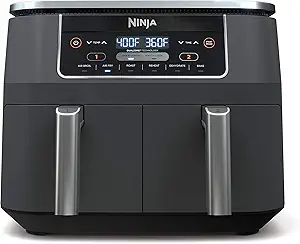
Ninja vs Magic Bullet: Overview & Brand Philosophy
The air fryer landscape is dominated by appliances engineered to balance cooking speed, capacity, and user convenience. Within this competitive market, Ninja and Magic Bullet represent two distinctly different approaches to countertop culinary technology. Ninja, a flagship brand under the SharkNinja umbrella, has established itself as an innovation-driven powerhouse. The company prioritizes multi-functionality, precision thermal dynamics, and heavy-duty performance, frequently pioneering form-factor evolutions such as dual-zone baskets and integrated probe thermometers.
Conversely, Magic Bullet—a subsidiary of Homeland Housewares and closely aligned with the NutriBullet ecosystem—approaches kitchen appliances through the lens of extreme accessibility and minimalism. Magic Bullet built its global reputation on ultra-compact personal blenders, and it brings that exact minimalist ethos to its air fryer line. Rather than overwhelming the user with complex digital arrays or oversized footprints, Magic Bullet focuses on small-batch cooking, intuitive analog-style interfaces, and aggressive price points aimed at budget-conscious consumers and small-space dwellers.
Ultimately, these two brands are catering to fundamentally different segments of the market. Ninja designs its appliances for busy families, home cooks seeking versatile culinary techniques (such as dehydrating, broiling, and multi-basket coordination), and individuals who prioritize rapid, high-wattage throughput. Magic Bullet targets dorm residents, single individuals, and entry-level cooks who demand a straightforward, plug-and-play appliance that takes up minimal counter real estate and performs basic convection frying without requiring a steep learning curve.
Key Differences & Technological Comparison
From an engineering perspective, the technical gap between Ninja and Magic Bullet centers on thermal precision, airflow dynamics, and digital versatility. Ninja air fryers feature proprietary convective heating systems—frequently branded as Max Crisp Technology—capable of driving internal temperatures up to 450°F (232°C). This high thermal ceiling, coupled with high-velocity internal convection fans, yields rapid moisture evaporation and superior surface Maillard reaction. Magic Bullet air fryers generally cap out around 400°F (204°C) with standard airflow fans, leading to longer cook cycles for dense proteins and slightly less consistent crisping on high-moisture foods.
Capacity and footprint represent another significant divergence. Magic Bullet focuses almost exclusively on compact capacities, such as their flagship 2.5-quart model, which is engineered to feed one to two people. In contrast, Ninja offers a sprawling product suite spanning from 4-quart single-basket units up to 10-quart multi-zone models featuring independent cooking chambers (DualZone Technology with Smart Finish features). While Magic Bullet excels at fitting into tight, low-clearance cabinet spaces, it lacks the volume required for batch cooking or family meals.
Control architecture and presets also delineate the two brands. Ninja utilizes robust digital control panels with pre-programmed algorithms designed for specific tasks: Air Fry, Air Broil, Roast, Bake, Reheat, and Dehydrate. Users can adjust time down to the minute and temperature in precise five-degree increments. Magic Bullet relies on streamlined mechanical dials or basic digital toggles that prioritize simplicity over granular control. The mechanical timer setup on lower-end Magic Bullet units eliminates digital fail points but prevents micro-adjustments during the cooking process.
Pros & Cons Comparison
Ninja Air Fryers
- Pros:
- Advanced airflow engineering and higher maximum temperatures (up to 450°F) for faster, crispier results.
- Versatile multi-functionality including broiling, baking, roasting, and dehydrating modes.
- Available in diverse, high-capacity formats including independent dual-zone compartments.
- Durable ceramic non-stick coatings that are free of PTFE, PFOA, and are dishwasher-safe.
- Cons:
- Significantly higher price point across all model lines.
- Larger overall footprint requires dedicated countertop or storage space.
- Higher operational noise levels due to high-velocity convective fans.
Magic Bullet Air Fryers
- Pros:
- Extremely budget-friendly price point, offering low entry barriers for first-time buyers.
- Ultra-compact footprint ideal for small apartments, studio kitchens, and dorm rooms.
- Straightforward, zero-friction interface with minimal settings or presets to navigate.
- Sufficient thermal output for standard everyday frozen appetizers and single-portion reheating.
- Cons:
- Restricted cooking capacity (typically 2.5 quarts), making it unsuitable for families or meal prepping.
- Lower peak temperatures and less uniform heat distribution compared to premium competitors.
- Basic non-stick coatings and lightweight plastic chassis that show wear faster under heavy usage.
Performance, Durability & Value Analysis
When assessing performance under rigorous testing, Ninja demonstrates clear superiority in both speed and thermal consistency. In head-to-head testing with standard benchmarks like fresh-cut fries, bone-in chicken thighs, and delicate proteins, Ninja appliances consistently achieve uniform browning with minimal need for manual basket shaking. The higher wattage (often ranging between 1500W to 1750W) allows for rapid thermal recovery after the basket is pulled out. Magic Bullet (typically operating around 900W to 1100W) struggles slightly with thermal recovery; opening the drawer introduces substantial heat loss, which increases overall cook times and can occasionally lead to uneven crisping if the basket is filled beyond half capacity.
Regarding durability and long-term value, the calculation depends heavily on intended usage frequency. Ninja's investment in ceramic-coated crisper plates yields exceptional longevity against flaking, scratching, and heat degradation, maintaining food-release properties over hundreds of cycles. Magic Bullet employs traditional non-stick coatings and lighter-gauge plastics throughout its construction, which are adequate for sporadic use but vulnerable to wear under heavy, daily cycles. However, from a pure value perspective, Magic Bullet offers an undeniable return on investment for the minimalist: it delivers core air frying capability at roughly a third to a half of the cost of an entry-level Ninja.
Final Verdict: Which Brand Should You Choose?
Choosing between Ninja and Magic Bullet comes down to your household size, cooking ambition, and budget flexibility:
Choose Magic Bullet if: You are cooking exclusively for one, working with tight countertop or studio constraints, or want a completely hassle-free, low-cost introduction to air frying. If your primary use cases are reheating leftover pizza, cooking single servings of frozen snacks, or crisping small portions of vegetables without breaking the bank, Magic Bullet provides all the functionality you need in an ultra-compact form factor.
Choose Ninja if: You cook for two or more people, plan to integrate air frying into daily meal preparation, or demand culinary versatility beyond standard frying. Ninja is the definitive choice for home chefs who value precise temperature controls, rapid cook times, ceramic durability, and multi-function capabilities like dehydrating and dual-basket synchronization. While the initial investment is higher, the superior build quality, capacity, and thermal performance make Ninja the more complete, future-proof kitchen appliance.
Features
When evaluating the feature ecosystems of Ninja and Magic Bullet air fryers, the two brands represent fundamentally divergent engineering philosophies: multifaceted digital culinary systems versus stripped-back, analog utility. Ninja is renowned for its advanced digital microprocessing and proprietary cooking technologies, such as the Max Crisp System, which propels superheated air up to 450°F to deliver rapid, even convection. Most Ninja appliances boast an extensive array of pre-programmed functions—including Air Fry, Roast, Reheat, Dehydrate, and Broil—alongside dual-zone flexibility found in their popular DualZone models. These two-basket systems introduce patented Smart Finish and Match Cook technologies, allowing consumers to synchronize the cooking times and temperatures of distinct dishes simultaneously. Furthermore, Ninja incorporates precision elements like integrated smart food thermometers and intuitive, segmented LED control panels that grant users granular mastery over minute-by-minute cook times and single-degree temperature intervals.
Conversely, Magic Bullet approaches the air fryer segment through the lens of extreme minimalism, engineering their units primarily for space-constrained environments and straightforward operation. The hallmark of the Magic Bullet air fryer line is its mechanical, analog interface, completely eschewing digital displays, multi-stage cooking algorithms, and smart sensors in favor of dual rotary dials for time (up to 60 minutes) and temperature (capping out at 400°F). While this design omits specialized modes like low-heat dehydrating or multi-zone synchronization, it drastically flattens the learning curve and eliminates potential digital failure points. Magic Bullet utilizes a continuous single-loop heating element paired with a basic, fixed-speed fan, which performs reliably for standard reheating and single-portion frying, but fundamentally lacks the thermal velocity, programmatic versatility, and precision airflow optimization engineered into Ninja’s convection chambers.
The practical trade-offs regarding features center on user intent, counter space, and culinary ambition. Ninja’s feature-dense architecture provides home cooks with a legitimate alternative to traditional wall ovens, offering the thermal bandwidth to dehydrate beef jerky at 105°F or crisp frozen wings at 450°F with equal efficacy, albeit at the expense of a steeper learning curve and a substantially larger footprint. Magic Bullet sacrifices this technical sophistication for instantaneous, "set-it-and-forget-it" functionality; its feature set caters exclusively to rudimentary air frying tasks such as crisping frozen snacks or roasting single-serving vegetables. Ultimately, while Ninja wins decisively in technical capability, programmability, and dynamic versatility, Magic Bullet offers a hyper-focused, distraction-free appliance engineered for users who value functional simplicity over complex feature menus.
Performance
When evaluating performance, Ninja air fryers represent the upper echelon of consumer-grade convection engineering, driven by high-wattage heating elements and advanced airflow dynamics. Utilizing proprietary cyclonic air technology, Ninja units typically operate between 1,500 and 1,750 watts, generating rapid, uniform heat circulation that reaches up to 450°F with features like Max Crisp. This superior thermal transfer consistently produces restaurant-grade browning and crispness with minimal temperature drops when loaded. In contrast, the Magic Bullet Air Fryer operates as an entry-level compact appliance, generally powered by an element around 1,000 to 1,200 watts. While adequate for basic tasks, its convective power lacks the velocity and sheer heat output of Ninja's hardware. Consequently, Magic Bullet units often result in slightly longer cook times, a less pronounced crunch on dense foods like frozen root vegetables, and occasional hot-spotting due to less sophisticated internal aerodynamics.
The feature sets directly influence the technical versatility and consistency of each brand's operational performance. Ninja heavily prioritizes programmable precision, offering multi-function capabilities that range from air frying and roasting to broiling, dehydrating, and dual-zone independent temperature control on select models. Their digital interfaces allow minute-by-minute and degree-by-degree calibration, which translates to repeatable, exact culinary results. Magic Bullet takes an ultra-streamlined, analog approach, relying on basic mechanical dial timers and manual temperature knobs. This simplicity limits user control over subtle thermal variations, making fine-tuned cooking (such as delicate baking or precise reheating) considerably harder to achieve. While the Magic Bullet is virtually foolproof to operate, it sacrifices the expansive cooking envelope and tailored performance profiles that Ninja users benefit from.
Ultimately, the practical trade-offs come down to capacity efficiency versus heavy-duty processing power. Ninja’s ceramic-coated baskets, robust construction, and high thermal retention excel at handling dense, family-sized proteins and stacked batches with minimal performance degradation. Magic Bullet's space-saving 2.5-quart chamber heats up almost instantly because of its tiny footprint, making it surprisingly efficient for a single serving of fries or chicken tenders. However, the Magic Bullet quickly throttles under a full load; overcrowding drastically inhibits its weaker airflow, leading to steaming rather than frying. For consumers seeking culinary power, texture contrast, and multifaceted cooking performance, Ninja is vastly superior, whereas Magic Bullet delivers acceptable, modest performance tailored strictly for small spaces and low-complexity tasks.
Design
When evaluating the design philosophy of air fryers, Ninja and Magic Bullet approach the category from opposite ends of the functional spectrum. Ninja prioritizes culinary versatility and robust engineering, characterized by heavy-duty matte plastics, brushed stainless steel accents, and sophisticated digital interfaces. Its design architecture often incorporates multi-functional capabilities—such as dual-zone independent cooking chambers with sync-finish technology, smart temperature probes, and multi-tiered racks. The internal air-flow engineering is optimized with high-velocity cyclonic fans and custom-molded ceramic-coated crisper plates that ensure uniform heat distribution. Conversely, Magic Bullet adheres to a minimalist, highly compact aesthetic engineered specifically for simplicity, individual portions, and counter-space conservation. Constructed predominantly of lightweight gloss plastic, Magic Bullet air fryers feature a soft, rounded silhouette and rely on straightforward mechanical analog dials rather than complex digital logic boards.
The practical trade-offs between these two brands highlight a distinct tension between comprehensive control and effortless utility. Ninja’s digital control panels offer granular, degree-by-degree temperature precision and dedicated pre-programmed settings (such as Air Broil, Roast, and Dehydrate), but this level of sophistication increases the appliance's overall footprint, weight, and visual complexity on the countertop. Magic Bullet strips away these advanced capabilities in favor of ultra-fast usability; its simple 30-minute timer dial and single temperature profile lower the barrier to entry for novice cooks, but this design severely limits precise culinary experimentation. Furthermore, while Magic Bullet's 2.5-quart cylindrical basket easily fits into the smallest apartment kitchen cabinets, Ninja’s design yields significantly superior interior volume-to-exterior ratio, deeper rectangular baskets that accommodate larger proteins flatly, and superior ergonomic handles designed to bear heavier food loads without wrist strain.
Ultimately, the design victor depends heavily on user ergonomics, aesthetic preference, and maintenance priorities. Ninja demonstrates superior industrial design longevity, offering higher-grade non-stick surfaces (often ceramic rather than traditional PTFE), integrated cord storage, and meticulously ventilated chassis that keep the exterior cool to the touch even during high-heat cycles. Magic Bullet provides an appealing, retro-inspired aesthetic that prioritizes quick, hassle-free cleanup—its diminutive, lightweight basket is exceptionally easy to hand-wash in small sinks. However, from an objective engineering standpoint, Ninja excels in structural durability, thermal insulation, and interface responsiveness, making its design an asset for demanding daily cooks, while Magic Bullet’s design remains a triumph of compact, budget-friendly convenience for single-serving needs.