













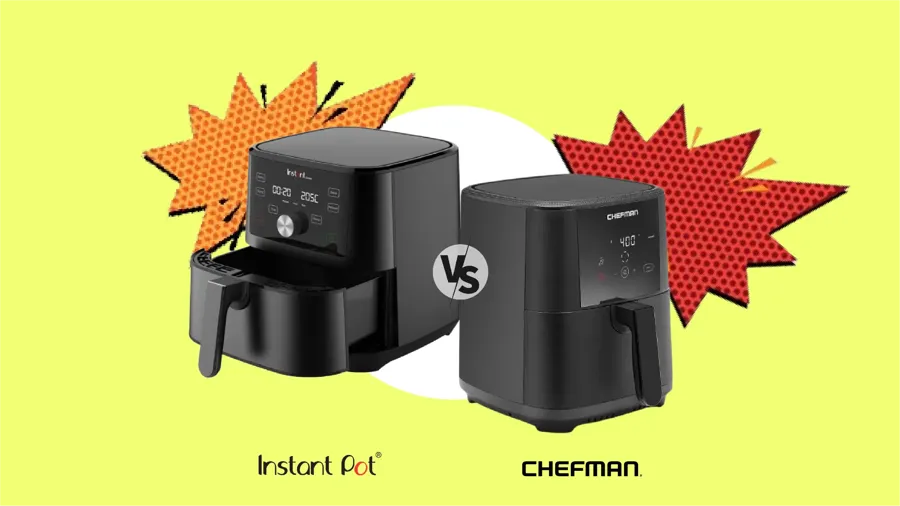
Chefman and Instant Pot are popular names in the air fryer industry, each offering unique features for different styles and consumers.
In this article we will compare both brands on key aspects to help you pick the one that suits your cooking style best.
Features
When evaluating the feature ecosystem of air fryers, Instant Pot (Instant Brands) approaches functionality with an emphasis on precise culinary engineering and multi-modal cooking intelligence. Drawing directly from their pressure-cooking legacy, Instant Pot air fryers—most notably the Vortex series—integrate high-performance heating elements coupled with their proprietary EvenCrisp technology, which regulates cyclonic airflow to maximize convection efficiency. Their technical feature set regularly includes intuitive digital interfaces with customizable smart programs (Air Fry, Roast, Broil, Bake, Reheat, and Dehydrate), highly responsive capacitive touch controls, and subtle but impactful quality-of-life additions such as the ClearCook viewing windows and integrated OdorErase air-filtration carbon filters. Furthermore, Instant Pot’s higher-end models often introduce dual-zone basket synchronization (SyncCook and SyncFinish), ensuring complex multi-component meals finish simultaneously without thermal bleed between compartments.
Conversely, Chefman structures its feature architecture around maximum consumer accessibility, mechanical versatility, and high-capacity utility at a more aggressive price point. Chefman’s technical strength lies in its diverse form factors, particularly their multifunction countertop air fryer ovens equipped with rotisserie spits, multi-rack dehydrating trays, and capacitive digital displays that feature extensive, pre-programmed food presets. While Instant Pot prioritizes micro-adjustments in internal thermodynamics and fan speeds, Chefman leans into rapid-heat dual-element systems and visual monitoring through oversized observation doors. Practical features often include broad temperature spectrums reaching up to 450°F (surpassing the standard 400°F ceiling of many baseline competitors) and integrated capacitive shake reminders that alert users mid-cycle to redistribute ingredients for uniform exposure.
The practical trade-offs between the two brands center on the balance between performance refinement and utilitarian versatility. Instant Pot delivers superior sensor accuracy, higher thermal retention, and more reliable sensor-driven presets that minimize moisture loss, making it the preferred choice for users who prioritize exact culinary execution and tactile durability. Chefman, while offering an undeniably broader array of out-of-the-box accessories and rotisserie functionality in their larger units, often utilizes lighter-gauge materials and less sophisticated heating algorithms, which can occasionally lead to uneven crisping if baskets are not manually tended. Ultimately, Instant Pot excels in core thermodynamic consistency and smart synchronization features, whereas Chefman provides a broader, more diversified toolkit designed for volume cooking and budget-conscious flexibility.
Performance
When evaluating performance, Instant Pot (primarily via its Vortex and Omni lines) leverages robust thermal engineering derived from its multicooker heritage. Instant Pot air fryers excel in convection efficiency, utilizing optimized fan speeds and proprietary EvenCrisp airflow technology. This system maintains remarkably stable chamber temperatures, yielding rapid preheats and a deep, uniform Maillard reaction on proteins and frozen foods with minimal hot-spotting. Moreover, Instant Pot units generally feature superior thermal insulation around the cooking cavity, which minimizes ambient heat radiation into the kitchen and preserves internal temperature stability even when opening the basket to shake ingredients. The brand's digital PID temperature controllers are finely calibrated, delivering precise micro-adjustments that prevent scorching in delicate tasks like dehydrating or gentle baking.
Chefman counters with a performance profile centered on raw wattage, fast rise-times, and functional versatility, particularly evident in its family-sized, multi-rack countertop ovens and dual-basket models. Chefman's engineering leans into aggressive heating element deployment paired with high-velocity internal fans. While this architecture achieves lightning-fast initial crisping, it can occasionally produce uneven heat distribution across larger surface areas or multiple tray tiers, requiring more frequent manual rotation of racks and food baskets. Where Chefman excels, however, is in specialized performance features on select models, such as integrated, real-time internal meat probes and high-temp searing capabilities that match higher-end competitors at an aggressive price-to-power ratio. For standard batch frying—such as wings or fries—Chefman delivers ultra-crisp results quickly, though it demands more active user monitoring to avoid overcooking.
Ultimately, the practical trade-off in performance comes down to Instant Pot’s steady, precision-driven execution versus Chefman’s high-heat, aggressive output. Instant Pot provides a more reliable culinary baseline with fewer temperature fluctuations, making it the superior performer for multi-stage cooking where moisture retention inside and an even crust outside are paramount. Chefman presents a technically competitive, high-speed alternative best suited for consumers prioritizing swift cooking times and crunchy textures, provided they are willing to accept slightly less consistent heat dispersal throughout the entire cooking chamber.
Design
When evaluating the design philosophy of air fryers, Instant Pot (Instant Brands) and Chefman approach consumer kitchenware from fundamentally different engineering angles. Instant Pot leverages its legacy of multi-cooker ergonomics, focusing heavily on utilitarian durability, thermal efficiency, and intuitive touch-interface integration. The exterior chassis of an Instant Pot air fryer—particularly within the Vortex and ClearCook lines—frequently combines brushed stainless steel accents with heavy-duty, BPA-free plastics that resist heat transfer, keeping the unit cool to the touch. A major technical highlight of Instant Pot’s design is the ClearCook viewing window paired with an internal illumination system, which solves the recurring consumer frustration of heat loss during basket removal. Furthermore, Instant Pot’s digital control dials and capacitive touch panels offer a responsive, tactile user experience that simplifies programming multi-stage cooking operations with minimal visual clutter.
Chefman, conversely, prioritizes minimalist, modern aesthetics engineered for contemporary, space-constrained kitchens. The brand leans into sleek matte-black finishes, integrated digital displays that remain hidden until illuminated, and ultra-compact footprints that maximize internal capacity relative to counter space. Chefman has carved out a unique design niche in the air fryer-toaster oven hybrid and multi-tier rotisserie market, where French door mechanisms and transparent pull-down doors dominate over traditional pull-out baskets. While these design choices provide exceptional viewing angles and make rotating accessories easier, they often require higher-tolerance hinge maintenance and can be more susceptible to exterior heat radiation compared to Instant Pot's insulated drawer systems. However, Chefman’s internal non-stick coatings and square basket architectures are strategically engineered for optimized surface area, often accommodating larger flat cuts of protein without overlapping.
From a practical trade-off perspective, the design comparison hinges on industrial utility versus living-space elegance. Instant Pot’s design triumphs in component longevity and functional feedback—features like audible alerts, odor-reducing filters (OdourErase technology), and dishwasher-safe, heavy-gauge crisper plates showcase a design engineered around everyday wear and tear. Chefman excels in aesthetic integration and spatial efficiency, offering units that look high-end on a countertop at an accessible price point, though sometimes at the cost of thinner wall insulation and lighter-weight plastic components. Consumers seeking a robust, thermally isolated design with high-precision tactile feedback will naturally lean toward Instant Pot, while those prioritizing a sleek, understated footprint and versatile multi-level interior access will find Chefman's engineering better aligned with their needs.
Conclusion
Instant Pot emerges as the overall winner.
With excelling in energy efficiency, build quality, product variety, smart features, ease of use, safety, heating system, and noise level. It offers superior quality, versatility, and advanced technologies compared to Chefman.
Chefman, however, stands out with its affordability and is still a strong contender with good cooking performance, energy efficiency, and product variety at a more budget-friendly price.
Compare current retail pricing, active promotions, and verified stock availability directly from authorized stores:





