Ninja vs Gourmia: Overview & Brand Philosophy
The modern countertop kitchen appliance market has seen explosive growth over the last decade, with air fryers emerging as a staple in millions of households. Within this competitive landscape, Ninja (a flagship brand of SharkNinja Operating LLC) and Gourmia represent two fundamentally different approaches to product engineering, brand positioning, and pricing strategy. Understanding the philosophy behind each manufacturer is essential for determining which brand aligns best with your culinary workflow and household budget.
Ninja has cemented its reputation as an engineering-driven innovator in the small domestic appliance sphere. The brand's philosophy centers on multifunctionality, high thermal efficiency, and commercial-adjacent build quality adapted for home use. Ninja designs its appliances to eliminate kitchen clutter by combining convection frying with pressure cooking, dehydrating, indoor grilling, and baking. Rather than competing in the budget tier, Ninja aims for the mid-to-premium segment, banking on proprietary heating technologies, superior air circulation dynamics, and robust warranty backing to justify its higher upfront cost.
Conversely, Gourmia approaches the market through the lens of value engineering, accessibility, and intuitive mass-market design. Headquartered in Brooklyn, New York, Gourmia focuses on lowering the barrier of entry to smart, healthy cooking. Their product line leans heavily on sleek, digital-first aesthetics, pre-programmed user presets, and partnerships with major wholesale and discount retailers like Costco and Walmart. Gourmia’s philosophy is not necessarily to reinvent thermodynamic convection, but to package dependable air frying performance with user-friendly touch controls at an exceptionally aggressive price point.
Key Differences & Technological Comparison
When analyzing the technological architectures of Ninja and Gourmia, the divergence in engineering priorities becomes immediately evident across heating mechanisms, user interfaces, and capacity management.
Convection Dynamics and Heat Distribution: Ninja employs proprietary air movement systems—most notably its Max Crisp Technology—which utilizes high-output fans capable of driving temperatures up to 450°F (232°C). This superheated air velocity creates rapid moisture evaporation, producing a significantly crispier exterior on foods without oil compared to standard convection designs. Gourmia typically tops out at 400°F (204°C) across most units. While Gourmia utilizes its own 360° FryForce Technology to cycle air evenly around the basket, its fan speeds are comparatively gentler, which can occasionally lead to slight discrepancies in browning if the basket is fully packed.
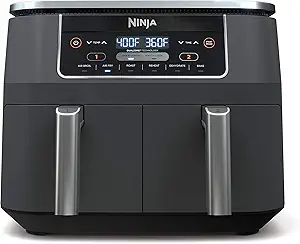
Form Factor and Dual-Zone Capabilities: Ninja pioneered the dual-zone independent basket market with its Foodi DualZone series. These appliances feature separate heating elements and independent fans for each basket, coupled with "Smart Finish" technology that synchronizes different cooking times and temperatures so two disparate dishes conclude simultaneously. Gourmia has since entered the dual-basket arena, but their primary strength remains in their single-basket, large-capacity footprint (ranging from 6 to 8 quarts). Gourmia baskets frequently utilize French-door styles or wide-pan formats that accommodate flat surface cooking better than deeper, cylindrical baskets.
Materials, Non-Stick Coatings, and Build Integrity: Build quality is where the pricing disparity between the two brands is most tangible. Ninja uses heavy-duty, BPA-free plastics paired with ceramic-coated crisper plates and baskets, significantly reducing the risk of PTFE degradation over years of thermal cycling. Gourmia units, while visually modern with brushed stainless steel accents, rely more extensively on lightweight plastics and traditional PTFE non-stick coatings. While Gourmia's surfaces are initially very slick and easy to clean, they generally show wear and flaking sooner under aggressive washing routines than Ninja's ceramic coatings.
Pros & Cons Comparison
Ninja Air Fryers
- Pro: Superior thermal velocity with heat ceilings reaching up to 450°F for faster, deeper crisping.
- Pro: Advanced dual-zone synchronization algorithms (Smart Finish and Match Cook).
- Pro: Premium non-stick ceramic coatings free of PTFE, PFOA, and heavy metals.
- Pro: Exceptional build durability designed for frequent, high-heat multi-year usage.
- Con: Considerably higher price point across virtually all comparable capacity tiers.
- Con: Appliances tend to have larger, heavier footprints that occupy significant counter space.
- Con: Higher fan speeds generate noticeably louder operational decibel levels.
Gourmia Air Fryers
- Pro: Unmatched value proposition, frequently offering large capacities at a fraction of Ninja's price.
- Pro: Sleek, modern digital interfaces featuring one-touch intuitive guided cooking prompts.
- Pro: Large, single-basket viewing windows are integrated into many baseline models.
- Pro: Quieter general operation during active convection cycles.
- Con: Lower maximum operating temperatures (typically capped at 400°F).
- Con: Standard PTFE non-stick coatings are more vulnerable to scratching and long-term degradation.
- Con: Inconsistent heat distribution when cooking at maximum volumetric capacity.
Performance, Durability & Value Analysis
From a raw culinary performance metric, Ninja consistently demonstrates measurable advantages in speed, heat retention, and texture optimization. In side-by-side testing of dense proteins, frozen foods, and hand-cut root vegetables, Ninja units reach baseline preheat temperatures in roughly half the time of equivalent Gourmia models. Furthermore, the combination of Ninja's ceramic crisper trays and high-CFM (cubic feet per minute) airflow creates a Maillard reaction that mimics deep frying more convincingly than Gourmia. Gourmia still produces satisfactory, evenly cooked results, but users will find that foods require longer cook times and more frequent manual basket shaking to achieve uniform crispness.
From an economic and longevity perspective, the value equation depends entirely on usage frequency. Gourmia offers an almost unbeatable entry cost, frequently pricing 7-quart digital units under the $80 mark. For weekend cooks, college apartments, or small families trying convection cooking for the first time, Gourmia provides astonishing utility for the money. However, Ninja represents the superior long-term investment for daily users. The robust heating coils, heavy-gauge plastics, higher-grade mechanical components, and resilient ceramic non-stick coatings mean a Ninja air fryer typically endures years of daily wear without loss of structural or thermal integrity, effectively lowering its true cost-per-use over time.
Final Verdict: Which Brand Should You Choose?
The choice between Ninja and Gourmia fundamentally comes down to your budget constraints, how often you cook, and the specific culinary techniques you intend to execute.
Choose Ninja if: You cook at home daily, prioritize multi-course meals, and require high-heat versatility. Ninja is the correct choice if you want to eliminate multiple appliances by investing in a true multi-cooker, value dual-basket independent synchronization, or are cautious about non-stick coatings and prefer heavy-duty, PTFE-free ceramic surfaces. It is an investment for the serious home cook who demands professional-grade browning and long-term durability.
Choose Gourmia if: Your primary buying factor is value-for-capacity. Gourmia is the ideal selection for budget-conscious buyers, casual home cooks who use an air fryer a few times a week for basic reheating and quick meals, or those with large families who need a wide single-basket footprint without breaking the bank. Gourmia delivers 85% of the culinary utility of premium brands at roughly 40% to 50% of the cost, making it the undisputed champion of the budget air fryer segment.
Features
When evaluating the feature ecosystem of air fryers, Ninja positions itself as an engineering-driven powerhouse centered on specialized multifunctionality and thermal precision. Ninja’s flagship innovations, such as its DualZone technology with Smart Finish (which synchronizes cooking times across two independent baskets) and integrated Foodi Smart Thermometer probes, elevate it above entry-level appliances. Mechanically, Ninja units feature robust, high-velocity convection fans and wide, highly accurate temperature spans—typically ranging from 105°F for gentle dehydrating up to 450°F for its proprietary Max Crisp technology. Additionally, Ninja utilizes superior proprietary ceramic nonstick coatings that are inherently PTFE- and PFOA-free, providing both health-conscious durability and elevated heat transfer. While these feature sets result in an intuitive, high-performance cooking experience, they also command a premium price point and demand significant kitchen counter real estate.
Conversely, Gourmia approaches features through the lens of mainstream accessibility, smart-kitchen convenience, and turnkey usability. Rather than focusing on proprietary multi-cooker engineering, Gourmia integrates broad convenience features into budget-friendly footprints. The brand stands out for its high-contrast, guided-cooking touch interfaces that provide clear visual prompts such as "Add Food" and "Turn Food," which demystify the air-frying process for novice cooks. Gourmia also aggressively incorporates modern connectivity, offering Wi-Fi-enabled models compatible with dedicated smartphone apps, Google Assistant, and Amazon Alexa—a feature tier Ninja largely reserves for its ultra-premium smart ovens. Gourmia complements this with FryForce 360° airflow technology and an extensive array of one-touch presets for specific culinary staples, maximizing automated convenience right out of the box.
The practical trade-off between the two brands centers on advanced thermal capability versus guided automation and value. Ninja excels in raw technical features that appeal to culinary enthusiasts: hyper-precise temperature regulation, true multi-zone flexibility, specialized moisture-retention modes, and premium non-toxic basket materials that withstand high-heat cycles without degradation. Gourmia, while offering competitive airflow dynamics and modern smart-home integration, relies on standard non-stick basket coatings and broader temperature bands with slightly less heating consistency across dense loads. Consumers seeking cutting-edge culinary versatility, multi-zone synchronization, and long-term mechanical reliability will find Ninja’s feature suite superior, whereas those prioritizing digital convenience, one-touch guided presets, and smart connectivity on a budget will benefit from Gourmia’s practical feature distribution.
Performance
When evaluating performance, Ninja air fryers generally outperform the competition through superior heating precision and thermodynamic efficiency. Ninja relies on advanced cyclonic air technology, robust heating coils, and industrial-grade high-velocity convection fans that minimize hot spots and significantly shorten preheat cycles. The brand’s flagships, such as the Foodi and DoubleStack series, reliably sustain temperatures up to 450°F (with specialized Max Crisp modes), allowing for rapid exterior Maillard browning while locking in internal moisture. This thermal capacity ensures that dense batches of proteins or frozen foods crisp evenly without stewing in their own vapors. Furthermore, Ninja’s dual-zone models utilize intelligent dual-fan systems that modulate power dynamically, ensuring that separate compartments maintain precise, independent thermal profiles even when running distinct cooking modes simultaneously.
Gourmia approaches performance with a focus on accessible, value-engineered efficiency, leveraging its proprietary FryForce 360° Technology to circulate superheated air. In routine cooking applications—such as reheating leftovers, cooking French fries, or roasting vegetables—Gourmia delivers commendable results that rival premium competitors. However, practical trade-offs emerge under heavy kitchen demands; Gourmia units typically top out at 400°F and feature less powerful blower motors, which translates to marginally longer cooking times and less aggressive crisping on high-moisture proteins. While Gourmia's automated shake reminders and preheat alerts optimize user interaction to mitigate uneven cooking, its single-zone thermal recovery drops more noticeably when the basket is loaded to capacity compared to Ninja's heavy-duty thermal retention.
The performance divide between the two brands ultimately hinges on consistency versus economic utility. Ninja provides commercial-grade thermal velocity, wider temperature ranges, and exceptional dehydrating and broiling capabilities, making it the superior engineering choice for culinary enthusiasts who demand blistering heat and rapid cycle times. Conversely, Gourmia maximizes everyday utility with reliable, intuitive baseline performance that satisfies standard residential needs without the premium price tag. While Gourmia capably achieves the core promise of air frying, Ninja’s thermal stability, rapid moisture evacuation, and raw heating power offer a noticeable competitive edge in texture, speed, and versatility.
Design
From an engineering and aesthetic standpoint, Ninja and Gourmia approach air fryer design with distinctly different philosophies, reflecting their respective market positioning. Ninja focuses heavily on functional, industrial-grade engineering characterized by heavy-duty matte plastics, brushed metal accents, and robust mechanical tolerances. Their designs are built for long-term physical resilience, often prioritizing specialized cooking mechanisms such as the dual-zone independent heating systems found in the Foodi series. In contrast, Gourmia leans toward a sleek, modern, and tech-forward presentation that punches above its price class. Gourmia air fryers typically feature high-gloss finishes and expansive, seamless glass-style capacitive touchscreens that often integrate directly into the appliance’s top panel or front door, offering a streamlined countertop footprint that mimics high-end European small appliances.
When examining technical ergonomics and user-interface architecture, the practical trade-offs between the two brands become pronounced. Ninja relies heavily on dedicated, tactile push-buttons alongside localized digital displays; this design choice ensures immediate tactile feedback and reduced menu diving, making adjustments to temperature and time during high-heat operation effortless. Furthermore, Ninja's basket engineering is exceptional, offering superior non-stick ceramic coatings, robust handles with minimal thermal transfer, and precision-fitted crisper plates that remain firmly seated during food tossing. Gourmia’s design, while visually cleaner due to its all-digital interfaces and guided one-touch cooking presets, can sometimes suffer from lower-tactility membrane controls that are prone to fingerprint smudging and can occasionally be temperamental when handled with wet or greasy hands.
Ultimately, the design divergence comes down to utility-first durability versus modern, cost-efficient elegance. Ninja’s higher-profile physical architecture typically commands more vertical and horizontal counter clearance, but it compensates with superior internal airflow geometry and structural thermal insulation that keeps outer housings cooler to the touch. Gourmia succeeds by engineering hyper-efficient internal volume-to-footprint ratios—frequently outperforming Ninja in total basket capacity relative to the appliance's exterior dimensions—and often incorporating convenient visual features like interior viewing windows and internal lights. For consumers, Ninja offers a design engineered for intensive, heavy-use longevity and precise physical control, whereas Gourmia provides an ultra-contemporary, intuitive layout optimized for spatial efficiency and modern kitchen integration.