Ninja vs Cuisinart: Overview
Comparing Ninja and Cuisinart helps you determine which brand is best suited for your needs in Air Fryers. Both brands offer strong choices depending on your budget and key feature requirements.
Key Features & Comparison
Evaluate factors such as build quality, warranty, customer satisfaction, and total value before making your final purchase choice between Ninja and Cuisinart.
Features
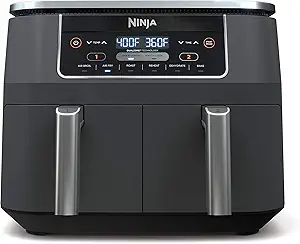
Feature sets between the two brands reveal fundamental differences in user interaction and programming philosophy. Ninja equips its appliances with advanced digital microcontrollers, offering dedicated pre-programmed routines such as Max Crisp, Air Roast, Dehydrate, and Air Broil. The brand's DualZone technology—featuring independent heating elements and fans across two separate baskets—stands out mechanically, enabling users to synchronize different cooking times and temperatures via features like Smart Finish and Match Cook. Furthermore, modern Ninja units frequently incorporate integrated smart thermometers that monitor internal food temperatures continuously, automatically stopping the cook cycle when precise doneness is achieved.
Cuisinart takes an approach that favors analog precision and continuous mechanical control, though digital iterations have joined their roster. Cuisinart models frequently utilize heavy-duty rotary dials to adjust temperature, function, and mechanical timers independently, reducing points of electronic failure and delivering immediate tactile feedback. Rather than relying on rigid digital presets, Cuisinart provides expansive internal layouts featuring multiple rack positions, dedicated oven lights, and specialized wire-mesh air frying baskets that sit over drip trays. While Ninja excels in automated convenience and zone isolation, Cuisinart delivers superior feature parity with traditional full-sized ranges, including specialized settings for low-temperature proofing, bagel browning, and dual-direction convection airflow.
Performance
In terms of pure air frying mechanics, Ninja typically outperforms Cuisinart regarding air velocity and localized moisture evacuation. Ninja’s cylindrical chambers and tightly ducted fan systems generate an intense cyclonic vortex of superheated air, reaching temperatures up to 450°F quickly. This concentrated airflow rapidly renders subcutaneous fat and strips surface moisture from proteins and starches, producing an exceptionally uniform, shatteringly crisp exterior with minimal added oil. Thermal recovery times after opening the basket are exceptionally brief, ensuring that the cooking environment maintains thermal equilibrium even during frequent agitation of ingredients.
Cuisinart’s performance shines through balanced, ambient convection and expansive surface-area exposure rather than ultra-high-speed turbulent air. Because Cuisinart units feature larger horizontal footprints, food can be arranged in a single, non-overlapping layer across a wide wire basket, mitigating the uneven steaming that can occur in crowded vertical baskets. While Cuisinart may require a slightly longer preheat cycle and can produce subtle hot spots near the perimeter heating rods, it excels in delicate baking and roasting where Ninja’s aggressive fan might dry out interior crumb structures or shift lighter batters. For pure speed and deep-fried emulation, Ninja takes the lead, but Cuisinart delivers superior thermal gentleness and wide-surface caramelization.
Design
Architecturally and aesthetically, Ninja and Cuisinart occupy opposite ends of contemporary kitchen design. Ninja predominantly employs dark, high-impact polymers accented with brushed metallic trim, creating a decidedly modern, tech-forward presence. The engineering focuses on high-density insulation around self-contained slide-out baskets, minimizing exterior chassis heat while maximizing interior thermal retention. These baskets are almost universally coated in high-grade, PTFE/PFOA-free non-stick ceramic surfaces, engineered for effortless release and high-cycle dishwasher resilience, though the vertical footprint demands significant under-cabinet clearance during extraction.
Conversely, Cuisinart adheres to a professional, commercial-kitchen aesthetic characterized by seamless brushed stainless steel exteriors, classic analog control clusters, and wide-view tempered glass oven doors. This horizontal form factor allows users to monitor the culinary progression without venting heat, a distinct advantage over Ninja's opaque basket design. However, the trade-off lies in thermal dissipation and cleaning maintenance; Cuisinart’s single-walled metal construction radiates substantial exterior heat to surrounding surfaces during operation. Additionally, maintaining Cuisinart’s bare stainless steel interior and wire mesh baskets requires significantly more manual scrubbing compared to Ninja’s slick, ceramic non-stick components.