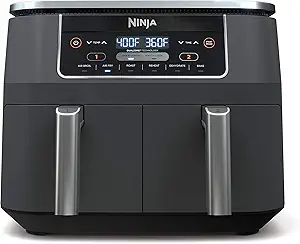
Ninja vs Chefman: Overview
Comparing Ninja and Chefman helps you determine which brand is best suited for your needs in Air Fryers. Both brands offer strong choices depending on your budget and key feature requirements.
Key Features & Comparison
Evaluate factors such as build quality, warranty, customer satisfaction, and total value before making your final purchase choice between Ninja and Chefman.
Features
Ninja sets a rigorous benchmark in feature sets by incorporating proprietary multi-functional technologies across its air fryer lineup. Flagship innovations like the DualZone system feature two independently controlled cooking baskets equipped with 'Smart Finish'—a software synchronization that ensures two distinct foods with different temperatures and cooking times finish simultaneously—and 'Match Cook' to duplicate settings across zones. Beyond standard air frying, Ninja units routinely integrate high-end capabilities such as specialized Max Crisp technology (reaching up to 450°F), accurate low-temperature dehydration, roasting, broiling, and air-reheating. The interface architecture is tailored for granular parameter adjustments, offering precise digital timing and thermal micro-adjustments that cater to precision cooking.
Chefman counters with practical, consumer-friendly feature integration tailored primarily to everyday convenience and straightforward volume cooking. Many of Chefman’s popular models highlight viewing windows paired with internal illumination, allowing cooks to visually track the Maillard reaction without breaking the convective thermal seal by opening the basket. In addition, Chefman excels in offering oversized, multi-tier air fryer toaster oven combos featuring rotisserie spits, dehydration racks, and French-door access systems. While Chefman’s digital presets cover broad staples like fries, poultry, and meat, they generally lack the complex micro-controller software sync capabilities and specialized high-heat thresholds engineered into Ninja’s feature suite.
Performance
From a technical standpoint, Ninja demonstrates a marked superiority in thermal stability, air velocity, and convective heat transfer. Ninja’s high-power heating elements—often operating between 1600W and 1800W—pair with aerodynamically optimized fan blades to generate a rapid cyclonic vortex. This high air velocity accelerates moisture evaporation on food surfaces, producing a uniformly crisp exterior while maintaining core succulence. Furthermore, Ninja’s thermal recovery time after opening the basket is exceptionally rapid, preventing the heat-soak lag that can lead to uneven, soggy results. Whether dealing with frozen breaded items or raw proteins, Ninja’s calibrated airflow achieves consistent, repeatable browning with minimal oil dependency.
Chefman delivers respectable cooking performance for everyday items, but it encounters mechanical limitations when handling dense batches or demanding culinary processes. While Chefman units reach target temperatures quickly due to their compact internal volumes, the airflow distribution is frequently more localized, which can create distinct hotspots closer to the heating coil. Consequently, users often need to shake or rotate foods more frequently throughout the cooking cycle to avoid uneven browning. Additionally, Chefman’s heating systems experience a steeper thermal drop and slower recovery curve when the chamber is loaded to maximum capacity, resulting in slightly longer cooking times and less aggressive crisping compared to Ninja’s high-velocity convection output.
Design
In terms of industrial design and structural execution, Ninja embraces a utilitarian, durable aesthetic dominated by heavy-gauge, heat-resistant polymers, brushed stainless accents, and intuitive, membrane-sealed control panels. The basket architecture is particularly noteworthy: Ninja generally employs a PFAS-free, ceramic-coated crisper plate system that significantly outperforms traditional chemical nonstick layers in both abrasion resistance and toxicological safety under high heat. Ergonomically, the handles are reinforced, the basket glide mechanisms lock securely without wobbling, and the footprint is engineered to maximize internal horizontal cooking surface area rather than deep vertical stacking, which promotes better exposure to convective air.
Chefman leans toward modern, minimalist countertop aesthetics, often integrating glossy black shells, sleek touchscreens, and large tempered glass viewing portals that look upscale out of the box. However, the physical build reflects its budget-tier positioning through thinner outer chassis plastics, lighter gauge metals on internal walls, and handles that feel less substantial during heavy use. Chefman’s nonstick coatings, typically standard PTFE-based solutions, are more susceptible to wear, scratching, and degradation over extended dishwashing cycles compared to Ninja’s ceramic alternatives. Nonetheless, Chefman's spatial design in its toaster oven and vertical air fryer formats is well-optimized for consumers seeking maximum internal volume within a compact countertop footprint.