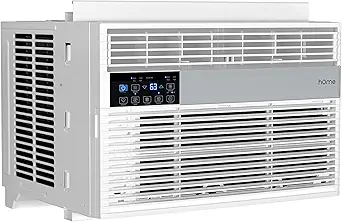
Midea vs Homelabs: Overview
Comparing Midea and Homelabs helps you determine which brand is best suited for your needs in Air Conditioners. Both brands offer strong choices depending on your budget and key feature requirements.
Key Features & Comparison
Evaluate factors such as build quality, warranty, customer satisfaction, and total value before making your final purchase choice between Midea and Homelabs.
Customer Support & Warranty
When evaluating customer service infrastructure and warranty coverage, Midea leverages its massive scale as a global manufacturing giant, whereas hOmeLabs approaches consumer support with the agility typical of a modern, direct-to-consumer boutique brand. Midea typically provides a standard one-year limited warranty across its residential portfolio, though select flagship models equipped with inverter technology may feature extended coverage on the compressor for up to five or ten years depending on regional retail terms. However, navigating Midea's customer service pipeline can sometimes prove bureaucratic and sluggish; warranty fulfillment frequently relies on localized authorized repair centers, which can introduce delays in diagnostic turnaround times and replacement part logistics during peak summer months.
Conversely, hOmeLabs operates with a North American customer-centric ethos, frequently offering a standard two-year warranty when products are registered directly through their platform, effectively doubling the initial protection offered by many legacy competitors. Their support model prioritizes digital ticketing, live chat, and direct replacements rather than dispatching field technicians for complex repairs, which translates to faster resolution times for defective portable or window units. The trade-off lies in long-term serviceability; hOmeLabs does not maintain the deep reservoir of technical component supply chains that Midea possesses, meaning out-of-warranty failures are often harder to repair at the component level, rendering end-of-life units less serviceable compared to Midea's widely documented hardware.
Energy Efficiency
In the domain of energy conservation, Midea holds a decisive engineering advantage through its proprietary variable-speed inverter compressors and cutting-edge aerodynamic air channel designs. Exemplified by its innovative U-shaped window air conditioners, Midea units regularly achieve exceptional Combined Energy Efficiency Ratios (CEER) exceeding 15.0, comfortably surpassing the baseline criteria for Energy Star Most Efficient recognition. By allowing the compressor to modulate its rotational speed dynamically rather than constantly cycling on and off at full load, Midea dramatically reduces both inrush current and aggregate kilowatt-hour consumption, resulting in tangible cost reductions on monthly utility bills in regions subject to sustained thermal loads.
In contrast, hOmeLabs predominantly engineers units using conventional fixed-speed, rotary compressors designed to provide reliable cooling at accessible price points. While their modern window and portable units routinely meet baseline Energy Star requirements with respectable CEER figures hovering around 11.0 to 12.0, they inherently lack the thermal modulation efficiency native to inverter-driven systems. The frequent start-stop duty cycles of hOmeLabs compressors induce higher cumulative power draw during moderate ambient conditions where partial-capacity operation would suffice. For budget-conscious buyers facing brief, intermittent hot spells, hOmeLabs provides adequate operational thrift, but Midea represents the superior long-term investment for continuous, high-efficiency thermal management.
Noise Level
Acoustic performance represents one of the starkest technical differentiators between these two manufacturers, largely driven by architectural design choices. Midea has fundamentally reshaped window air conditioner acoustics with its patented U-shaped form factor, which effectively isolates the noisy compressor outside the window pane while allowing the sash to close securely in the channel between the mechanical and airflow sections. When paired with variable-speed DC inverter motors and ultra-quiet tangential blowers, Midea units can operate at decibel levels as low as 32 to 42 dBA on their lowest operational tiers, making them virtually imperceptible in master bedrooms, home offices, and noise-sensitive study spaces.
On the other hand, hOmeLabs employs a traditional consolidated monobloc chassis across its window and portable configurations, housing both the condenser and evaporator compartments inside a contiguous casing. Even with internal acoustic insulation and balanced blower wheels, operational sound profiles typically fluctuate between 50 and 56 dBA during standard active cooling phases. While hOmeLabs engineers their mechanical resonance to produce a consistent, smooth white-noise profile devoid of high-pitched whines or abrupt chassis rattling, the mechanical hum and vibrational transfer through window frames remain markedly more noticeable than Midea's acoustically decoupled architecture.
Cooling Performance
Thermal drawdown capability and airflow dispersion are foundational metrics where both brands demonstrate competent, albeit mechanically distinct, operational paradigms. Midea benefits from proprietary fluid dynamics modeling and advanced micro-channel heat exchangers, enabling high CFM (cubic feet per minute) output paired with intelligent, wide-angle oscillating louvers. Because its inverter systems can ramp up beyond nominal capacity to achieve rapid initial thermal pulldown before stabilizing, Midea systems excel at eliminating indoor thermal stratification quickly, delivering uniform room temperatures even when outdoor ambient heat indices climb into extreme triple-digit territory.
hOmeLabs takes a more straightforward, high-torque approach to thermal management, producing robust, direct cooling power driven by proven rotary compressor dynamics. Their window and portable units deliver intense, rapid localized cooling bursts that are particularly effective at dropping temperatures in open-plan spaces, small studio apartments, and rooms with high heat gain from poorly insulated windows. However, the fixed-speed design means the unit cools rapidly until the setpoint is reached and then shuts off, leading to minor cyclical temperature swings of two to three degrees between cycles. While hOmeLabs yields vigorous and dependable thermal extraction, Midea achieves superior steady-state climate precision and superior long-duration comfort.
Compare current retail pricing, active promotions, and verified stock availability directly from authorized stores: