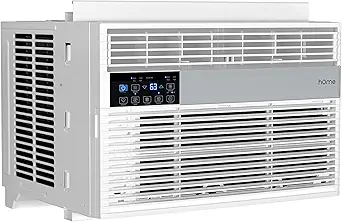





Homelabs vs Rheem: Overview
Comparing Homelabs and Rheem helps you determine which brand is best suited for your needs in Air Conditioners. Both brands offer strong choices depending on your budget and key feature requirements.
Key Features & Comparison
Evaluate factors such as build quality, warranty, customer satisfaction, and total value before making your final purchase choice between Homelabs and Rheem.
Customer Support & Warranty
When comparing warranty structures and customer service, hOmeLabs and Rheem operate in entirely different tiers of the HVAC and consumer appliance industries. hOmeLabs, specializing primarily in portable and compact window units, provides a standard consumer-electronics warranty, typically spanning one to two years with limited component coverage. Their customer support pipeline is predominantly digital, relying heavily on self-service portals, email tickets, and web chat. While this approach facilitates quick troubleshooting and hassle-free warranty replacements for small-scale defects, it often lacks the technical depth needed for complex diagnostic procedures. Consumers generally find hOmeLabs responsive for out-of-the-box failures, but long-term support for individual replacement parts is minimal once the limited warranty period expires.
In contrast, Rheem offers a commercial-grade, professional support ecosystem built around whole-home split systems, packaged units, and high-capacity ductless systems. Rheem typically protects its equipment with a robust 10-year limited parts warranty, often including conditional unit replacement warranties on premium compressor models when registered properly. Service and support are delivered through an extensive network of licensed HVAC technicians, distributors, and certified contractors. This infrastructure ensures that troubleshooting, part replacements, and complex repairs are handled by certified professionals. The trade-off is the reliance on third-party contractor availability and installation quality, but the resulting warranty longevity and technical backing far exceed the transient nature of hOmeLabs' consumer-tier service model.
Energy Efficiency
Energy efficiency highlights a stark architectural divide between hOmeLabs' focus on localized, supplemental cooling and Rheem's engineering for comprehensive, high-SEER2 climate control. hOmeLabs produces Energy Star-certified window and portable units that emphasize low amperage draw and smart scheduling features to minimize immediate electrical consumption. Utilizing standard rotary compressors and modest CEER (Combined Energy Efficiency Ratio) ratings, typically ranging between 10.0 and 12.0, hOmeLabs units are effective at curbing energy waste in single-room applications. However, their reliance on fixed-speed or basic cycle algorithms limits their seasonal optimization, resulting in efficiency losses when fluctuating ambient temperatures demand variable cooling capacity.
Rheem, by comparison, leverages cutting-edge thermal engineering to achieve industry-leading seasonal efficiency metrics, with high-end central and inverter-driven mini-split systems reaching SEER2 ratings well above 20 and EER2 ratings exceeding 13. Utilizing variable-speed Copeland scroll compressors and advanced EcoNet smart technology, Rheem systems modulate output in precise, continuous increments rather than engaging in power-hungry on/off cycling. Additionally, Rheem features optimized microchannel condenser coils and aerodynamically refined fan blades that maximize heat rejection while minimizing electrical overhead. While a Rheem system involves a significantly higher initial investment, its thermodynamic efficiency and dynamic load adjustment deliver exponentially greater long-term energy savings across large residential footprints compared to hOmeLabs' plug-and-play models.
Noise Level
Acoustic performance is a crucial differentiator between these two brands, governed primarily by mechanical design and compressor placement. hOmeLabs units, by their nature as self-contained portable or window-mounted appliances, place the compressor, blower motor, and condenser fan directly within or immediately adjacent to the living space. Although hOmeLabs engineers their units with vibration-dampening grommets and sleep-mode fan profiles to keep sound levels around 50 to 55 decibels (dBA) on low settings, the proximity of the rotary compressor generates an unavoidable hum and noticeable mechanical click during cycling. For light sleepers or dedicated quiet spaces, this acoustic footprint can be an intrusive presence.
Rheem achieves an exceptionally quiet indoor environment by isolating the major sources of acoustic disruption outside the home. Rheem's outdoor condensing units are engineered with swept-wing fan designs, composite sound-dampening bases, and insulated compressor blankets, allowing outdoor noise levels to drop as low as 55 to 60 dBA. Indoors, high-efficiency Rheem air handlers and mini-split indoor heads operate with variable-speed ECM blowers that can glide along at sound levels as low as 19 to 25 dBA, which is virtually imperceptible to the human ear. For homeowners prioritizing acoustic serenity throughout their entire residence, Rheem's split-system architecture holds a definitive engineering advantage over hOmeLabs' all-in-one indoor designs.
Cooling Performance
In evaluating raw cooling performance, sensible heat extraction, and latent heat (humidity) removal, hOmeLabs designs units intended for rapid, point-of-use thermal relief. Ranging from 5,000 to roughly 14,000 BTU, hOmeLabs air conditioners excel at localized convection, quickly dropping temperatures in closed spaces up to 500 square feet. Their straightforward directional louvers and high-velocity blower wheels deliver immediate directional cooling. However, because they rely primarily on single-speed refrigeration cycles and basic thermal sensors, hOmeLabs units often struggle with temperature stratification, leaving hot spots in irregular room geometries and exhibiting limited dehumidification capacity during prolonged periods of extreme ambient heat.
Rheem, conversely, delivers high-tonnage, precisely calculated thermal management designed to maintain stable thermal comfort throughout an entire structure. Ranging from 1.5 to 5 tons (18,000 to 60,000 BTU), Rheem systems employ electronic expansion valves (EEVs) and variable-capacity cooling to precisely match the home's instantaneous cooling load. This continuous, modulated operation excels at deep moisture extraction, keeping indoor relative humidity at optimal levels without overcooling the air. Furthermore, when integrated into a properly balanced duct network or multi-zone mini-split setup, Rheem eliminates temperature disparities entirely, maintaining rigorous, uniform temperature setpoints across dynamic weather fluctuations and intense external heat loads that would completely overwhelm a localized hOmeLabs appliance.