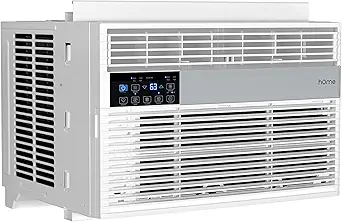
Hisense vs Homelabs: Overview
Comparing Hisense and Homelabs helps you determine which brand is best suited for your needs in Air Conditioners. Both brands offer strong choices depending on your budget and key feature requirements.
Key Features & Comparison
Evaluate factors such as build quality, warranty, customer satisfaction, and total value before making your final purchase choice between Hisense and Homelabs.
Customer Support & Warranty
When evaluating post-purchase reliability, Hisense operates with the substantial infrastructure of a global electronics conglomerate, providing standard one-year limited warranties that frequently extend to two or more years on the compressor circuit for select models. Customer service is routed through centralized call centers, an integrated web portal, and authorized third-party service technician networks across North America. However, because of the sprawling corporate hierarchy, consumers may occasionally experience bureaucratic bottlenecks, prolonged turnaround times for replacement parts, or mixed technical aptitude when troubleshooting specific appliance-level issues.
hOmeLabs, conversely, functions primarily as a direct-to-consumer and e-commerce-centric brand, which translates into a notably more agile and personalized customer support experience. They typically offer a straightforward one-year warranty, often bolstered by an additional six-month extension simply upon registering the product online. While hOmeLabs lacks the sprawling brick-and-mortar repair network of Hisense, their digital help desk, email responsiveness, and no-hassle unit replacement policies are frequently lauded by buyers who prefer swift resolution over navigating protracted warranty claim workflows.
Energy Efficiency
In the realm of power consumption, Hisense holds an engineering edge due to its heavy investment in variable-speed inverter technology. Many of Hisense’s window and portable units boast Energy Star certification with exceptionally high Combined Energy Efficiency Ratios (CEER), sometimes exceeding 12.0 or 15.0 on advanced inverter models. By modulating compressor speed rather than utilizing abrupt start-stop cycles, Hisense units draw less continuous wattage, lower thermodynamic stress on the electrical grid, and significantly diminish long-term utility costs for frequent or multi-room users.
hOmeLabs designs its air conditioners around pragmatic, budget-conscious consumers, primarily utilizing standard rotary compressors that adhere to baseline modern efficiency metrics. While a significant portion of their window line carries Energy Star ratings, their portable and standard window units tend to feature standard CEER numbers hovering between 10.0 and 11.0. hOmeLabs incorporates helpful efficiency modes, such as intelligent Eco modes and 24-hour programmable timers, but the lack of proprietary variable-capacity inverter components means they consume comparatively more power during sustained, high-heat summer operations.
Noise Level
Acoustic performance heavily relies on internal chassis isolation and motor dynamics, where Hisense's dual-inverter designs and cross-flow fans clearly shine. In their premium and quiet-series lineups, Hisense manages to keep operational sound as low as 38 to 44 decibels (dBA) on low settings, which rivals quiet indoor conversation or a library atmosphere. The suppression of high-frequency motor whine and smooth transitions during cooling demand changes make Hisense models exceptionally well-suited for bedrooms, nurseries, and focused home office environments.
hOmeLabs models register slightly higher on the acoustic spectrum, typically producing sound levels between 50 and 55 dBA on low fan speeds and reaching up to 58 dBA on high. The noise profile is characterized by a steady, consistent white noise produced by the traditional compressor engagement and robust blower wheel. While this constant hum is often unobtrusive and even preferred by light sleepers seeking acoustic masking, it lacks the ultra-silent dampening and whisper-quiet performance engineered into Hisense’s specialized low-noise product lines.
Cooling Performance
Cooling performance reveals distinct thermodynamic behaviors between the two brands. Hisense delivers a robust dynamic range, offering air conditioners spanning from compact 5,000 BTU window units to heavy-duty 14,000 BTU dual-hose portable systems capable of handling substantial thermal loads. Because Hisense incorporates multi-directional motorized louvers and rapid-cool algorithms, the units circulate air swiftly, stripping latent heat and humidity from large square footages quickly and maintaining tight temperature bands with minimal thermal drift.
hOmeLabs focuses on dependable, straightforward mechanical cooling designed to punch above its weight in small-to-medium residential spaces. Their BTU configurations are optimized for standard room dimensions (typically 150 to 450 square feet), prioritizing strong airflow velocity and aggressive dehumidification. Although hOmeLabs units may exhibit a slightly wider temperature hysteresis due to traditional on/off compressor cycling, they excel at delivering an immediate, sustained burst of cold air that rapidly stabilizes room temperatures, making them highly effective for everyday seasonal cooling.
Compare current retail pricing, active promotions, and verified stock availability directly from authorized stores: