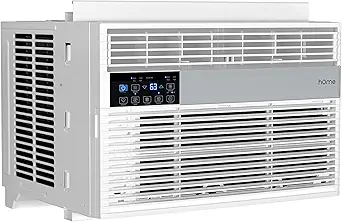
GE vs Homelabs: Overview
Comparing GE and Homelabs helps you determine which brand is best suited for your needs in Air Conditioners. Both brands offer strong choices depending on your budget and key feature requirements.
Key Features & Comparison
Evaluate factors such as build quality, warranty, customer satisfaction, and total value before making your final purchase choice between GE and Homelabs.
Customer Support & Warranty
GE establishes a formidable advantage in customer support and warranty infrastructure, leaning heavily on its century-old manufacturing legacy and extensive domestic service network. Most GE residential air conditioners come backed by a limited one-year warranty covering both parts and labor, with select premium or inverter-driven models offering extended coverage on the sealed refrigeration system. What truly sets GE apart is its dedicated factory service fleet, "GE Appliances Factory Service," which provides access to trained technicians, widely cataloged OEM replacement parts, and structured troubleshooting channels via phone, chat, and digital scheduling. This widespread footprint minimizes downtime in the event of component failure and provides enterprise-level accountability that protects the consumer's investment over several seasons.
In contrast, hOmeLabs operates as a modern direct-to-consumer appliance brand that manages customer relations primarily through decentralized, digital-first support infrastructure. hOmeLabs typically matches the industry-standard one-year limited warranty, but frequently offers an additional six-month warranty extension upon product registration on their website. While their support team is generally responsive via email and online ticketing for returns or direct replacements, hOmeLabs lacks a proprietary network of field technicians. Consequently, mechanical or refrigeration failures under warranty are typically resolved via unit replacements rather than component-level repairs. For minor issues beyond the warranty window, sourcing bespoke replacement parts can prove more challenging than with GE, making hOmeLabs better suited for consumers who prioritize streamlined digital support over traditional hands-on technical service.
Energy Efficiency
When evaluating energy efficiency, GE leverages cutting-edge thermal engineering and broad Energy Star certification across its diverse catalog of window, portable, and through-the-wall units. GE has aggressively adopted electronic variable-speed inverter technology in its modern lineups, allowing compressors to modulate output dynamically rather than cycling abruptly on and off. This sophisticated motor design yields exceptional Combined Energy Efficiency Ratios (CEER), often exceeding 12.0 to 15.0 in inverter-equipped window units. Furthermore, GE integrates its proprietary SmartHQ platform, granting users granular power consumption monitoring, predictive scheduling, and integration with home automation ecosystems to curtail phantom draw and optimize seasonal utility expenditures.
hOmeLabs approaches energy efficiency with an emphasis on cost-effective, pragmatic operation, utilizing optimized rotary compressors that comply with Department of Energy standards. While select hOmeLabs models achieve Energy Star ratings, the brand predominantly relies on traditional fixed-speed single-stage compressors paired with standard digital thermostats and basic Eco/Energy Saver modes. These units operate on standard duty cycles—shutting off fans and compressors once ambient targets are met—which inherently consumes more aggregate wattage during peak heat loads than variable-frequency drives. For budget-conscious purchasers or moderate climate zones, hOmeLabs offers adequate thermal-to-power parity, but it yields lower overall seasonal efficiency benchmarks compared to GE's advanced inverter-driven units.
Noise Level
Acoustic performance is an area where GE's mechanical design demonstrates clear refinement, particularly within its ultra-quiet and profile-series window and portable units. By employing variable-speed inverter compressors, dual-fan motor assemblies, and dense internal insulation, GE isolates vibrational resonance and smooths out the mechanical drone typical of residential AC units. Premium GE units are engineered to operate as low as 40 to 44 decibels (dBA) on low fan settings—equivalent to a quiet library. The gradual ramping up and down of the inverter motor prevents the abrupt, jarring acoustic spikes associated with standard compressor engagement, making GE models particularly well-suited for bedrooms, nurseries, and home offices where acoustic stability is paramount.
hOmeLabs air conditioners generally produce a louder, more conventional acoustic signature, typically registering between 50 and 58 dBA depending on the fan speed and chassis format. Because hOmeLabs relies largely on single-speed rotary compressors, the start-stop cycle introduces noticeable mechanical clicks and transient hums as the refrigeration cycle engages. While hOmeLabs incorporates well-balanced blower wheels and multi-speed fans that generate a relatively smooth, masking white noise on low settings, the lack of secondary acoustic dampening and variable compressor modulation means mechanical vibrations are more easily transferred through window sills and room environments. Users prioritizing whisper-quiet operation may find hOmeLabs slightly intrusive compared to GE's acoustically engineered units.
Cooling Performance
GE delivers top-tier cooling performance underpinned by high-capacity refrigeration systems, robust heat exchangers, and rapid airflow delivery. Ranging from compact 5,000 BTU units to heavy-duty 24,000 BTU models, GE's portfolio demonstrates superior sensible and latent heat removal, rapidly pulling moisture out of the air while driving ambient temperatures down. Units equipped with inverter compressors excel at maintaining a consistent room temperature within a tight half-degree tolerance, eliminating the uncomfortable temperature swings that plague standard units. Additionally, GE's motorized air louvers and multi-directional airflow systems provide extended room penetration, ensuring uniform thermal dissipation throughout medium and expansive open-concept living spaces.
hOmeLabs designs its cooling systems to prioritize rapid, punchy ambient pull-down across popular residential footprint sizes, typically focusing on the 5,000 to 14,000 BTU range for window and portable units. Their appliances feature robust high-velocity blowers and hydrophilic aluminum condenser fins that provide effective thermal transfer in localized zones. However, because their single-stage compressors run at full capacity until the thermostat cut-off threshold is reached, hOmeLabs units can occasionally overshoot target temperatures or leave slight residual humidity during brief cooling bursts, known as short-cycling in smaller spaces. Nevertheless, for standard square-footage bedrooms, apartments, or supplemental cooling scenarios, hOmeLabs delivers reliable, forceful chilling power at an accessible price point.
Compare current retail pricing, active promotions, and verified stock availability directly from authorized stores: