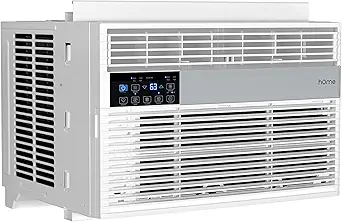
Amana vs Homelabs: Overview
Comparing Amana and Homelabs helps you determine which brand is best suited for your needs in Air Conditioners. Both brands offer strong choices depending on your budget and key feature requirements.
Key Features & Comparison
Evaluate factors such as build quality, warranty, customer satisfaction, and total value before making your final purchase choice between Amana and Homelabs.
Customer Support & Warranty
Amana approaches customer service and warranty with the backing of legacy appliance infrastructure, operating under the Daikin/Goodman manufacturing umbrella for its commercial PTAC units and licensed through major appliance channels for consumer window units. This setup yields a robust warranty profile, particularly on commercial-grade room air conditioners where Amana frequently offers up to a five-year limited warranty on the sealed refrigeration system and one-year comprehensive coverage on parts and labor. Their support infrastructure is deeply embedded in professional trade channels, meaning replacement components, technical schematics, and certified HVAC service technicians are widely accessible, though direct consumer support for budget window units can occasionally feel bureaucratic and slow.
In contrast, hOmeLabs functions as a modern, direct-to-consumer brand that prioritizes agile, digital-first customer engagement over traditional enterprise dealer networks. hOmeLabs typically backs its portable and compact window air conditioners with a standard two-year limited warranty—surpassing the entry-level one-year term common to basic retail models—with an additional six months often available upon product registration. While their online support, chat systems, and no-hassle return or replacement procedures are streamlined and user-friendly for everyday apartment dwellers, the brand lacks an extensive network of field technicians, usually opting to replace defective units entirely rather than dispatching component-level repairs.
Energy Efficiency
When evaluating energy efficiency, Amana concentrates heavily on engineering systems that satisfy rigorous commercial benchmarks and regional building energy codes. Many of Amana's consumer-facing and institutional units integrate advanced inverter compressors and smart thermostatic controls designed to maintain steady thermal regulation without repetitive high-amperage compressor cycles. Their premium window models frequently carry high Combined Energy Efficiency Ratios (CEER) exceeding 11.5 and boast Energy Star certification, utilizing eco-conscious refrigerants such as R-32 that exhibit lower global warming potential (GWP) and superior thermodynamic heat transfer properties compared to older formulations.
hOmeLabs prioritizes accessible efficiency tailored to intermittent household use, offering solid Energy Star-rated units across their window and portable lineups, though their technology relies predominantly on conventional single-speed rotary compressors. While hOmeLabs maximizes operational savings through features like Eco Mode—which shuts down both compressor and fan once target temperatures are achieved—and programmable 24-hour timers, their portable air conditioners face inherent thermodynamic efficiency penalties common to single-hose configurations. For buyers focused strictly on reducing long-term kilowatt-hour consumption during continuous summer use, Amana holds an engineering edge due to superior heat exchange coil design and modern variable-capacity integration.
Noise Level
Amana designs its air conditioning architecture with structural rigidity and acoustic dampening in mind, particularly since a large portion of its product catalog caters to hospitality environments where low decibel output is critical. By isolating compressor vibrations through heavy-duty rubber grommets, incorporating dense chassis insulation, and using dual-fan or cross-flow blower systems, Amana units effectively eliminate harsh mechanical rattling and compressor drone. On medium and low fan settings, higher-end Amana window units can maintain ambient operating sound levels around 42 to 49 decibels, presenting a smooth, white-noise profile that blends comfortably into bedroom and office settings.
hOmeLabs units are generally engineered to remain competitively quiet for everyday residential use, averaging between 50 and 55 decibels during standard compressor engagement. The brand accomplishes acceptable sound attenuation through streamlined plastic housing and aerodynamically shaped fan blades, making them unobtrusive in common living spaces. However, due to lighter-gauge chassis materials and the compact enclosure of their portable units—which place the compressor directly inside the living space—hOmeLabs models exhibit more noticeable operational humming and vibrational resonance during high-load cooling periods than structurally fortified Amana systems.
Cooling Performance
Cooling performance is an area where Amana's heavy-duty engineering philosophy is distinctly apparent, offering units that range from standard 5,000 BTU bedroom air conditioners to massive 24,000 BTU whole-room appliances. Amana leverages hydrophilic-coated aluminum fins, grooved copper tubing, and robust centrifugal blowers to maximize sensible and latent heat removal from high-humidity zones. This commercial-grade thermodynamic design allows Amana units to pull down ambient room temperatures rapidly and sustain targeted climate thresholds even when exterior ambient temperatures exceed 100 degrees Fahrenheit, demonstrating exceptional resilience against thermal overload.
hOmeLabs delivers reliable, targeted cooling performance that is well-matched to apartments, dorms, and single-room residential applications. Their units feature wide-angle motorized louvers that facilitate active air circulation, effectively preventing localized cold spots in small to mid-sized rooms ranging from 150 to 550 square feet. Nevertheless, hOmeLabs’ reliance on single-hose portable architectures and smaller-displacement compressors means their systems work harder to maintain set points under extreme heat spikes, making them best suited for standard residential duty cycles rather than severe commercial or sustained high-heat environments.
Compare current retail pricing, active promotions, and verified stock availability directly from authorized stores: