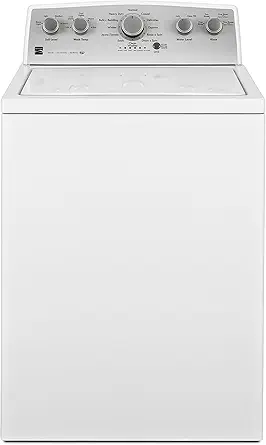
Speed Queen vs Kenmore: Overview
Comparing Speed Queen and Kenmore helps you determine which brand is best suited for your needs in Washing Machines. Both brands offer strong choices depending on your budget and key feature requirements.
Key Features & Comparison
Evaluate factors such as build quality, warranty, customer satisfaction, and total value before making your final purchase choice between Speed Queen and Kenmore.
Energy Efficiency
When assessing energy efficiency, Kenmore and Speed Queen approach laundry engineering from fundamentally opposing philosophies. Kenmore, which sources its modern appliance architecture predominantly from tier-one manufacturers like LG and Whirlpool, aggressively prioritizes utility reduction to satisfy rigorous Department of Energy (DOE) and ENERGY STAR criteria. Many Kenmore and Kenmore Elite models feature advanced inverter direct-drive motors, multi-stage load-sensing telemetry, and specialized cold-water wash profiles that dynamically calibrate water levels and drum rotation to minimize both kilowatt-hour (kWh) and water consumption. In contrast, Speed Queen's engineering philosophy is anchored in commercial-grade longevity and mechanical washing performance. Because Speed Queen’s flagship top-load units (such as the classic TC5 series) rely on traditional, high-torque induction motors and full-tub, deep-fill wash actions, they routinely pull significantly more electrical power to overcome inertial mass and require substantially more energy to heat the larger volume of water needed for standard cycles.
From a purely data-driven perspective, Kenmore holds an indisputable technical advantage in per-cycle efficiency metrics. Kenmore’s front-load and high-efficiency (HE) impeller top-loaders consistently achieve top-tier Consortium for Energy Efficiency (CEE) ratings, utilizing low-water friction washing mechanisms that average around 12 to 14 gallons per cycle (GPC), paired with high-speed spin cycles upwards of 1,200 to 1,300 RPM that extract far more residual moisture to reduce subsequent dryer runtimes. Speed Queen does provide ENERGY STAR-certified front-load alternatives (such as the FF7 series) and eco-friendly modes on its TR series, but its staple top-load agitator machines routinely consume 25 to 40 gallons of water per cycle and operate at lower spin speeds (around 710 to 820 RPM), forcing consumers to expend more total thermal and electrical energy throughout the complete wash-and-dry sequence.
The practical trade-off between these two brands ultimately balances immediate utility savings against long-term lifecycle sustainability. For eco-conscious households targeting the lowest possible monthly utility footprint, Kenmore delivers superior operational efficiency, sophisticated cycle optimization, and measurable reductions in water and power draw. However, consumer analysts must weigh this against appliance lifespan: while a Kenmore machine might require replacement or costly electronic repair within an 8-to-12-year window, a Speed Queen is engineered with industrial-grade mechanical components designed to endure 25 years (or 10,400 cycles). Speed Queen's higher per-cycle energy and water cost is the direct price paid for uncompromising cleaning power and hardware durability, whereas Kenmore delivers optimal, modern resource conservation tailored for strict conservation benchmarks.
Programs Variety
When evaluating program variety between Speed Queen and Kenmore, the fundamental divergence in engineering philosophy becomes immediately apparent: Speed Queen prioritizes industrial-grade simplicity and mechanical efficiency, whereas Kenmore leans into modern, consumer-driven feature density. Speed Queen’s lineup—predominantly spanning its TC, TR, and FF series—approaches cycle selection through a utilitarian lens. Core cycles such as Normal Eco, Heavy Duty, Perm Press, and Delicates form the backbone of their interface. While upper-tier models like the TR7 introduce targeted cycles such as Pet Plus, Sanitize, and specialized Handwash profiles, the brand intentionally limits programmatic complexity. By avoiding redundant or hyper-specialized algorithms, Speed Queen engineers a platform optimized for robust, repeatable mechanical agitation and reliable water temperature governance rather than digital novelty.
Conversely, Kenmore, leveraging its historical partnerships with major tier-one manufacturers like LG and Whirlpool, delivers a significantly more expansive and granular cycle architecture. Modern Kenmore and Kenmore Elite washers typically boast an array of specialized programs tailored to contemporary lifestyle demands, including Accela Wash (express cycles), NSF-certified Allergen and Sanitize cycles, Activewear, Kids Wear, and dedicated Steam Treat cycles. Furthermore, Kenmore excels in modular customization, offering users deep control over variable wash parameters through multi-level soil, temperature, spin speed, and custom soak combinations. Where Speed Queen utilizes straightforward water-fill logic (such as physical Deep Fill overrides or standard auto-sensing), Kenmore implements sophisticated multi-stage sensor regimens that continuously adapt drum rotation dynamics, spray-rinse patterns, and cycle timing based on real-time soil and load metrics.
The practical trade-off between these two approaches hinges on whether a user values specialized garment care or streamlined, fail-safe operation. Kenmore clearly wins on paper regarding programmatic versatility, making it the superior choice for households that wash diverse technical fabrics, require allergen-reduction steam profiles, or demand tailored cycle programming for delicate wardrobes. However, this vast cycle matrix brings added electronic complexity and prolonged wash times governed by restrictive energy-saving algorithms. Speed Queen’s deliberate programmatic restraint eliminates user decision fatigue, dramatically lowers control-board failure rates, and yields faster, more aggressive cycle executions that thoroughly clean standard textiles without requiring the user to navigate layers of digital sub-menus.
Noise Level
When evaluating acoustic performance, Speed Queen and Kenmore approach noise mitigation from fundamentally distinct engineering philosophies. Speed Queen builds commercial-grade machines intended to withstand decades of heavy use, utilizing heavy-gauge steel cabinets, solid metal gears, and robust suspension systems. Consequently, their units—particularly traditional top-loaders like the Classic Clean TC5 series—exhibit a pronounced mechanical sound profile. The physical agitation, mechanical transmission engagement, and heavy-duty motor produce an unmistakable, rhythmic churn and operational hum that regularly reaches 60 to 70 decibels during peak cycles. While modern Speed Queen models, such as the TR7 and front-loading FF7, utilize advanced variable-speed inverter motors and dynamic balancing to soften this acoustic footprint, the brand's primary commitment remains indestructible mechanical architecture rather than whisper-quiet dampening.
Kenmore, by contrast, relies on consumer-focused domestic engineering designed to integrate seamlessly into contemporary residential living spaces. Depending on the model tier and OEM manufacturing partner (traditionally Whirlpool or LG), Kenmore washers frequently incorporate dedicated sound insulation packages, such as their proprietary Quiet Pak systems, along with direct-drive motor technology. By eliminating belts and traditional mechanical transmissions in their higher-end and Kenmore Elite front-load platforms, Kenmore significantly reduces high-frequency motor whine and mechanical grinding. Their electronic suspension systems and advanced dynamic vibration reduction algorithms continuously adjust tub momentum to prevent catastrophic drum thumping during high-speed spin cycles, resulting in an operational decibel level that often settles between 45 and 55 decibels during standard wash phases.
The practical trade-offs regarding noise level largely dictate ideal placement within the home. Kenmore's lower operational decibels and insulated chassis make it far superior for second-floor installations, open-concept floor plans, or laundry closets adjacent to main living areas and bedrooms, where ambient noise disruption must be minimized. Speed Queen's industrial acoustic signature, however, is best suited for basements, detached utility spaces, or garages. While Speed Queen units emit a noticeably louder mechanical presence throughout the cycle, their massive steel base plates prevent machine walking and low-frequency structural resonance far better than the lighter chassis designs of Kenmore, representing an acoustic trade-off where mechanical durability supersedes silence.
Fabric Care
When evaluating fabric care, Speed Queen and Kenmore represent fundamentally divergent design philosophies: industrial-grade mechanical extraction versus modern, sensor-driven textile preservation. Speed Queen’s reputation is built on commercial-grade durability and uncompromising wash intensity, typically utilizing all-metal drive systems, high-fill water levels, and physical agitators. In classic models like the TC5, the aggressive transmission-driven agitation provides rapid soil removal for resilient fabrics like denim and workwear, but it imparts significant shear stress and friction on delicate fibers, accelerating pilling and fraying over time. Even Speed Queen's TR series, which introduced the gentler "Perfect Wash" system by moving the agitator and tub in tandem, struggles with nuanced textile handling; while it reduces friction, it relies on hydraulic wash action that can compromise stain removal on gentle cycles unless heavily supplemented with chemical detergents.
Conversely, Kenmore—whose modern washing machines are largely engineered by leading consumer electronics OEMs like LG and Whirlpool—approaches fabric care through advanced drum kinematics, cycle versatility, and thermal control. Kenmore’s high-efficiency (HE) impeller top-loaders and front-load models eschew harsh mechanical thrashing in favor of low-friction tumbling, multi-directional wash-plate motions, and precise water-level metering. Technologies such as Kenmore's Accela Wash, Triple Action agitators, and steam-enhanced cycles penetrate woven fabrics to dissolve soil and allergens at lower mechanical thresholds, preserving fiber integrity, minimizing micro-tear damage, and preventing premature fabric thinning. Additionally, Kenmore machines integrate dedicated micro-cycles for activewear, woolens, and silks that dynamically regulate spin-speed ramp-ups to prevent tensile stretching during high-G water extraction.
Ultimately, the practical trade-off between the two brands pits machine longevity against garment lifespan. Speed Queen delivers unmatched mechanical reliability and exceptional cleaning on heavy, rugged fabrics, but its high-torque agitation creates an unforgiving environment for delicate modern synthetics and fine natural fibers, necessitating the frequent use of mesh wash bags and low-speed compromises. Kenmore sacrifices some long-term component durability and mechanical simplicity in favor of digital adaptability and gentle, enzyme-activating wash profiles. For households whose laundry baskets contain a wide variety of fine garments, athleisure, and delicate textiles, Kenmore offers a demonstrably superior fabric care ecosystem that reduces garment degradation and keeps clothes looking newer for longer.