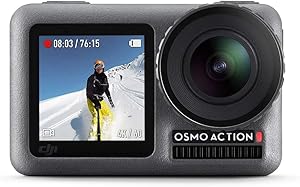

GoPro vs DJI: Overview
Comparing GoPro and DJI helps you determine which brand is best suited for your needs in Video Cameras. Both brands offer strong choices depending on your budget and key feature requirements.
Key Features & Comparison
Evaluate factors such as build quality, warranty, customer satisfaction, and total value before making your final purchase choice between GoPro and DJI.
Features
Feature-wise, GoPro distinguishes itself with creator-centric shooting modes, versatile aspect ratios, and the robust Quik editing ecosystem. Modern GoPro cameras excel with their taller 8:7 sensors, enabling shooters to capture wide vertical and horizontal crops from a single take without moving the camera, an invaluable tool for multi-platform social media workflows. Combined with GP-Log, 10-bit color, advanced time-lapse modes like Star Trails, and deep integration with cloud backup services, GoPro cameras offer advanced post-production headroom that high-end video editors and action professionals demand.
DJI counters with hardware-level workflow enhancements and seamless audio integration that often outshine GoPro in real-world scenarios. The most significant feature advantage for DJI is its native compatibility with DJI Mic transmitters, allowing external wireless audio recording directly to the camera without cumbersome media mods or adapters. Furthermore, DJI’s software focuses on frictionless shooting with rapid gesture control, pre-recording buffers, and custom user profiles that can be swapped instantly. For creators who demand quick turnaround times and hassle-free audio over complex color grading, DJI’s feature suite represents a more practical, all-in-one capture tool.
Performance
In terms of raw imaging performance, GoPro traditionally holds an edge in sheer resolution and aggressive stabilization. With capabilities reaching up to 5.3K at high frame rates, GoPro footage delivers immense fine detail, crisp textures, and vibrant dynamic range under optimal lighting conditions. The brand's proprietary HyperSmooth stabilization remains the gold standard for high-vibration sports, offering unmatched horizon leveling and jitter reduction that makes rough downhill mountain biking and surfing footage look effortlessly cinematic. However, this high computational load can sometimes lead to thermal throttling and reduced operational longevity in warm, static environments.
DJI prioritizes thermal efficiency, low-light capability, and sustained runtimes. By employing slightly larger sensor sizes in recent models alongside optimized heat dissipation, DJI cameras routinely outperform GoPro in dimly lit conditions, delivering cleaner images with less digital noise when the sun goes down. RockSteady and HorizonSteady provide stabilization that is practically indistinguishable from GoPro for standard handheld and athletic use, while DJI’s battery architecture (such as the Extreme Battery) resists freezing temperatures and offers superior recording durations without overheating, making it the more reliable operational workhorse across diverse climates.
Design
GoPro adheres to a time-tested, utilitarian design philosophy characterized by ruggedized, rubberized enclosures and integrated folding mounting fingers. This monolithic build is engineered to withstand extreme impacts, deep water submersion without a separate housing, and intense physical abuse. The dual-screen setup on recent models provides useful framing for selfies, though the front display is non-touch. GoPro’s hardware feels unapologetically tough and industrial, reassuring extreme athletes that the camera can survive severe crashes, mud, and ocean swells straight out of the box.
DJI revolutionizes camera ergonomics through intelligent modularity and functional ease. The brand’s hallmark design triumph is its magnetic quick-release mounting system, which allows users to effortlessly swap the camera between chest mounts, tripods, and handlebars in seconds, utterly outpacing GoPro’s traditional thumbscrew system. Additionally, DJI designs generally feature responsive front and rear touchscreens, offering far better navigation versatility for vloggers. By balancing tactile durability with clever mechanical engineering, DJI crafts a user experience that minimizes mechanical friction and streamlines the physical act of content creation.