Canon vs DJI: Overview
Comparing Canon and DJI helps you determine which brand is best suited for your needs in Video Cameras. Both brands offer strong choices depending on your budget and key feature requirements.
Key Features & Comparison
Evaluate factors such as build quality, warranty, customer satisfaction, and total value before making your final purchase choice between Canon and DJI.
Features
Canon’s feature suite emphasizes deep optical customization, standardized professional broadcast formats, and industry-benchmark autofocus. Canon cameras often feature high-bitrate internal recording (including 10-bit 4:2:2 and RAW video in selected models), comprehensive gamma curves like Canon Log 2 and Log 3, and dedicated monitoring tools such as waveforms and false color. A defining technological advantage is Canon’s Dual Pixel CMOS AF II, which provides remarkably natural focus racking and deep-learning subject detection across human, animal, and vehicular subjects. Furthermore, the expansive native RF mount ecosystem grants filmmakers access to premium prime lenses and cine-servo zooms that cannot be matched by fixed-lens architectures.
DJI counters with an aggressively innovative, software-enhanced feature set designed to eliminate auxiliary production gear. In their handheld lines, features like integrated mechanical gimbals, ActiveTrack subject-following, and omnidirectional microphone integration (via seamless DJI Mic pairing) empower solo shooters to execute complex movements that would typically require a camera operator and a grip. On the cinema spectrum with the Ronin 4D, DJI incorporates LiDAR focusing systems that achieve automated focus pulling with manual lenses, 4-axis stabilization, and integrated long-range wireless video transmission. While Canon requires users to build out a camera rig with third-party accessories, DJI delivers a consolidated, plug-and-play feature ecosystem engineered to bypass setup friction.
Performance
In terms of pure optical performance and sensor fidelity, Canon generally establishes a higher baseline ceiling. Leveraging large Super 35 and Full Frame sensors, Canon cameras deliver superior low-light performance, expansive dynamic range, and a natural, pleasing roll-off in the highlights. Canon’s proprietary color science is widely considered an industry benchmark, famous for rendering organic, flattering skin tones straight out of the camera with minimal grading required. For high-end documentary work, commercial production, and cinematic storytelling where image texture and gradability are paramount, Canon consistently outperforms smaller-sensor alternatives.
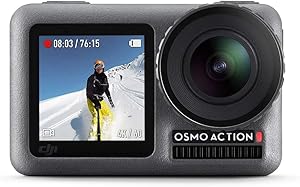
DJI’s performance advantage lies in dynamic stability, operational responsiveness, and computational reliability. In challenging action or run-and-gun scenarios, DJI’s physical gimbal stabilization vastly outperforms the digital and optical in-body image stabilization (IBIS) found in Canon mirrorless systems, eliminating micro-jitters without cropping the frame or introducing warping artifacts. DJI systems also perform exceptionally well in thermal management; compact bodies like the Action series and Osmo Pocket feature robust passive and active cooling that minimizes thermal shutdown during continuous, long-take 4K recording. While DJI’s dynamic range and low-light noise handling on its consumer products trail Canon’s large-format sensors, DJI’s flagship Ronin 4D matches true cinema-grade performance with dual-native ISO and up to 8K resolution.
Design
Canon’s industrial design adheres to proven, ergonomic photographic traditions developed over several decades. Their bodies—whether the hybrid EOS R series or modular Cinema EOS models like the C70 and C300 Mark III—prioritize tactile handling, sculpted deep handgrips, weather-sealed magnesium-alloy chassis, and dedicated physical dials for shutter, iris, and ISO. Inputs and outputs are thoughtfully isolated for professional cabling, offering full-sized HDMI, robust timecode BNCs, and standard XLR audio terminals. The trade-off is physical bulk; a fully functional Canon video setup often requires a substantial footprint, making it less accessible for spontaneous or covert shooting.
DJI completely rethinks camera physical architecture by prioritizing ultra-compact footprints, rapid modularity, and structural integration. Products like the Osmo Pocket 3 integrate an entire sensor, screen, and three-axis motorized head into an enclosure that fits into a jacket pocket, paired with a rotating OLED touchscreen that intuitively dictates the shooting aspect ratio. Even DJI’s cinema-tier Ronin 4D integrates carbon fiber and aluminum alloys to fuse the camera body, gimbal motors, and monitor mounts into a unified, balanced package. While DJI cameras often rely more heavily on touchscreen menus rather than physical dials and sacrifice legacy audio ports in favor of wireless receivers, their forward-thinking industrial design offers unprecedented agility in the field.
Compare current retail pricing, active promotions, and verified stock availability directly from authorized stores: