














When it comes to home vacuuming, few matchups are as compelling as Kenmore vs Tineco.
Kenmore brings decades of trusted American performance, known for powerful suction and classic reliability. Tineco, on the other hand, is a rising star from the tech-forward side of the market, focused on sleek, cordless innovation and smart cleaning features.
If you’re stuck choosing between the dependable strength of Kenmore and the futuristic appeal of Tineco, this comparison breaks it all down — one aspect at a time.
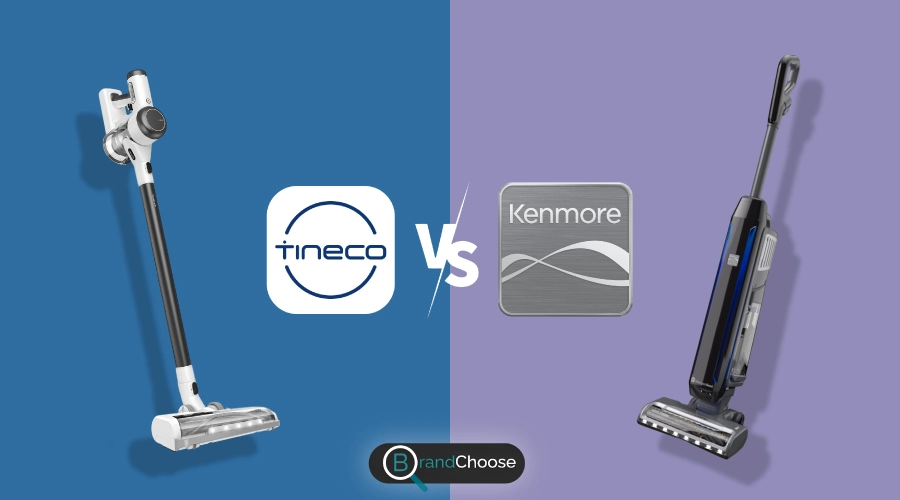
Features
Kenmore and Tineco approach vacuum cleaner engineering from fundamentally different eras of home care philosophy, resulting in stark contrasts across their core feature sets. Kenmore, a long-standing stalwart in the floorcare market, builds its reputation on traditional, mechanically robust utility. Its bagged canister and upright models emphasize raw pneumatic performance, physical adaptability, and allergen containment. Hallmark Kenmore features include true sealed HEPA filtration systems certified by the Asthma and Allergy Foundation of America, multi-surface motorized Pet PowerMates, foot-activated floor-to-carpet height adjustments, and ultra-durable direct-drive brush motors. While the brand has gradually introduced cordless stick vacuums, its standout engineering remains tethered to durable, tactile mechanics, generous dust capacities that measure in multiple quarts rather than fractions of a liter, and hard-wired, heavy-duty suction control designed for deep pile carpet extraction and whole-home longevity.
Conversely, Tineco represents the vanguard of smart, sensor-driven home cleaning technology, focusing primarily on cordless stick vacuums and all-in-one wet-dry floor washers. The defining technological strength of the Tineco ecosystem is its proprietary iLoop Smart Sensor, which actively detects debris levels and automatically adjusts motor speed, suction intensity, and water flow in real time to optimize both battery life and cleaning efficiency. Tineco products boast rich digital interfaces, featuring high-definition onboard LED/LCD displays, voice prompts, and smartphone app connectivity that tracks filter maintenance, runtime diagnostics, and cleaning history. Moreover, Tineco dominates the wet-dry hybrid segment with self-cleaning, dual-tank systems that separate clean water from wastewater and centrifugal drying roller stations, effectively eliminating the post-clean manual maintenance required by traditional wet mops and vacuums.
When weighing the practical trade-offs of these feature sets, the choice pivots between digital automation and analog endurance. Tineco provides a highly sophisticated, lightweight user experience where smart automation simplifies spot-cleaning and sealed hard-floor maintenance, but it requires diligent maintenance of small-capacity tanks, routine battery charging, and frequent filter cleaning to prevent motor strain. Kenmore sacrifices the sleek ergonomics, digital readouts, and cordless agility of Tineco in exchange for industrial-grade airflow, massive collection capacity, and low-maintenance bagged containment that prevents secondary dust exposure during disposal. Ultimately, Kenmore’s feature set is optimized for consumers seeking raw deep-cleaning power and mechanical resilience for diverse, heavily carpeted environments, whereas Tineco excels for modern consumers who prioritize smart automation, real-time feedback, and the seamless convenience of wet-dry hard-surface maintenance.
Performance
When evaluating performance, Kenmore and Tineco represent fundamentally different engineering philosophies, pitting classic, high-wattage corded muscle against agile, sensor-driven cordless technology. Kenmore’s performance identity is rooted in raw, relentless suction power and high-cfm (cubic feet per minute) airflow, predominantly delivered through its legendary bagged canister and upright models. Driven by potent 12-amp motors and sealed HEPA systems, Kenmore excels at deep-cleaning high-pile carpets and lifting embedded pet dander from the base of floor fibers. Their dual-motor systems—separating the primary suction drive from the brushroll mechanism—ensure that agitator speed does not drop when transitioning onto denser surfaces. The trade-off for this sheer mechanical brute force is physical cumbersome-ness; Kenmore machines achieve maximum suction persistence through corded power draw, meaning they never suffer from motor throttling or battery-induced performance drops, but they demand more physical effort to maneuver.
Conversely, Tineco champions intelligent, digital-motor efficiency designed for the modern multi-surface home. Through its proprietary iLoop Smart Sensor technology, Tineco cordless stick vacuums and wet/dry floor washers dynamically detect hidden dust, debris, and liquid messes, automatically adjusting suction power and roller speed in real time. This optimized power management delivers impressive bursts of performance—often exceeding 120 to 150 Air Watts in their flagship stick models—while preserving battery life. Where Tineco unequivocally outclasses Kenmore is in hard-floor maintenance and hybrid wet/dry cleaning; models like the Floor ONE series simultaneously vacuum and wash sealed surfaces, dissolving sticky residue that traditional dry vacuums leave behind. However, Tineco's performance is strictly governed by run-time constraints, with high-demand Max modes often depleting batteries in under 15 minutes, and its lightweight digital motors cannot replicate the sustained, deep-fiber agitated lift that Kenmore generates on plush carpeting.
Ultimately, the performance victor depends on home topography and cleaning habits. Kenmore is the superior performer for rigorous, heavy-duty deep cleaning, particularly in spacious, heavily carpeted environments where consistent airflow and large-capacity dirt capture are non-negotiable. Tineco delivers superior daily agility, cutting-edge multi-surface adaptability, and automated suction efficiency that excels on hardwood, tile, and low-pile rugs. While Kenmore wins on raw, unyielding suction longevity, Tineco offers a more technologically refined, modern performance profile tailored for quick, comprehensive whole-home maintenance.
Design
Kenmore and Tineco approach vacuum cleaner design from fundamentally divergent philosophies, representing the traditional utilitarian powerhouse and the sleek, technology-forward modern appliance, respectively. Kenmore’s engineering prioritizes mechanical longevity, high-capacity utility, and rugged durability. Historically revered for its canister and upright formats, Kenmore relies on robust, thick-molded plastics, physical step-pedals, and utilitarian latching mechanisms. Its designs often center around bagged filtration architectures, which favor hygienic disposal and structural simplicity over compact aerodynamics. The industrial design is decidedly functional, with heavier chassis, extended wand lengths, and integrated tool caddies built directly into the main body. While this results in exceptional physical resilience and broad cleaning swaths, the trade-off manifests in a bulky footprint, cumbersome storage requirements, and significant operational weight that can make multi-level maneuvering taxing for the user.
Conversely, Tineco champions an agile, smart-home aesthetic defined by lightweight materials, modular assembly, and digital integration. Specializing in cordless stick vacuums and wet-dry floor washers, Tineco designs emphasize ergonomic efficiency with balanced center-of-gravity placements, swivel steering necks, and sleek, minimalist silhouettes. A hallmark of Tineco’s technical design is its iLoop Smart Sensor technology, visually communicated through interactive LED or full-color LCD screens on the handle assembly that actively monitor debris levels and battery runtime in real time. The brand utilizes high-precision, translucent, bagless dustbins and magnetic or quick-release latching systems that allow for seamless transitions between hand-held and full-length configurations. However, this focus on lightweight, compact engineering means smaller dust capacities that necessitate frequent emptying, alongside an increased reliance on delicate electronic microprocessors that may not possess the same rough-and-tumble physical durability as Kenmore’s analog assemblies.
Ultimately, the practical trade-offs in design reflect different consumer priorities regarding space and workflow. Kenmore’s design caters to users with extensive square footage, wall-to-wall carpeting, and dedicated utility closets who value time-tested durability and low-maintenance bagged containment over technological novelties. In contrast, Tineco is designed for modern, multi-surface living spaces—particularly those with predominantly hard floors—where quick deployment, wall-mounted charging stations, and automated suction modulation take precedence. Kenmore delivers an industrial, mechanically robust design built for high-volume endurance, while Tineco delivers an intuitive, tech-centric design optimized for effortless handling and contemporary convenience.
Conclusion
Kenmore and Tineco offer two very different experiences. One is rooted in dependable, all-around strength — the other is redefining convenience through smart design. Whether you’re upgrading your weekly clean or looking for a daily, grab-and-go option, the right choice depends on your home, your habits, and your style. Pick your path — clean confidently.
Compare current retail pricing, active promotions, and verified stock availability directly from authorized stores:







