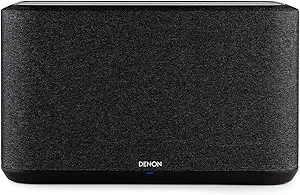
Denon vs Harman Kardon: Overview
Comparing Denon and Harman Kardon helps you determine which brand is best suited for your needs in Speakers. Both brands offer strong choices depending on your budget and key feature requirements.
Key Features & Comparison
Evaluate factors such as build quality, warranty, customer satisfaction, and total value before making your final purchase choice between Denon and Harman Kardon.
Product Selection
When examining product selection, Harman Kardon and Denon target vastly different listening environments, reflecting divergent brand philosophies. Harman Kardon emphasizes lifestyle, portable, and aesthetic home audio. Their catalog is defined by visually distinct standalone wireless speakers like the Aura Studio and SoundSticks, alongside premium portable Bluetooth speakers such as the Onyx Studio and Go + Play series, and select soundbars like the Citation line. While they offer sophisticated solutions for casual, multi-room, and design-conscious environments, their portfolio noticeably lacks component-level audio equipment, traditional passive hi-fi loudspeakers, or modern multi-channel audio/video receivers (AVRs), having largely phased out their legacy receiver lines to focus on integrated smart lifestyle audio.
In contrast, Denon offers a substantially wider, engineering-focused ecosystem built around both modern lifestyle streaming and traditional high-fidelity separates. Denon is universally recognized for its market-leading AVRs, ranging from entry-level 5.2 channel receivers to reference-grade 15.4 channel flagship processors (such as the AVR-A1H). Furthermore, through its proprietary HEOS network platform, Denon competes directly in the wireless multi-room and smart home space with soundbars and standalone streaming speakers (the Denon Home series). They also cater to traditional audiophiles with integrated stereo amplifiers, network audio players, CD players, and turntables. For consumers seeking architectural home theater builds, dedicated listening rooms, or scalable whole-home systems, Denon provides a significantly more comprehensive and versatile selection than Harman Kardon.
Affordability
From an affordability standpoint, Harman Kardon generally operates within the mid-tier consumer audio bracket, with products primarily priced between $150 and $800. Their standalone Bluetooth and plug-in home speakers are priced competitively against other design-forward lifestyle brands like Bose and Bang & Olufsen. Because Harman Kardon designs self-contained, active units that house their own amplification and digital signal processing, the upfront cost represents a total audio solution with zero hidden expenses for external cabling, source components, or amplification. Additionally, frequent discounts across standard retail channels and telecom bundle promotions (especially for the Onyx Studio line) make entry into the Harman Kardon ecosystem remarkably accessible for casual buyers.
Denon presents a far broader financial spectrum, with price points spanning from budget-friendly lifestyle gear to uncompromising high-end components costing several thousand dollars. While an entry-level Denon Home 150 wireless speaker sits around $250—directly comparable to mid-range Harman Kardon options—the broader Denon catalog quickly scales into serious enthusiast territory. Their AV receivers and integrated stereo amplifiers demand a significantly higher financial commitment, often starting around $400 for entry-level models and climbing well above $3,000 to $6,000 for flagship AV processors. Furthermore, investing in Denon components usually mandates separate outlays for passive speakers, subwoofers, and dedicated interconnects, making Denon inherently more expensive and capital-intensive across most of its ecosystem.
Quality/Durability
Harman Kardon approaches build quality through a marriage of premium lifestyle materials and modern industrial design. Their speakers prominently feature smoked acrylic enclosures, spun aluminum accents, acoustically transparent Kvadrat fabrics, and distinctive dome architectures. While these materials grant Harman Kardon speakers an unmistakable and luxurious appearance, they introduce certain structural trade-offs. Transparent plastics and exposed domes are susceptible to hairline scratches, scuffs, and dust accumulation over time, requiring careful handling. Furthermore, their portable models rely on integrated rechargeable lithium-ion batteries, which inevitably face chemical degradation after several years of regular charge cycles, potentially limiting the operational lifespan of portable units without professional servicing.
Denon prioritizes traditional, rugged audio engineering, resulting in higher long-term durability and hardware longevity. Denon's component chassis are constructed from rigid sheet metal, reinforced internal bracing, and thick brushed aluminum front panels designed to mitigate mechanical vibration and withstand thermal stress. Their component devices utilize heavy-duty toroidal power transformers, discrete amplifier circuit topographies, and expansive heatsinks that contribute to decades-long service lives. Even within their wireless 'Denon Home' lifestyle line, the construction is denser, utilizing impact-resistant composite enclosures and water-repellent, durable textile wraps. Denon products are primarily mains-powered, eliminating the planned obsolescence tied to internal battery decay and making them inherently more durable over a multi-decade horizon.
Sound Quality
The acoustic profile of Harman Kardon is engineered to deliver an immediate, rich, and crowd-pleasing sound signature that leverages proprietary Digital Signal Processing (DSP). Harman Kardon speakers generally emphasize a full-bodied low-end with prominent mid-bass punch and smooth, non-fatiguing highs, largely adhering to the research-backed 'Harman Target Curve.' Down-firing subwoofers and dual passive radiators are common across their line, allowing relatively compact enclosures to produce astonishingly authoritative bass. However, this consumer-tuned presentation occasionally suffers from slight midrange masking, where intricate acoustic instruments or complex vocal textures can be recessed beneath deep bass frequencies, trading analytical precision for energetic, room-filling musicality.
Denon delivers a more disciplined, neutral, and audiophile-grade acoustic performance characterized by wide dynamic range, spatial accuracy, and transparency. In their standalone components and AVRs, Denon relies on discrete high-current amplification and high-resolution digital-to-analog converters (DACs) to preserve absolute signal fidelity across the frequency spectrum. Furthermore, Denon products benefit from advanced acoustic room calibration suites, such as Audyssey MultEQ XT32 and optional Dirac Live, allowing listeners to surgically tune their system's output to the room's physical acoustics. The resulting soundstage is remarkably coherent, delivering rapid transient response, micro-detail resolution, and natural vocal reproduction that exposes nuanced master recordings far more faithfully than Harman Kardon’s DSP-shaped lifestyle output.