VIZIO vs Klipsch: Overview
Comparing VIZIO and Klipsch helps you determine which brand is best suited for your needs in Soundbars. Both brands offer strong choices depending on your budget and key feature requirements.
Key Features & Comparison
Evaluate factors such as build quality, warranty, customer satisfaction, and total value before making your final purchase choice between VIZIO and Klipsch.
Product Selection
When examining product selection, Klipsch and VIZIO adopt fundamentally different catalogue strategies tailored to distinct market segments. Klipsch focuses on a curated, premium lineup rooted in traditional acoustic engineering, primarily organized under series like the Cinema and Reference lines. Rather than saturating the market with dozens of minor variations, Klipsch concentrates on standalone bars and bundled 3.1 to 5.1 packages that often integrate wireless subwoofers featuring large drivers (often 8 to 12 inches). This selective approach prioritizes audio enthusiasts seeking an expansive home-theater footprint without transitioning to full AV receiver setups, though it limits options for buyers wanting ultra-compact form factors or modular, standalone surround expansion.
Conversely, VIZIO maintains one of the most comprehensive and tiered catalogues in the consumer soundbar industry, systematically organized through its V-Series, M-Series, and flagship Elevate tiers. VIZIO excels at providing an entry point for virtually every room size and use case, ranging from space-saving 2.0 all-in-one bars for small bedrooms to full-fledged 5.1.4 Dolby Atmos systems with innovative auto-rotating height speakers. This expansive segmentation allows consumers to select models based on very specific budget caps, physical dimensions, and HDMI connectivity requirements, giving VIZIO a decisive advantage in overall variety, modularity, and versatility across the mass consumer spectrum.
Design/Look
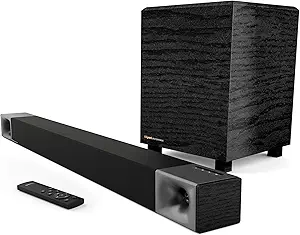
Klipsch soundbars reflect the brand's heritage aesthetic, characterized by an industrial, high-end appearance that borrows heavily from classic speaker cabinetry. Models frequently showcase Klipsch's iconic copper spun-graphite woofers behind removable grilles, flanked by proprietary Tractrix horns. Premium real-wood or textured wood-grain vinyl finishes are standard on many Cinema series models, giving them a substantial, furniture-grade presence beneath a television. This deliberate acoustic-first design results in larger, heavier enclosures that intentionally reject the plastic-heavy trends of modern consumer tech, catering to buyers who want their audio gear to serve as a visual centerpiece.
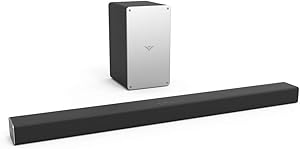
VIZIO pursues a sleek, modern consumer-electronics aesthetic designed to blend seamlessly into contemporary home entertainment setups. Utilizing dark acoustic fabrics, matte plastics, and low-profile silhouettes, VIZIO soundbars are engineered to tuck discreetly under low-clearance modern displays without blocking IR sensors. Its flagship models, particularly the VIZIO Elevate, introduce sophisticated mechanical engineering via motorized end-caps that rotate upward to reflect Atmos height channels when immersive audio is detected. While VIZIO lacks the handcrafted wood-cabinet appeal of Klipsch, its clean lines, minimalist branding, and futuristic mechanical accents offer a polished look that integrates effortlessly with a wide range of modern interior decors.
Affordability
In terms of cost of ownership, Klipsch positions itself in the mid-to-high tier of the soundbar market, reflecting its legacy hi-fi pedigree and physical driver materials. Entry-level Klipsch setups generally start at a price point where competitors often provide full surround solutions. While buyers receive superior cabinet acoustics, oversized subwoofers, and robust internal amplification, the cost-per-channel ratio is relatively high. Buyers investing in Klipsch are primarily paying for acoustic output and build quality rather than bargain pricing, making the brand less attractive to casual viewers looking for a cheap upgrade to standard television speakers.
VIZIO is widely recognized as a benchmark for value and price-to-performance efficiency in the home theater audio segment. Its entry-level V-Series delivers competent 2.1 and 5.1 surround sound at price points where most legacy brands only offer basic stereo bars. Moving up the stack, the M-Series and Elevate lines offer spatial audio features like Dolby Atmos and DTS:X decoding at a fraction of the cost of traditional acoustic brands. VIZIO achieves this through efficient manufacturing and economies of scale, making immersive surround sound exceptionally accessible to budget-conscious consumers who refuse to compromise on modern format support.
Sound Quality
Sound quality from Klipsch is defined by its signature dynamic, lively, and articulate sound profile driven by proprietary 90x90 Tractrix horn-loaded tweeters. This engineering delivers exceptionally clean high-frequency dispersion and remarkable dialogue clarity without relying heavily on artificial digital signal processing. Paired with ported wood subwoofers that move substantial air, Klipsch soundbars deliver authentic cinematic impact, punchy mid-bass, and effortless transient response. For music listening and high-impact blockbuster action, the physical presence and low distortion at high volumes provide an authoritative performance that closely mirrors a discrete speaker system.
VIZIO relies more heavily on sophisticated DSP and dedicated multi-channel driver arrays to deliver an enveloping, highly processed spatial audio experience. While smaller driver enclosures and polymer cabinets mean VIZIO lacks the pure acoustic resonance and raw mid-range warmth of Klipsch, its systems excel at immersive object-based surround positioning. With discrete wired rear surrounds and up-firing Atmos drivers standard on mid-to-high-tier bundles, VIZIO creates an effective three-dimensional sound bubble around the listener. Dialogue clarity is maintained via dedicated center-channel tuning modes, providing a balanced, cinematic experience that is impressively immersive for modern multi-channel media consumption.