LG vs JBL: Overview & Brand Philosophy
In the home theater space, soundbars have evolved from simple television speaker replacements into sophisticated, multi-channel acoustic hubs. LG and JBL represent two distinct engineering philosophies in this market. LG approaches the category from a modern consumer electronics standpoint, focusing heavily on ecosystem integration, advanced spatial computing, and seamless interoperability with contemporary visual displays. With a strong reliance on high-resolution processing and proprietary features that complement their market-leading OLED televisions, LG designs soundbars tailored to complete a modern, smart-home entertainment suite.
Conversely, JBL brings decades of legacy acoustic engineering and professional live-sound heritage to the table. As a cornerstone brand of Harman International (a subsidiary of Samsung), JBL prioritizes raw acoustic performance, robust transient response, and room-filling low-end power. Their philosophy centers on dynamic energy, bass authority, and plug-and-play simplicity. While LG strives to engineer precise, DSP-driven spatial soundstages, JBL focuses on visceral, high-impact audio that bridges the gap between home cinema immersion and high-energy music listening.
Ultimately, the choice between these two audio giants hinges on whether a consumer prioritizes digital refinement and television-ecosystem cohesion (LG) or analog acoustic power, deep sub-bass reproduction, and versatile, hardware-driven engineering (JBL). Both brands command substantial market share, yet they cater to noticeably different listener preferences and home theater topologies.
Key Differences & Technological Comparison
When analyzing the technological foundations of both brands, several distinct hardware and software methodologies emerge across surround decoding, physical design, and smart platform functionality.
Surround Processing and Spatial Audio
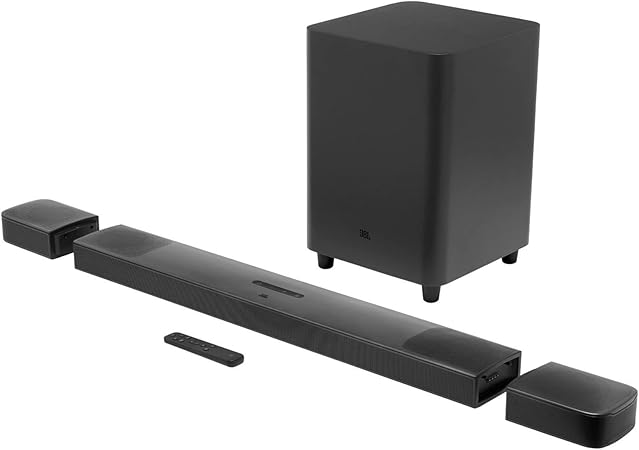
LG relies heavily on cutting-edge digital signal processing (DSP). Partnering extensively with Meridian Audio on acoustics and deploying native Dolby Atmos and DTS:X decoding across mid-to-high-tier models, LG champions technologies like "Triple Level Spatial Sound." Higher-end models feature dedicated up-firing center channels designed specifically to anchor on-screen dialogue while expanding the vertical plane. JBL, while supporting Dolby Atmos and DTS:X, often achieves spatial audio through its proprietary MultiBeam technology—an algorithmic beamforming approach that physically bounces sound waves off side walls—alongside truly wireless, battery-powered detachable rear speakers in their flagship "Bar" series, eliminating the need for rear power cables altogether.
Television and Smart Home Ecosystem Integration
LG holds a distinct advantage for owners of modern LG displays. Through features like WOW Orchestra (which combines the television's built-in speakers with the soundbar for a richer soundstage), WOW Interface (enabling soundbar management directly from the TV's on-screen menu), and zero-loss wireless transmission via WOWCAST, LG provides unprecedented synergy across its product lines. JBL adopts a more agnostic approach; it does not favor any TV manufacturer, relying instead on standard eARC protocols, robust AirPlay 2, Google Cast, and universal Bluetooth connectivity to ensure identical performance regardless of the connected display.
Acoustic Tuning and Low-Frequency Extension
JBL consistently outperforms LG in low-frequency extension and dynamic scale. Many JBL systems pair relatively compact soundbars with down-firing subwoofers boasting massive 10-inch drivers, capable of hitting foundational, sub-30Hz frequencies with authority. LG's subwoofers tend to prioritize tight, controlled bass suited for dialogue-heavy programming and balanced film mixes, but they occasionally lack the visceral chest-thumping impact that action cinema enthusiasts and bass-heavy music listeners demand from JBL.
Pros & Cons Comparison
LG Soundbars
- Pro: Advanced Ecosystem Synergy: Unmatched integration with LG TVs via WOW Orchestra, unified remote functionality, and wireless WOWCAST capabilities.
- Pro: High-Resolution Audio Decoding: Broad support for uncompressed 24-bit/96kHz audio, MQA, and comprehensive DTS:X support across more models.
- Pro: Innovative Center Height Drivers: Select models feature up-firing center channels that significantly elevate dialogue clarity and vocal presence.
- Con: Subwoofer Impact: Bass output can lean polite or thin on entry-to-mid-tier models compared to equivalently priced competitors.
- Con: Complex DSP Modes: The sheer number of proprietary sound modes (AI Sound Pro, Cinema, Clear Voice) can result in an unnatural or over-processed sound signature if not properly calibrated.
JBL Soundbars
- Pro: Detachable Wireless Surrounds: Flagship models feature ingenious battery-powered rear channels that dock into the main bar to charge, offering true wire-free surround sound on demand.
- Pro: Authoritative Bass Response: Large-displacement subwoofers deliver superior low-end slam, depth, and cinematic rumble without distortion.
- Pro: Display Agnostic: Delivers full feature utility on any television brand without reserving premium features for a specific brand ecosystem.
- Con: Limited DTS Support: Newer entry-to-mid-range JBL models frequently drop DTS:X processing, focusing exclusively on Dolby formats.
- Con: Battery Degradation Risk: Models with detachable rear speakers rely on internal lithium-ion batteries that may experience diminished runtime over years of sustained use.
Performance, Durability & Value Analysis
From an acoustic performance standpoint, both brands deliver commendable value, but their long-term durability profiles diverge. LG’s physical construction relies primarily on lightweight composites and fine acoustic mesh, which looks elegant in contemporary living rooms but can be prone to cosmetic wear over time. LG's internal electronics and software stacks are exceptionally stable, supported by frequent firmware updates over Wi-Fi. In terms of value, LG aggressively prices its mid-tier multi-channel soundbars (such as the S-series and SC9S), frequently bundling them alongside television purchases, making them an extraordinarily high-value proposition for consumers already investing in an LG screen.
JBL products are built with a more rugged, utilitarian ethos. Featuring rigid metal grilles, industrial-grade plastics, and heavy driver magnets, JBL soundbars are designed to survive the rigors of heavy use. Their subwoofers feature substantial enclosures that minimize cabinet resonance under heavy loads. However, potential buyers should assess value through the lens of longevity: while JBL’s detachable surround speakers offer unmatched convenience and true 5.1 to 9.1 immersion, the eventual degradation of those internal lithium cells represents a long-term service consideration. Despite this, JBL retains strong resale value and delivers exceptional raw decibel-per-dollar metrics, especially for open-concept floor plans requiring high volume thresholds.
Final Verdict: Which Brand Should You Choose?
Choosing between LG and JBL depends directly on your existing television hardware, room architecture, and personal acoustic preferences:
Choose LG if: You already own an LG OLED or NanoCell television and want seamless integration, unified control, and zero-latency wireless connectivity. LG is also the superior choice for audiophiles who prioritize high-resolution music playback, natural dialogue clarity, and broad support for DTS:X physical media formats alongside standard Dolby Atmos content.
Choose JBL if: You want genuine cinematic immersion without running messy cables to the back of your room, thanks to their detachable wireless rear modules. JBL is the definitive choice for viewers who demand subterranean, earth-shaking bass for action movies and gaming, as well as those who desire a neutral, high-output sound system that performs uniformly well across any brand of television.
Product Selection
LG and JBL approach their soundbar portfolios with fundamentally divergent product design philosophies, reflecting their broader home entertainment ecosystems. LG’s catalog is meticulously structured to mirror its television tiers, ranging from minimalist all-in-one models to ultra-premium, discrete multichannel systems like the S95 series. Their lineup excels in technical synergy and forward-looking audio formats, heavily investing in up-firing center channels, IMAX Enhanced certification, and proprietary WOW Orchestra integrations that harmonize with LG OLED panels. Across its mid-to-high tier selections, LG emphasizes modular expansion and advanced DSP, offering consumers highly calibrated, cinematic setups with discrete wireless rear surround kits that integrate up-firing drivers for true Dolby Atmos and DTS:X height spatialization.
Conversely, JBL leverages its rich professional audio heritage to curate a lineup defined by acoustic horsepower, plug-and-play simplicity, and architectural versatility. The crown jewel of JBL's consumer selection is the modular "Bar" series (such as the Bar 1000 and Bar 1300X), which stands out technically with battery-powered, fully detachable wireless surround speakers. This engineering choice addresses one of the most persistent trade-offs in consumer audio: running power cables to rear channels. While JBL’s overall product spread is leaner than LG’s vast catalog, it skews more heavily toward sheer acoustic output, utilizing massive, class-leading discrete subwoofers (often 10 to 12 inches) and rugged, high-excursion drivers designed to excel equally at high-SPL party environments and dynamic movie playback.
From an analytical standpoint, the ideal product selection depends entirely on the consumer's architectural and ecosystem constraints. LG delivers an exhaustive breadth of choices with granular price steps, making it the superior catalog for audiophiles seeking fine-tuned DSP room calibration, comprehensive high-res audio codec support, and total television-audio hardware unification. JBL trades categorical depth for practical consumer innovation; its tighter selection targets consumers who want class-dominant low-frequency performance, high dynamic range, and the unmatched spatial flexibility of completely wire-free surrounds, albeit with fewer ultra-budget or TV-synchronized niche options than LG provides.
Design/Look
From an engineering and aesthetic standpoint, LG approaches soundbar design with a philosophy deeply rooted in modern living room integration and television synergy. LG soundbars, particularly the higher-end S-series and SC9 models, feature sleek, low-profile silhouettes characterized by brushed metallic textures, dark neutral tones, and premium eco-friendly wrap-around acoustic fabrics. A primary technical strength of LG’s industrial design is its "WOW Orchestra" and TV-matching synergy; many models are dimensionally tailored to sit flush between the feet of LG OLED and QNED televisions, and select units include custom brackets that seamlessly replace the TV stand itself. The build quality emphasizes streamlined subtlety, utilizing low-reflection top surfaces and hidden digital displays that fade out when not in use to minimize visual distraction in home theater environments. The physical trade-off, however, is that this tailored aesthetic can look somewhat mismatched or overly sterile when paired with non-LG displays or eclectic furniture setups.
In contrast, JBL champions a utilitarian, lifestyle-oriented design language marked by robust, rounded rectangular forms and high-durability materials. Most JBL soundbars, such as the Bar series, feature full-coverage matte plastic enclosures paired with wrap-around punch-hole metal grilles rather than fabric, making them far more resistant to dust, cat claws, and accidental physical damage. The crowning engineering achievement in JBL’s premium design suite is its truly wireless, detachable battery-powered rear surround speakers. These modules magnetically dock to the ends of the main soundbar to charge, maintaining a clean, single-unit footprint during casual viewing, and unclip to be placed around the room for dedicated cinema sessions. While this provides unparalleled functional versatility, it introduces visual trade-offs: the docking seams break up the visual uniformity of the soundbar, and the overall industrial look leans more aggressive and tech-heavy compared to LG’s furniture-grade finishes.
Ultimately, the choice between LG and JBL regarding design centers on the balance between seamless living room integration and modular utility. LG wins on minimalist elegance, offering ultra-slim depths and tailored mounting profiles that disappear beneath a wall-mounted panel, making them ideal for design-conscious buyers seeking an unobtrusive AV setup. JBL excels in rugged tactile engineering and functional innovation, offering heavy-duty metal protection and a shape-shifting modularity that eliminates visible surround-sound cabling. While LG's fabric covers require delicate maintenance to prevent fraying and stains, JBL's all-metal and hard-plastic builds trade away some living-room warmth in favor of exceptional longevity and functional flexibility.
Affordability
When assessing affordability in the soundbar market, LG and JBL employ markedly different value-engineering strategies that appeal to distinct consumer priorities. LG consistently dominates the entry-to-midrange price brackets by leveraging massive supply-chain efficiencies, offering multi-channel hardware and advanced digital signal processing at surprisingly low MSRPs. Budget-conscious buyers can frequently acquire full 3.1 or even 5.1-channel systems from LG—often bundled with wireless subwoofers and rear satellites—for the price of a competitor’s standalone unit. Furthermore, LG soundbars pack high-tier software features into their affordable tiers, such as AI Sound Pro, Meridian audio tuning, and high-resolution audio decoding. In contrast, JBL approaches affordability through component longevity and raw acoustic engineering rather than sheer channel count. An entry-level JBL soundbar typically offers fewer auxiliary channels for the same money, but compensates with superior enclosure rigidity, higher-grade physical drivers, and their proprietary MultiBeam technology, which delivers a wider, more convincing virtual soundstage without requiring supplementary satellite speakers.
The technical trade-offs between these two brands become pronounced when examining the performance-per-dollar ratio across different use cases. LG is the superior value proposition for budget-conscious home theater enthusiasts who already own modern smart TVs—particularly LG OLEDs—as features like WOW Orchestra and TV Sound Mode Share bypass the need to purchase premium audio processing hardware. However, LG’s more affordable models often cut costs in their lower-frequency physical hardware, utilizing lighter subwoofer cabinets that can produce boomy, less controlled bass at high volumes. JBL, leveraging the legacy of parent company Harman, delivers substantial value in low-end power, where even their budget 'Deep Bass' and 'Cinema' series feature robust physical amplification and heavily tuned ported subwoofers that outperform LG in musicality and dynamic headroom. The trade-off with JBL is a leaner digital feature set; entry-to-mid tiers frequently lack extensive EQ software, app-based customization, or upward-firing Dolby Atmos height channels, forcing consumers to spend more if they want cutting-edge spatial audio formats.
Ultimately, determining the more affordable brand depends on whether a consumer measures value by feature density or acoustic durability. LG wins on paper for total utility per dollar, aggressively discounting previous-generation stock and providing accessible entry points to spatial audio decoding that make home theater setups democratized for the masses. JBL offers a superior long-term investment for listeners who prioritize plug-and-play simplicity, superior analog acoustic tuning, and hard-wearing materials that resist physical wear and driver degradation over time. While LG minimizes the barrier to entry for complex, multi-speaker surround configurations, JBL maximizes the intrinsic audio quality and bass performance of traditional stereo and 3.0 setups, meaning budget shoppers must choose between LG’s multi-channel technical versatility and JBL’s bulletproof, room-filling sound signatures.
Sound Quality
When evaluating sound quality, LG soundbars reflect a philosophy centered on cinematic spatial processing, high-resolution clarity, and software-driven acoustic tuning. Engineered frequently in collaboration with Meridian Audio, LG’s higher-end systems excel in producing transparent, articulate high frequencies and highly intelligible dialogue through dedicated center channels and AI Sound Pro algorithms. LG strongly emphasizes immersive object-based formats like Dolby Atmos and DTS:X, utilizing up-firing drivers and psychoacoustic virtualization to create an expansive, vertical soundstage. However, while LG excels in spatial dispersion and crisp, neutral vocal reproduction, its mid-range can occasionally sound clinical or thin, and its subwoofers—though capable—often lack the visceral, room-shaking depth preferred by action-movie enthusiasts or bass-heavy music listeners without significant manual equalization.
Conversely, JBL leverages its rich legacy in professional cinema and live-sound acoustics to deliver a fundamentally warmer, more dynamic, and punchier audio profile. JBL soundbars are renowned for their robust bass response, typically pairing bar units with substantially larger, down-firing wireless subwoofers that effortlessly hit sub-bass frequencies without distortion. Furthermore, JBL’s innovative use of true wireless detachable rear surround speakers—found in models like the Bar 9.1 and Bar 1300—allows for authentic, uncompromised discrete channel separation that digital virtualization simply cannot replicate. The trade-off with JBL’s consumer-friendly, energetic V-shaped or warm sound signature is that upper-treble detail can occasionally be overshadowed by dominant lower-mid frequencies, and vocal clarity in complex, layered scenes may require volume compensation compared to LG’s pristine dialogue isolation.
Ultimately, the practical trade-off between the two brands comes down to acoustic presentation versus environmental versatility. Audiophiles and cinephiles seeking pinpoint vocal accuracy, detailed acoustic reproduction, and seamless synergy with modern OLED televisions will find LG’s refined, high-resolution approach superior for everyday television and dialogue-driven cinema. On the other hand, users seeking an impactful, theater-like audio experience with visceral, chest-thumping bass and authentic discrete surround sound without the clutter of permanent wiring will find JBL’s acoustic engineering and robust low-end authority undeniably more immersive.
Compare current retail pricing, active promotions, and verified stock availability directly from authorized stores:
Compare current retail pricing, active promotions, and verified stock availability directly from authorized stores: