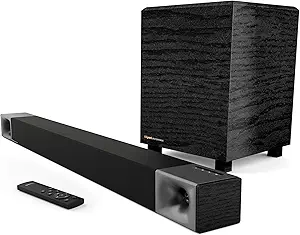
Sony vs Klipsch: Overview & Brand Philosophy
The home theater audio market has evolved significantly from bulky multi-speaker racks to sleek, high-performance soundbars capable of delivering immersive audio. Within this space, Sony and Klipsch represent two profoundly different engineering philosophies. Sony approaches audio through the lens of a massive consumer electronics and entertainment conglomerate. Their soundbar ecosystem is driven by bleeding-edge digital signal processing (DSP), spatial audio algorithms, HDMI 2.1 integration, and tight synergy with modern visual displays and gaming consoles. Sony prioritizes versatile, all-in-one cinematic immersion designed to adapt seamlessly into the modern connected living room.
Conversely, Klipsch approaches soundbars with the mindset of a heritage acoustic manufacturer. Founded on the principles of high efficiency, wide dynamic range, and low distortion, Klipsch leans into raw acoustic engineering rather than heavy digital manipulation. Known for their proprietary horn-loaded tweeters and real wood finishes, Klipsch builds soundbars that feel more like traditional high-fidelity audio systems re-engineered into slim form factors. While they embrace modern decoding formats like Dolby Atmos, their primary goal remains consistent: delivering visceral, high-output, dynamic sound with analog-inspired clarity and high-efficiency power delivery.
Choosing between these two audio heavyweights comes down to a fundamental preference: do you value Sony’s technologically advanced, spatially calibrated computational audio, or do you prioritize Klipsch’s dynamic, uncompressed acoustic horsepower and premium furniture-grade build quality?
Key Differences & Technological Comparison
The primary technical differentiator between Klipsch and Sony lies in how they generate their soundstages. Sony relies heavily on advanced psychoacoustics and proprietary digital processing. Technologies such as 360 Spatial Sound Mapping, Vertical Surround Engine, and S-Force Pro Front Surround use algorithmic delays and reflections to map virtual "phantom" speakers around the listener. Models like the Sony Bravia Theater Bar 9 or HT-A7000 utilize up-firing and beam tweeters calibrated via automated room acoustic software (Sound Field Optimization) to bounce sound off ceilings and walls, achieving a three-dimensional Dolby Atmos and DTS:X dome even in asymmetrical rooms.
Klipsch relies primarily on physical acoustic design. Central to the Klipsch soundbar lineup (such as the Cinema series and the newer Flexus series developed in collaboration with Onkyo) is their signature Tractrix horn technology. By coupling tweeters to 90x90 Tractrix horns, Klipsch mechanically increases acoustic output, controls directivity, and minimizes the sound reflections that cause muddiness in untreated rooms. This results in exceptional dialogue intelligibility, sparkling high-frequency detail, and dynamic slam that requires less amplifier wattage. However, Klipsch typically offers less virtualized surround processing; if you want surround sound, Klipsch generally prefers you add physical rear speakers rather than relying solely on psychoacoustic trickery.
From a hardware and connectivity standpoint, Sony holds a distinct advantage for cutting-edge home entertainment. High-end Sony soundbars frequently feature full-bandwidth HDMI 2.1 passthrough ports supporting 4K at 120Hz, Variable Refresh Rate (VRR), and Auto Low Latency Mode (ALLM)—making them the undisputed choice for PlayStation 5 and Xbox Series X enthusiasts. Klipsch soundbars, while equipped with eARC for uncompressed audio transmission from your TV, traditionally focus on audio paths rather than high-spec video switching, often limiting passthrough to standard 4K/60Hz.
Build materials also diverge sharply. Sony favors minimalist, industrial aesthetics dominated by acoustically transparent fabric, perforated metal grilles, and robust composite plastics designed to blend unobtrusively beneath ultra-thin OLED displays. Klipsch, true to its hi-fi roots, frequently utilizes engineered wood enclosures wrapped in real wood veneers, adding substantial physical mass that dampens internal cabinet resonance while providing a classic, premium furniture look.
Pros & Cons Comparison
Sony Soundbars
- Pros:
- Class-leading spatial processing and 360-degree virtual soundfield generation.
- Superior gaming integration with full HDMI 2.1 passthrough (4K/120Hz, VRR, ALLM).
- Advanced room-correction algorithms adapt well to irregular room layouts.
- Seamless ecosystem integration with Sony Bravia TVs (Acoustic Center Sync, on-screen quick menus).
- Robust multi-channel expandability with optional wireless subwoofers and rears featuring built-in batteries.
- Cons:
- High-end models and proprietary modular components carry a significant price premium.
- Can sound overly digital or processed if artificial sound modes are misconfigured.
- Entry-to-mid-tier standalone bars can lack deep bass impact without a dedicated subwoofer.
Klipsch Soundbars
- Pros:
- Tractrix horn-loaded drivers deliver unmatched dialogue clarity and dynamic efficiency.
- Subwoofers included with systems are substantially larger and hit harder than typical competitor units.
- High-grade acoustic enclosures made with wood elements reduce resonance and distortion.
- Warm, energetic, and musical sound signature that excels with two-channel music playback.
- Simple, intuitive setup with fewer complex digital menus to navigate.
- Cons:
- Lacks cutting-edge HDMI 2.1 passthrough features for hardcore gamers.
- Virtual surround soundstage is narrower compared to Sony's advanced spatial mapping.
- Earlier generations suffered from occasional wireless subwoofer sync and firmware bugs (largely mitigated in newer Flexus lines).
Performance, Durability & Value Analysis
When assessing long-term performance and acoustic durability, Klipsch benefits from the robustness of traditional loudspeaker manufacturing. Horn drivers place less mechanical strain on internal voice coils to reach high volumes, resulting in minimal distortion even when pushed to room-shaking levels during explosive action scenes. The substantial wood cabinets used in the Cinema and Flexus lineups offer superior longevity against cabinet rattle compared to all-plastic soundbars. However, Klipsch's historical value proposition was occasionally marred by power-supply and wireless connectivity hiccups in early firmware releases. Their partnership with Onkyo has substantially stabilized their electronic architectures, restoring strong value for consumers seeking raw acoustic power per dollar.
Sony represents the gold standard in software stability, firmware support, and component integration. A Sony soundbar will reliably integrate with smart home ecosystems, decode virtually every consumer audio codec without latency, and maintain rock-solid wireless handshakes with its peripheral components. While Sony’s premium systems demand top-tier investment—often requiring you to purchase the soundbar, subwoofer, and rears separately—the resale value remains remarkably high, and the structural reliability of their internal electronics is industry-leading. From a pure performance-per-dollar metric, Klipsch gives you bigger drivers and heavier bass out of the box, but Sony delivers superior technological future-proofing.
Final Verdict: Which Brand Should You Choose?
The decision between Klipsch and Sony ultimately depends on your media consumption habits, room layout, and system priorities:
Choose Sony if: You are building a high-tech modern entertainment center, own a modern gaming console (PS5 or Xbox Series X), or already utilize a Sony Bravia TV. Sony is also the clear winner for rooms with vaulted or uneven ceilings where you need intelligent, automated room calibration to simulate true surround sound without placing physical speakers all over the room. If seamless connectivity, modern app controls, and cutting-edge spatial audio virtualization top your list, Sony is worth the premium investment.
Choose Klipsch if: You prioritize crisp, effortless dialogue, acoustic impact, and two-channel music performance above all else. Klipsch is the ideal choice for movie lovers who want deep, thunderous bass straight out of the box and listeners who find digitally virtualized audio artificial or fatiguing. If your living room can accommodate a bolder, furniture-grade aesthetic and you want the visceral punch of an old-school movie theater horn system condensed into a sleek bar, Klipsch delivers unrivaled acoustic authority.
Product Selection
When evaluating product selection in the soundbar category, Sony demonstrates an expansive and segmented catalog designed to address every consumer archetype, from entry-level apartment dwellers to high-end home theater purists. Sony’s lineup spans ultra-accessible 2.0 and 2.1-channel stereo units to state-of-the-art multi-component flagship systems like the HT-A7000 and the modular Bravia Theater Quad. The technical breadth of Sony's portfolio is characterized by deep technological integration, featuring proprietary digital signal processing, 360 Spatial Sound Mapping, dedicated up-firing Dolby Atmos and DTS:X transducers, and ecosystem-specific synergies such as Acoustic Center Sync with Bravia displays. This comprehensive portfolio ensures that whether a buyer requires a compact standalone bar for dialogue enhancement or an expandable 7.1.4-channel spatial audio architecture with optional wireless subwoofers and rear surrounds, Sony possesses an engineered solution engineered with high-bandwidth HDMI 2.1 pass-through and broad audio codec support.
Conversely, Klipsch adopts a more focused, audio-centric approach to its soundbar portfolio, prioritizing acoustic dynamics, high sensitivity, and legacy hi-fi performance over vast model proliferation. Centered primarily around its Cinema series and the updated Flexus family (co-engineered with Onkyo), Klipsch’s catalog deliberately avoids the race for ultra-budget clutter, concentrating instead on the mid-range to premium home cinema tier. Klipsch soundbars are engineered around horn-loaded tweeters, real wood enclosures, and substantial internal amplification, resulting in exceptional dialogue clarity, wide dispersion, and high dynamic headroom. While the total number of Klipsch models is more limited compared to Sony's sprawling catalog, Klipsch's modularity is highly effective; the Flexus series, for instance, allows users to scale from a foundational 2.1 or 3.1.2 soundbar to a comprehensive multi-channel configuration using proprietary low-latency RF links with dedicated subwoofers and wireless surrounds.
The practical trade-offs in product selection highlight divergent brand philosophies: versatility and technical feature density versus dedicated acoustic performance. Sony holds a distinct advantage in portfolio diversity, offering superior choices for gamers requiring 4K/120Hz and VRR passthrough, diverse form factors, and tightly integrated virtual surround virtualization. However, this vast catalog can overwhelm consumers with overlapping model tiers and incremental feature variations. Klipsch offers a much leaner, more transparent selection process with a clear upgrade path centered on tactile build quality and raw, uncompressed dynamic output. However, buyers seeking ultra-compact desktop formats, budget sub-$150 bars, or bleeding-edge virtual DSP processing will find Klipsch's curated range somewhat restrictive compared to the exhaustive variety of the Sony ecosystem.
Design/Look
In the realm of soundbar aesthetics and industrial design, Sony and Klipsch operate on completely divergent philosophical spectrums, each targeting distinct living room environments. Sony champions a sophisticated, modern, and minimalist design ethos characterized by low-profile silhouettes and monochromatic palettes. Engineering their chassis with premium acoustic fabrics, refined matte plastics, and discreet perforated metal grilles, Sony soundbars—such as the HT-A7000 or Bravia Theater Bar 9—are intentionally styled to blend seamlessly beneath contemporary ultra-thin OLED and LED televisions. From a functional design standpoint, Sony prioritizes practical ergonomics; their units frequently feature recessed cable-management bays, touch-capacitive control surfaces, and low vertical clearances that avoid obstructing TV panels or infrared sensors. This understated aesthetic makes Sony ideal for clutter-free, design-forward smart homes where the audio hardware is meant to be heard rather than prominently seen.
Conversely, Klipsch leans into a bold, heritage-driven aesthetic that treats the soundbar as an exposed, statement piece of furniture rather than a concealed tech accessory. Heavily influenced by their legendary architectural speakers, models in the Klipsch Cinema and Flexus series utilize real wood veneer enclosures, exposed tractrix horn-loaded tweeters, and tactile, analog-style physical switchgear. The engineering trade-off for this visual grandeur is physical footprint; Klipsch soundbars and their matching wireless subwoofers are noticeably bulkier, taller, and more aggressive in styling than Sony's streamlined offerings. However, the use of dense wooden cabinetry is not purely decorative—it provides structural rigidity and dampens cabinet resonance far more effectively than standard extruded plastics, marrying vintage acoustic engineering with striking retro visual cues.
Ultimately, the choice between Sony and Klipsch regarding design comes down to architectural context and personal taste. Sony delivers unmatched integration for the modern digital ecosystem, offering sleek, space-conscious enclosures engineered to tuck effortlessly into entertainment consoles without competing for visual attention. Klipsch, by contrast, appeals to audiophiles and homeowners who appreciate mid-century modern craftsmanship and high-end cabinetry, willing to sacrifice console clearance for an authoritative, furniture-grade presence. While Sony masters the art of discreet, high-tech minimalism, Klipsch excels in celebrated, tactile industrial design.
Affordability
When evaluating affordability in the soundbar category, Sony and Klipsch approach value from fundamentally different engineering and marketing philosophies. Sony targets a comprehensive, tiered market strategy that democratizes high-end audio processing across various price brackets. From budget-friendly entry-level stereo bars costing under $150 to premium, multi-channel modular flagships, Sony leverages its massive global manufacturing scale to aggressively price feature-dense units. Even in its mid-to-entry-tier systems, such as the HT-S series or the standalone HT-A3000, Sony packs in proprietary digital signal processing (DSP)—notably Vertical Surround Engine and 360 Spatial Sound Mapping—alongside comprehensive HDMI eARC connectivity and Bluetooth versatility. The practical trade-off for Sony’s digital wizardry at lower price points is acoustic hardware; budget Sony bars frequently utilize smaller, cost-optimized full-range cone drivers housed in ABS plastic enclosures, sacrificing raw acoustic warmth for advanced spatial decoding.
Conversely, Klipsch defines affordability not through low entry-level price floors, but through high component value and acoustic efficiency. Klipsch rarely competes in the ultra-budget sub-$200 space; instead, its pricing starts in the mid-range with series like the Cinema and the newer Flexus systems (engineered in partnership with Onkyo). Klipsch’s engineering priority skews heavily toward hardware-first acoustics, featuring high-efficiency Tractrix horns, dedicated textile dome tweeters, and substantially constructed, ported wooden enclosures rather than resonant plastics. Consequently, consumers spend more upfront on a Klipsch system, but they receive superior real-world acoustic sensitivity, uncompressed dynamic headroom, and articulate mid-range dialogue clarity without relying on synthetic processing. Additionally, Klipsch frequently packages larger, high-output wireless subwoofers with their mid-tier bars, whereas Sony often treats dedicated subwoofers and rear surrounds as expensive, modular add-ons that inflate the true cost of ownership.
Ultimately, the affordability verdict hinges on whether a consumer prioritizes initial purchase price and spatial technology, or acoustic horsepower and physical build. Sony wins decisively on sheer budget versatility, lower barrier to entry, and the integration of cutting-edge virtualized codecs (like Dolby Atmos and DTS:X) within cost-conscious packages, making it the practical choice for casual viewers and space-constrained apartments. Klipsch represents a higher initial financial commitment, but yields greater long-term acoustic return on investment (ROI) for audiophiles and home theater purists. With Klipsch, the consumer pays a slight premium to bypass digital acoustic compensation in favor of traditional, high-fidelity physical engineering, resulting in a product that often outlasts and outperforms comparably priced plasticky competitors in sheer sound pressure and tonal accuracy.
Sound Quality
When evaluating sound quality, Sony and Klipsch represent two fundamentally different acoustic philosophies: advanced digital signal processing (DSP) versus traditional, high-efficiency mechanical engineering. Sony excels at virtual soundstage expansion and spatial audio mapping. Utilizing proprietary processing engines such as Vertical Surround Engine and 360 Spatial Sound Mapping—most notably seen in their premium HT-A series—Sony soundbars simulate height and width channels with remarkable precision, even from single-unit enclosures. Their tonal balance is characteristically neutral, smooth, and tuned for cinematic immersion, with clear, natural dialogue reproduction and well-integrated, if occasionally reserved, bass. Sony's technical strength lies in psychoacoustics; their systems intelligently adapt to room boundaries to deliver an expansive, three-dimensional Dolby Atmos experience, though this digital manipulation can sometimes introduce subtle compression or mid-range softness in complex audio tracks.
Conversely, Klipsch builds its soundbars around horn-loaded transducer technology, prioritizing dynamic range, acoustic efficiency, and analog-style power over aggressive spatial virtualization. Featuring their signature Tractrix horns paired with linear travel suspension (LTS) tweeters, Klipsch soundbars—such as the Cinema and Flexus series—deliver an immediate, lively, and articulate sound signature. Dialogue clarity is exceptionally crisp with unrivaled transient response, ensuring that whispers cut through background noise without unnatural digital enhancement. Furthermore, Klipsch typically pairs their soundbars with substantially larger, down-firing or ported subwoofers that produce visceral, high-output low-frequency extension that out-punches Sony’s built-in or bundled bass modules. The trade-off is a narrower, more directional sweet spot and a soundstage that remains largely tethered to the front of the room, as Klipsch focuses on physical driver output rather than enveloping virtual surround algorithms.
Ultimately, the choice in sound quality hinges on content preference and listening environments. Sony offers the superior all-in-one cinematic illusion, making it the preferred choice for movie enthusiasts seeking enveloping Dolby Atmos and spatial audio without deploying an array of physical speakers. Klipsch, on the other hand, delivers a raw, high-impact acoustic presentation that excels in musicality, dialogue intelligibility, and room-filling volume. While Sony's sound is sophisticated, spacious, and subtly tuned, Klipsch provides an energetic, front-heavy home theater experience that champions physical acoustic dynamics over digital emulation.