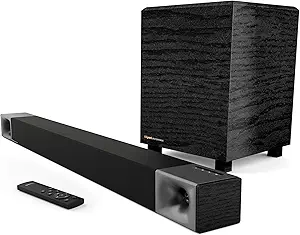
Klipsch vs BESTISAN: Overview
Comparing Klipsch and BESTISAN helps you determine which brand is best suited for your needs in Soundbars. Both brands offer strong choices depending on your budget and key feature requirements.
Key Features & Comparison
Evaluate factors such as build quality, warranty, customer satisfaction, and total value before making your final purchase choice between Klipsch and BESTISAN.
Product Selection
Klipsch approaches product selection from an enthusiast-grade audio perspective, engineering a curated lineup of premium home theater soundbars. Their portfolio primarily centers on advanced ecosystems like the Cinema and Reference series, spanning from capable 2.1-channel setups to sophisticated 5.1.4 Dolby Atmos systems. Klipsch designs its soundbars with modular expansion in mind, frequently incorporating dedicated wireless subwoofers with large, high-excursion drivers and offering optional wireless surround satellite speakers. This tiered catalog targets consumers seeking an authentic, cinematic soundstage with HDMI eARC integration, advanced acoustic horn technology, and multi-room wireless streaming capabilities.
Conversely, BESTISAN focuses on the ultra-accessible, entry-level segment, presenting a utilitarian selection of compact and budget-friendly soundbars. Their catalog predominantly consists of standalone 2.0-channel stereo bars and compact 2.1 configurations tailored for desktop gaming monitors, small bedrooms, or secondary televisions. While BESTISAN offers variations in physical length and driver arrays, their ecosystem lacks true spatial audio formats like Dolby Atmos, modular expansion options, or high-tier smart features. Instead, they cater efficiently to consumers seeking basic TV audio replacements without the complexity or physical footprint of a multi-component theater setup.
Design/Look
Klipsch distinguishes itself through an iconic, industrial aesthetic that borrows heavily from its legendary heritage hi-fi loudspeakers. Klipsch soundbars frequently incorporate real wood finishes, woven textured grilles, and exposed, signature copper-spun Tractrix horn-loaded tweeters that make a bold, decorative statement beneath modern televisions. The subwoofers accompanying these units are similarly robust, featuring heavy MDF cabinets designed to dampen internal resonance. This deliberate, furniture-grade craftsmanship appeals directly to audiophiles who appreciate high-end visual appeal and structural durability alongside their acoustics.
In stark contrast, BESTISAN adopts an unassuming, minimalist aesthetic designed to blend discreetly into compact entertainment spaces. Their enclosures rely primarily on molded ABS plastics, matte-finished synthetic polymers, and lightweight metal or cloth front grilles. While BESTISAN soundbars are clean, modern, and reasonably well-assembled for their price point, they prioritize unobtrusive utility over premium acoustic styling. The lack of genuine wood, metallic accents, or luxury materials clearly demarcates BESTISAN as a practical, utilitarian solution rather than a visual centerpiece.
Affordability
When analyzing consumer affordability, Klipsch occupies the upper-mid to premium tier of the market, with prices reflecting their proprietary acoustic research and high-grade materials. Investing in a Klipsch system entails a significant capital outlay, often ranging from mid-tier investments to premium four-figure price tags for flagship Dolby Atmos configurations. However, this cost is justified for serious listeners by the inclusion of heavy-duty materials, powerful amplification, complex DSP, and a clear path for future satellite expansions, representing long-term value for home theater aficionados.
BESTISAN, on the other hand, operates almost exclusively in the extreme budget tier, frequently pricing their products well below the entry barrier of established acoustic brands. Their soundbars provide maximum immediate utility per dollar spent, making them an accessible option for students, rental apartments, or auxiliary rooms where a high-end audio setup is financially impractical. The trade-off for this exceptional affordability is the omission of proprietary driver engineering, certified surround codecs, and high-end digital connectivity like HDMI eARC, but for cost-sensitive buyers, the value proposition remains compelling.
Sound Quality
The acoustic output of Klipsch soundbars is defined by dynamic range, low distortion, and the brand's proprietary Tractrix horn-loaded technology. This acoustic engineering provides exceptionally focused high frequencies, pinpoint dialogue intelligibility, and high acoustic efficiency that easily fills large open-concept living rooms. Paired with tuned DSP modes and commanding down-firing or front-firing subwoofers capable of sub-30Hz low-frequency extension, Klipsch delivers an impactful, cinema-grade experience with thunderous bass and nuanced spatial imaging suited for both complex film soundscapes and high-fidelity music playback.
BESTISAN provides a significant step up from standard, thin flat-screen television speakers, offering clearer vocal presentation and basic stereo separation. However, due to smaller full-range drivers, compact enclosures, and modest internal amplification, the sound profile lacks true sub-bass weight, macro-dynamic impact, and wide-stage realism. At higher volumes, BESTISAN units can struggle with cabinet resonance and compression, narrowing the soundstage. While completely adequate for casual television viewing, podcasts, and basic gaming, they cannot match the physical displacement, low-end authority, or pristine acoustic precision engineered into Klipsch sound systems.