Bose vs Klipsch: Overview
Comparing Bose and Klipsch helps you determine which brand is best suited for your needs in Soundbars. Both brands offer strong choices depending on your budget and key feature requirements.
Key Features & Comparison
Evaluate factors such as build quality, warranty, customer satisfaction, and total value before making your final purchase choice between Bose and Klipsch.
Product Selection
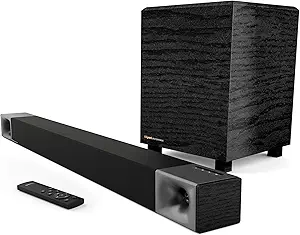
Klipsch focuses its soundbar lineup heavily on high-output home theater integration, categorizing models primarily through its dedicated Cinema and Flexus series. The catalog ranges from compact 2.1-channel systems to expansive 5.1.4 Dolby Atmos packages that utilize modular expansions, allowing consumers to add proprietary wireless subwoofers and surround speakers. Klipsch structures its selection around acoustic scale and traditional speaker engineering, offering fewer lifestyle-oriented micro-bars in favor of full-sized enclosures equipped with large, dedicated subwoofers right out of the box.
Bose approaches product selection through a cohesive, multi-room ecosystem characterized by its Smart Soundbar portfolio, spanning entry-level standalone bars to flagship models like the Smart Ultra Soundbar. Rather than emphasizing bundled physical hardware, Bose prioritizes scalable, software-driven solutions where individual components—such as the Bass Module series and Surround Speakers—can be added incrementally. Additionally, Bose maintains standalone options tailored for dialogue clarity in smaller bedrooms, such as the TV Speaker, giving them a broader reach for casual listeners who prioritize smart connectivity over raw channel configuration.
Design/Look
Klipsch soundbars showcase an unapologetic, industrial aesthetic that mirrors the brand's heritage hi-fi cabinet designs. Utilizing real wood finishes, exposed horn-loaded tweeters, and tactile analog-style controls, Klipsch builds hardware that intentionally stands out as a piece of classic audio furniture. However, this traditional aesthetic comes with significant physical bulk; their soundbars tend to feature deeper profiles and substantial footprints, making them less suited for tight wall-mount clearances or minimalist media consoles.
Bose establishes the industry benchmark for modern minimalism, utilizing low-profile enclosures crafted with seamless metal grilles, impact-resistant glass tops, and subtle matte finishes. The design philosophy emphasizes invisibility and integration, engineered to tuck beneath low-clearance televisions without obscuring the screen or IR sensors. While Bose enclosures blend effortlessly into contemporary living spaces, their reflective tempered-glass surfaces can introduce unwanted glare from bright television screens, representing a functional trade-off against their sleek, luxury finish.
Affordability
Klipsch generally delivers a higher ratio of physical hardware per dollar, frequently bundling heavy-hitting, dedicated wireless subwoofers with their mid-tier and flagship bars at competitive pricing. Because Klipsch relies on standard acoustic volume and traditional transducer technology rather than proprietary software ecosystems, entry-level and mid-range packages offer consumers an accessible route to genuine cinematic bass without requiring expensive separate add-ons. Furthermore, legacy Klipsch models see significant retail discounts, enhancing their value proposition for budget-conscious home theater enthusiasts.
Bose commands a distinct premium that reflects its extensive digital signal processing, smart voice assistant integration, and high-end materials. The initial barrier to entry for a flagship Bose system is steep, and because bass modules and satellite speakers are sold separately at high price points, building a complete physical surround system demands a substantial financial investment. While consumers pay more up front, the cost is balanced by long-term firmware support, strong resale value, and the versatility of a unified whole-home audio network.
Sound Quality
Klipsch soundbars leverage the company's signature Tractrix horn-loaded tweeters and custom woofers to deliver exceptional dynamic range, visceral impact, and lifelike dialogue clarity. High-frequency dispersion is focused and efficient, reducing room reflections and ensuring that movie effects cut through complex mixes with surgical precision. Paired with substantially ported, high-excursion subwoofers, Klipsch systems deliver deep, tactile low-end that physical home theater purists crave, though the bright, aggressive treble profile can occasionally induce listener fatigue during prolonged, high-volume music playback.
Bose relies on proprietary psychoacoustic engineering, PhaseGuide directional arrays, and advanced ADAPTiQ room calibration to project a soundstage that sounds far larger than the physical bar itself. Midrange reproduction is balanced and natural, rendering human voices with warmth and exceptional intelligibility even without a separate center channel. However, standalone Bose bars depend heavily on algorithmic processing to simulate lower frequencies, meaning they cannot replicate true subterranean bass impact unless paired with an expensive external bass module.