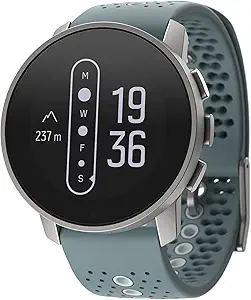






Huawei vs SUUNTO: Overview
Comparing Huawei and SUUNTO helps you determine which brand is best suited for your needs in Smart Watch. Both brands offer strong choices depending on your budget and key feature requirements.
Key Features & Comparison
Evaluate factors such as build quality, warranty, customer satisfaction, and total value before making your final purchase choice between Huawei and SUUNTO.
Battery Life
When examining battery endurance, SUUNTO and Huawei approach power management with fundamentally different design philosophies tailored to distinct user bases. SUUNTO excels in high-drain, precision-intensive scenarios, engineering its watches like the Suunto Vertical to provide class-leading GPS operational longevity. By integrating advanced dual-band multi-GNSS tracking with intelligent power profiles and optional solar charging, SUUNTO watches can deliver anywhere from 60 to an extraordinary 500 hours of continuous activity tracking depending on the battery mode. This makes them indispensable tools for ultra-endurance athletes and backcountry explorers who require absolute reliability over days or weeks in the wilderness without access to a charger.
Conversely, Huawei focuses on maximizing multi-week battery performance for daily smartwatch use through a lightweight, dual-chipset architecture and proprietary real-time operating systems (HarmonyOS). Models such as the Huawei Watch GT 4 and Watch Ultimate consistently provide between 7 to 14 days of typical smartwatch usage with continuous heart rate monitoring, sleep tracking, and regular notification syncs active. While Huawei devices handle standard workouts admirably, their continuous satellite-tracking stamina falls short of SUUNTO's specialized adventure endurance. Therefore, Huawei is optimal for users seeking hassle-free, infrequent charging cycles in everyday contexts, whereas SUUNTO remains the master of protracted, mission-critical expedition battery management.
Build Quality & Durability
SUUNTO has forged a storied reputation in Scandinavian industrial design, prioritizing rugged utility, repairability, and extreme environmental resilience. Crafted largely in Finland using 100% renewable energy, flagship models feature premium aerospace-grade materials, including sapphire crystal lenses, titanium grade 5 bezels, and glass-fiber reinforced polyamide casings. Built to exceed stringent military standards (MIL-STD-810H), SUUNTO watches are engineered to withstand thermal shock, prolonged freezing temperatures, heavy impacts, and hydrostatic pressure up to 100 meters. The physical aesthetics are undeniably utilitarian, featuring prominent mechanical pushers optimized for use with thick winter gloves or in torrential conditions.
Huawei, by contrast, bridges the gap between rugged durability and high-end horological luxury. The brand heavily leverages luxury watchmaking materials, famously utilizing zirconium-based amorphous liquid metal in the Watch Ultimate, accompanied by nanotech ceramic bezels and sapphire glass. While Huawei watches often achieve comparable 100-meter or diving-grade ISO 22810 water resistance ratings, their design language leans distinctly more executive and fashion-forward. The trade-off centers on intent: SUUNTO is built as a pure, scratch-resistant instrument designed to survive brutal mountain expeditions, whereas Huawei delivers sophisticated, high-tensile jewelry engineered to endure both the boardroom and demanding recreational dives with seamless grace.
Health & Fitness Tracking
In the domain of fitness tracking, SUUNTO operates as a deep analytical platform for structured training, periodization, and endurance performance. Utilizing advanced algorithms powered by Firstbeat and its proprietary SuuntoPlus ecosystem, SUUNTO tracks training load, recovery status, and Training Stress Score (TSS) with surgical precision. The user interface eschews superficial gamification in favor of actionable metrics like vertical ascent speed, power output via Stryd or cycling meters, and breadcrumb/topographic navigation. While SUUNTO delivers baseline health tracking such as sleep duration and continuous optical heart rate, its primary analytical strength lies in converting raw biometrics into meaningful endurance training adaptations.
Huawei takes a broader, consumer-centric approach through its highly sophisticated TruSeen biometric sensor arrays and TruSleep algorithms, which offer some of the most consistent optical accuracy in the mainstream consumer market. Huawei’s portfolio often incorporates clinical-grade capabilities, including on-demand ECG analysis, arterial stiffness detection, and peripheral SpO2 tracking, catering exceptionally well to preventive wellness. Although Huawei has expanded its sports tracking repertoire to include hundreds of athletic profiles and precise route tracking, its post-activity analytics skew toward casual and semi-serious fitness enthusiasts. Users seeking holistic wellness dashboards and medical-adjacent sensors will favor Huawei, while dedicated athletes demanding rigorous workload analysis will find SUUNTO vastly superior.
Smart Features & Connectivity
Smart features and software ecosystem connectivity highlight a stark divergence in operational priorities. SUUNTO maintains a strictly minimalist approach to smart connectivity, intentionally minimizing distractions to preserve battery life and cognitive focus. Its watches handle basic push notifications, offer music playback control for paired smartphones, and integrate deeply with third-party fitness hubs like Strava, TrainingPeaks, and Komoot. However, SUUNTO lacks modern smartwatch amenities such as an onboard voice assistant, independent cellular (LTE) connectivity, contactless payments in most models, or interactive third-party application stores capable of running standalone software.
Huawei provides a markedly more comprehensive, modern smartwatch experience powered by HarmonyOS. While operating under certain third-party ecosystem limitations outside of Asian markets, Huawei watches still provide rich interactive capabilities, including Bluetooth calling with onboard microphones and speakers, localized music storage, voice assistant integration, and access to the Huawei AppGallery. The touch interfaces are vibrant and fluid, leveraging high-resolution AMOLED panels that make reading messages and navigating watch widgets effortless. For consumers who view a wearable primarily as an intelligent extension of their smartphone, Huawei easily outclasses SUUNTO’s deliberately spartan and sport-focused connectivity suite.