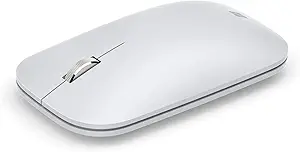
Logitech vs Microsoft: Overview
Comparing Logitech and Microsoft helps you determine which brand is best suited for your needs in Mouse. Both brands offer strong choices depending on your budget and key feature requirements.
Key Features & Comparison
Evaluate factors such as build quality, warranty, customer satisfaction, and total value before making your final purchase choice between Logitech and Microsoft.
Features
Logitech decisively leads in functional feature density, especially across its flagship professional and gaming lines. The company's hallmark innovations, such as the MagSpeed electromagnetic scroll wheel found on the MX Master series, provide an unmatched tactile experience by switching dynamically from precision click-to-click ratcheting to hyper-fast free-spinning at up to 1,000 lines per second. Furthermore, Logitech's companion software suites—Logi Options+ and G HUB—offer granular customization, application-specific macros, and sophisticated cross-computer file transfer capabilities via Logitech Flow. In the gaming tier, features like the Powerplay wireless charging mat system showcase Logitech's drive to solve fundamental user pain points through proprietary hardware-software synergies.
Microsoft's approach to features is historically conservative, centering on fundamental utility rather than deep software layers. While mice like the Microsoft Surface Precision Mouse feature multi-device smart switching and assignable side buttons via the Microsoft Mouse and Keyboard Center, the options are notably more limited in scope and platform flexibility. Many of Microsoft's mobile mice rely on basic touch strips or standard mechanical wheels that lack the kinetic feedback or high-speed navigation of Logitech's counterparts. For users who prefer a stripped-down, bloat-free configuration that operates purely at the driver level, Microsoft remains appealing, but it falls well short for power users demanding sophisticated automation and advanced button remapping.
Performance
In raw technical performance, Logitech holds an enormous advantage driven by its proprietary sensor developments. The brand's HERO (High Efficiency Rated Optical) sensor family delivers up to 32,000 DPI with sub-micron tracking accuracy, zero smoothing, and virtually no acceleration, all while drawing significantly less power than industry-standard optical units. Combined with Logitech's LIGHTSPEED wireless protocol—which achieves report rates down to 0.25 milliseconds—their mice match or exceed the latency metrics of standard wired connections. Even within the non-gaming MX productivity series, Darkfield sensors provide flawless tracking on virtually any surface, including high-gloss transparent glass with a minimum thickness of 4mm.
Microsoft's performance capabilities are tailored toward office precision rather than high-velocity tracking or zero-latency competitive play. The brand's proprietary BlueTrack technology offers dependable tracking on challenging surfaces like granite, carpet, and unfinished wood, making it exceptional for travel and variable work environments. However, Microsoft mice generally operate at modest polling rates (typically 125Hz to 500Hz) and lower maximum DPI ceilings, rendering them unsuitable for high-refresh-rate gaming or intense pixel-level digital artistry. While Microsoft delivers unwavering stability and zero jitter for document editing, spreadsheets, and web browsing, it lacks the performance ceiling and ultra-low latency architecture that Logitech routinely provides.
Design
Logitech's design philosophy is dictated by specialized ergonomics and material refinement. Their productivity flagships embrace sweeping, asymmetrical thumb rests, intuitive gesture controls integrated into the chassis, and dual-axis scroll wheels that drastically reduce repetitive strain. At the same time, Logitech has invested heavily in progressive ergonomic health, as seen in the vertical MX Vertical and Lift models designed to promote a neutral 57-degree handshake posture. Build quality across their higher tiers blends soft-touch rubberized coatings, premium plastics, and machined aluminum accents, creating a balance of durability, tactile grip, and sophisticated modern aesthetics.
Microsoft's industrial design language is historically distinctive and deeply influential, marked by sweeping organic contours and minimalist Scandinavian-inspired forms. The Sculpt Ergonomic Mouse, with its distinctive spherical, high-domed shape, remains one of the most effective solutions for pronation relief and carpal tunnel alleviation. Additionally, the Arc Mouse series exhibits remarkable industrial ingenuity, snapping into an ergonomic curve for power-on and flattening into a sleek, ultra-portable profile for transit. Microsoft generally favors clean, matte finishes and minimalist branding that mirror the Surface design ethos, offering exceptional visual synergy with modern office hardware even if it lacks the heavy-duty mechanical presence found in Logitech's top-tier peripherals.