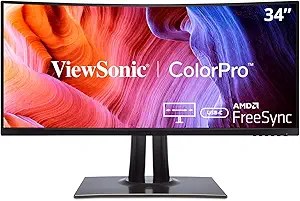






ViewSonic vs Sceptre: Overview
Comparing ViewSonic and Sceptre helps you determine which brand is best suited for your needs in Monitors. Both brands offer strong choices depending on your budget and key feature requirements.
Key Features & Comparison
Evaluate factors such as build quality, warranty, customer satisfaction, and total value before making your final purchase choice between ViewSonic and Sceptre.
Affordability
When analyzing the cost-to-performance ratio between these two display manufacturers, Sceptre firmly positions itself as an aggressive budget disruptor in the consumer space. Sceptre's product portfolio is engineered around stripping out non-essential luxuries—such as advanced ergonomic stands, internal USB hubs, and certified HDR hardware—to deliver entry-level and intermediate gaming monitors at prices that routinely undercut the market. Buyers on a strict budget can frequently acquire high-refresh-rate VA panels (ranging from 144Hz to 240Hz) or ultra-wide displays from Sceptre for the same price that established competitors charge for standard 60Hz or 75Hz office panels. This pricing strategy makes Sceptre exceptionally appealing for cash-conscious gamers and students seeking maximum raw specifications per dollar.
ViewSonic, by contrast, operates with a wider tiered pricing matrix that stretches from accessible office displays to high-end, color-critical studio monitors. While ViewSonic's entry-level VA and Omni gaming series compete closely with Sceptre on price, they generally command a 15% to 25% premium for comparable base specifications. However, this increased cost is usually balanced by better standard equipment, including more versatile stands, certified low-blue-light technology, and broader connectivity suites (such as DisplayPort and USB-C). Consequently, Sceptre represents pure, uncompromising upfront value for basic utility, whereas ViewSonic offers nuanced affordability where modest price increases directly translate to better daily ergonomics and panel reliability.
Customer Support & Warranty
The long-term ownership experience presents a significant divergence in corporate infrastructure, post-purchase reliability, and technical service. ViewSonic stands out as an enterprise-grade institution with a robust, well-established global support presence. Most ViewSonic consumer and professional monitors are backed by an industry-standard three-year limited warranty covering parts, labor, and the backlight. Furthermore, ViewSonic frequently provides clear, consumer-friendly pixel performance guarantees (such as strict dead-pixel policies) and streamlined Advanced Replacement services, particularly for their enterprise and ColorPro series. Their customer service pipeline features responsive multi-channel support, making warranty claims and technical troubleshooting relatively predictable and transparent.
Sceptre handles customer service on a far more lean and transactional operational model, which mirrors its ultra-low pricing tier. The brand typically offers a standard one-year limited warranty on most display panels, though select units carry three years depending on the retailer and model line. Navigating Sceptre's RMA process often requires consumers to cover outgoing shipping costs for repairs, and their dead-pixel tolerances are generally less forgiving than ViewSonic's rigorous standards. While Sceptre's domestic customer phone lines are accessible, user experiences highlight longer response intervals and less technical flexibility compared to ViewSonic's seasoned enterprise-grade apparatus.
Picture Quality
Picture quality reveals fundamental differences in panel sourcing, factory calibration, and target application. Sceptre relies heavily on high-contrast Vertical Alignment (VA) panels across its popular curved and gaming monitor lines. These displays excel in dark-room contrast ratios—often exceeding 3000:1—producing deep blacks that make them compelling for immersive media consumption and casual gaming. However, Sceptre monitors often display noticeable ghosting and black-level smearing during fast-paced motion due to slower pixel response times. Furthermore, out-of-the-box color accuracy tends to skew cool or over-saturated, with limited gamma control and viewing angles that degrade significantly off-axis.
ViewSonic provides a far more refined visual experience driven by mature image processing and diverse panel implementations. With specialized lineups like the ColorPro (VP series) and Omni (XG and VX series), ViewSonic utilizes high-grade IPS panels capable of covering broad color gamuts including 100% sRGB, Adobe RGB, and DCI-P3 with Delta E < 2 factory calibration right out of the box. Motion handling on ViewSonic gaming monitors is superior, featuring well-implemented overdrive stages that minimize inverse ghosting and motion blur. For professional photography, graphic design, and video grading, ViewSonic’s panel uniformity, color fidelity, and viewing angles vastly outperform anything in Sceptre’s hardware catalog.
Build Quality & Durability
The physical construction of a monitor dictates its longevity, thermal dissipation, and day-to-day usability. ViewSonic exhibits deliberate industrial design principles, leveraging rigid, high-density plastics and reinforced metal internal chassis that resist creaking and panel flex. Their professional and higher-tier gaming lines routinely include premium stands featuring full 4-axis adjustability (height, tilt, swivel, and 90-degree pivot), which eliminates the need to buy third-party monitor arms. The internal power boards and backlights used by ViewSonic have historically proven durable over years of continuous operation, reflecting their heavy presence in demanding corporate and educational environments.
Sceptre adopts a visibly lighter and more minimalist build philosophy that reflects its cost-cutting measures. Thin plastic bezels and hollow-feeling chassis are standard, and the included stands are often limited strictly to tilt adjustments, lacking height or swivel functionality. Additionally, Sceptre stands can exhibit wobble under vigorous desktop typing, compelling many users to utilize the integrated VESA mount holes for aftermarket arms. While Sceptre monitors are perfectly capable of enduring standard daily use without structural failure, their reliance on external power bricks and lighter assembly tolerances makes them feel substantially less substantial than ViewSonic's workhorse enclosures.