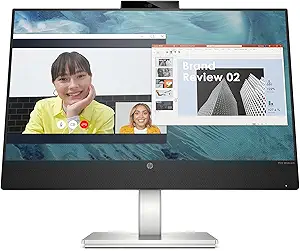





HP vs Sceptre: Overview
Comparing HP and Sceptre helps you determine which brand is best suited for your needs in Monitors. Both brands offer strong choices depending on your budget and key feature requirements.
Key Features & Comparison
Evaluate factors such as build quality, warranty, customer satisfaction, and total value before making your final purchase choice between HP and Sceptre.
Affordability
When analyzing price-to-performance metrics, Sceptre stands out as an aggressive disruptor focused almost entirely on entry-level affordability. By trimming down non-essential features, utilizing generic chassis molds, and leveraging high-yield VA panel supplies, Sceptre consistently undercuts the broader display market. Budget-conscious consumers, students, and entry-level gamers frequently gravitate toward Sceptre because the brand provides higher refresh rates (often 75Hz to 165Hz) and curved displays at price points where traditional legacy competitors only offer basic 60Hz flat panels. The trade-off for this exceptionally low cost of entry is typically found in less refined ergonomics, basic onboard electronics, and minimal included accessories.
HP approaches affordability through tiered economy-of-scale production rather than absolute rock-bottom pricing. While HP's entry-level consumer models (such as the HP V and M-series) carry a modest price premium compared to Sceptre, they frequently compensate with better overall panel consistency, integrated cable management, and more polished industrial designs. HP also benefits from enterprise-level manufacturing volume, allowing them to offer frequent commercial discounts, seasonal retail sales, and bundled packages. While Sceptre nearly always wins the raw upfront cost comparison, HP provides a more predictable value proposition where the slight price increase directly reflects superior baseline quality control and brand reliability.
Customer Support & Warranty
HP operates one of the most mature global service networks in the technology sector, translating into robust post-purchase support infrastructure for monitor owners. Most consumer HP displays come standard with a limited one-year warranty, while their commercial lines (like the E-series and Z-series) frequently extend to three or even five years with advanced unit replacement. HP's technical support ecosystem includes 24/7 web chat, dedicated phone lines, automated diagnostic software, and easily accessible firmware updates. While navigating HP's enterprise-focused automated phone trees can occasionally be cumbersome for consumer inquiries, their capacity to fulfill warranty claims, process replacements, and source proprietary replacement parts is far superior to budget-tier competitors.
Sceptre operates on a much leaner domestic support model, which reflects its low-margin business philosophy. The company offers a standard one-year limited warranty across the majority of its monitor portfolio, handled primarily via email tickets and limited phone hours during standard business times. While consumers occasionally report straightforward RMA processes for out-of-the-box defects, the overall support experience lacks the polish and extensive resources of a global conglomerate. Users may encounter slower turnaround times for repairs or replacements, less comprehensive troubleshooting documentation, and fewer proactive firmware or driver fixes, making Sceptre a brand best suited for self-sufficient users comfortable managing minor technical hurdles independently.
Picture Quality
In visual fidelity and panel engineering, HP prioritizes color accuracy, viewing angles, and natural image rendition across its diverse monitor lineup. HP heavily utilizes In-Plane Switching (IPS) panels across both consumer and professional displays, delivering broad 178-degree viewing angles, consistent gamma tracking, and tight sRGB coverage straight out of the box. Mid-to-high tier HP monitors often feature factory calibration reports, matte anti-glare coatings with minimal grain, and sophisticated backlight uniformity compensation. While HP's peak brightness levels on mainstream displays are generally average (typically 250 to 300 nits) and their native contrast ratios adhere to standard IPS limits (roughly 1000:1), the overall visual tuning is refined, balanced, and fatigue-free for long productivity and creative workflows.
Sceptre relies heavily on Vertical Alignment (VA) panel technology to drive both its flat and curved monitor offerings, resulting in a fundamentally different visual signature. Sceptre displays excel at deep native contrast ratios—frequently reaching 3000:1 or higher—which allows for much deeper blacks and punchier performance in dark-room gaming or media playback. However, this comes at the expense of color fidelity and viewing angles. Colors can shift noticeably when viewed off-axis, factory color calibration is largely non-existent, and panel overdrive tuning is often unrefined, leading to perceptible ghosting or black-smearing during fast-motion scenes. For casual entertainment and cost-effective gaming, Sceptre delivers impressive vibrance and contrast, but it lacks the visual precision and refined image processing engineered into HP's displays.
Build Quality & Durability
HP’s build quality reflects an adherence to strict corporate ergonomics and long-term hardware reliability. Even their entry-level monitors typically feature sturdy cast-aluminum or dense composite stands, rigid back housings, and tight chassis tolerances that minimize backlight bleed caused by frame warping. Higher-end HP displays feature fully articulated stands offering tilt, swivel, pivot, and height adjustments with smooth mechanical tensioning. Internal componentry—ranging from internal power supplies to display scaler boards—is engineered to meet commercial durability standards, meaning HP monitors routinely endure years of continuous operational cycles without panel degradation, capacitor failure, or excessive port looseness.
Sceptre's hardware engineering is markedly minimalist, prioritizing cost containment over rugged structural integrity. The majority of Sceptre monitors utilize lightweight, hollow plastics, and their included stands are often rudimentary, providing only basic forward and backward tilt with noticeable wobble on less stable desks. Additionally, Sceptre frequently relies on external power bricks that can run hot and introduce clutter, and panel assembly tolerances can vary, sometimes resulting in minor bezel gaps or localized edge-lit backlight bleed. While Sceptre monitors are generally durable enough to sit undisturbed on an office desk or VESA mount for several years, they lack the physical refinement, premium materials, and structural resilience inherent in HP’s hardware designs.