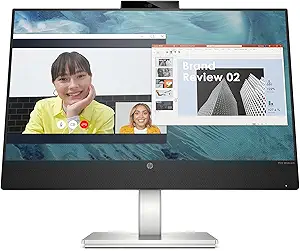
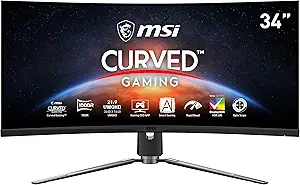
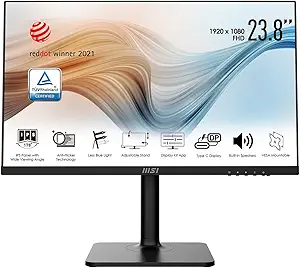
HP vs MSI: Overview
Comparing HP and MSI helps you determine which brand is best suited for your needs in Monitors. Both brands offer strong choices depending on your budget and key feature requirements.
Key Features & Comparison
Evaluate factors such as build quality, warranty, customer satisfaction, and total value before making your final purchase choice between HP and MSI.
Affordability
When assessing affordability in the monitor space, HP approaches cost-efficiency through the lens of utilitarian, general-purpose computing and enterprise deployment. HP excels in the ultra-budget to mid-range productivity segments, with lines like the HP V-Series and M-Series frequently undercutting competitors. From an engineering standpoint, HP manages low price points by prioritizing slim, modern industrial design, basic sRGB color accuracy, and reliable, mass-produced IPS or VA panels over high-bandwidth interfaces and robust ergonomic mechanics. The trade-off for HP's aggressive pricing is often found in the feature set: budget models typically omit height-adjustable stands, restrict refresh rates to 60Hz or 75Hz, lack built-in USB hubs, and frequently use external power bricks. For corporate rollouts, students, and telecommuters seeking crisp text and dependable 1080p or 1440p real estate without paying a premium for enthusiast-grade hardware, HP delivers exceptional baseline value.
Conversely, MSI approaches affordability from a performance-per-dollar metric, focusing heavily on budget-conscious gamers and content creators through its Optix and MAG product families. While MSI’s absolute entry-level monitors may start at a slightly higher price point than HP’s cheapest desktop displays, MSI drastically outperforms HP in feature density relative to cost. An entry-level investment with MSI routinely nets high-refresh-rate panels (144Hz to 180Hz), low gray-to-gray (GtG) response times, and adaptive sync technologies (AMD FreeSync and G-Sync compatibility), often paired with aggressive 1500R or 1000R panel curvatures. MSI’s technical engineering sacrifices some chassis refinement—often using thicker, gaming-aesthetic plastics and basic tilt-only stands at the lower end—to channel the bill of materials into better panel controllers, wider color gamuts (covering DCI-P3), and intuitive on-screen display (OSD) navigation via physical joysticks rather than clunky, legacy buttons.
Ultimately, the choice between HP and MSI in terms of affordability hinges on how a consumer defines value. HP wins on absolute price floor, making it the superior economic choice for standard home-office productivity, secondary informational screens, and non-demanding workflows where low power consumption and minimalistic desk footprints are prioritized over raw panel speed. MSI represents superior value engineering for mixed-use users, offering substantially more processing horsepower, frame-rate fluidity, and gaming-centric software utilities at accessible sub-$200 price thresholds. If your budget is strictly constrained to the lowest spend for basic visual output, HP is the pragmatic leader; if you measure affordability by how many high-tier technical specifications you can purchase per dollar, MSI is the clear winner.
Customer Support & Warranty
When evaluating customer support infrastructure and warranty protections in the monitor market, HP leverages its massive enterprise-grade supply chain to offer a remarkably consistent, user-friendly service ecosystem. HP typically provides a standard three-year limited warranty across the majority of its business, productivity, and upper-tier OMEN gaming displays, with one-year coverage usually reserved only for budget consumer panels. A significant engineering and quality-assurance strength of HP is its zero-bright-dot guarantee on premium panels, alongside an exceptionally robust Advanced Exchange service. This entitlement ensures that if an issue is validated by diagnostics, a refurbished or new replacement unit is shipped immediately—often before the defective monitor is returned—minimizing downtime for enterprise professionals and gamers alike. In contrast, MSI structures its display warranties primarily around the consumer and esports market, offering standard two-to-three-year warranties depending heavily on the regional distribution and display category (such as their Optix, MAG, or premium MEG series). While MSI has made notable strides in addressing modern hardware trends—such as integrating dedicated three-year burn-in warranties for their QD-OLED panels—their RMA processing predominantly adheres to a standard depot repair model rather than instant exchange, creating inherent latency for the end-user.
From a technical support and diagnostic standpoint, the trade-offs between the two brands reflect their divergent core audiences: corporate-operational utility versus DIY gaming performance. HP’s support channels are globally ubiquitous, benefiting from localized enterprise call centers, centralized fleet-management tools, and direct-integration firmware software (like HP Display Center) that simplifies serial tracking and driver-level debugging. MSI’s technical support, while staffed with agents knowledgeable in display panel overclocks, high-refresh rates, adaptive sync, and console compatibility modes, suffers from a more fragmented web-portal interface and variable regional turnaround times. MSI users frequently report more rigorous scrutiny during dead-pixel claims, as MSI typically enforces standard ISO 13406-2 Class II thresholds (requiring an accumulation of several dark or bright sub-pixels) before an RMA is authorized, unless covered under specific promotional zero-defect tiers. Consequently, HP takes the lead in overall warranty execution, enterprise reliability, and seamless claim turnaround, whereas MSI represents a viable, enthusiast-focused alternative whose support framework requires more customer patience, but rewards buyers with tailored protections on cutting-edge OLED and curved gaming architectures.
Picture Quality
When evaluating picture quality, HP and MSI target distinctly different user priorities through their respective panel engineering and display tuning. HP generally excels in professional, office, and creative color reproduction, particularly within its commercial E-series and premium Z by HP lineups. Leveraging high-grade IPS (In-Plane Switching) and DreamColor technologies, HP monitors prioritize absolute color fidelity, factory calibration, and wide viewing angles. They routinely deliver exceptional coverage of professional color spaces like sRGB, Adobe RGB, and DCI-P3 with low Delta E ratings straight out of the box. While HP’s consumer-tier screens offer clean, balanced output suitable for productivity and media consumption, their panels often cap out at standard refresh rates and exhibit the moderate contrast ratios typical of conventional IPS panels, leaving deep black levels somewhat compromised in dim environments.
In contrast, MSI’s engineering strongly leans toward dynamic, high-engagement visual performance rooted in gaming and high-performance multimedia. MSI heavily utilizes Rapid IPS, high-contrast VA, and cutting-edge QD-OLED (Quantum Dot OLED) panels across its Optix and MAG/MPG lines. By integrating Quantum Dot technology, MSI displays frequently achieve superior peak brightness, higher localized contrast ratios, and intensely saturated, wide color gamuts. In motion reproduction—a critical component of perceived picture quality—MSI drastically outperforms HP’s standard displays by offering hyper-fast refresh rates up to 360Hz and near-instantaneous response times that eliminate motion blur and ghosting. Furthermore, MSI's foray into QD-OLED provides inky, true blacks and virtually infinite contrast that HP’s predominantly LED-backlit portfolio rarely matches outside of specialized creative workstations.
Ultimately, the practical trade-off between the two brands hinges on whether your visual workflow favors calibrated realism or dynamic performance. HP is the superior choice for users demanding uniform color distribution, anti-glare clarity in brightly lit office conditions, and predictable, natural color accuracy for graphic design, photo editing, and extensive desktop use. Conversely, MSI represents the better investment for consumers seeking visual impact, superior HDR processing, and fluid motion handling, offering dramatically deeper contrast and punchier colors that elevate both cinematic immersion and fast-paced gaming environments.
Build Quality & Durability
When assessing the engineering and physical construction of computer monitors, HP and MSI take fundamentally different design paths that cater to distinct core audiences. HP emphasizes corporate resilience and structural understatedness, particularly within its commercial E-Series and high-end Z-Series lines. These displays leverage heavy-gauge matte plastics, integrated metal core columns, and counterbalanced internal steel chassis that offer exceptional rigidity and vibration dampening. In contrast, MSI leans heavily into gaming-oriented manufacturing across its Optix and MAG lines, utilizing aggressive styling with molded geometric plastics, customizable RGB illumination, and wide-span metallic tripod feet. While MSI’s metal-accented stands provide decent structural stability, their consumer-grade exterior shells often feature a higher proportion of lightweight plastics that can exhibit occasional chassis flex and audible creaking under thermal expansion, an issue rarely observed in HP’s rigorously tested business hardware.
In terms of ergonomics and mechanical durability, HP holds a distinct advantage regarding mechanical hardware longevity. HP’s height, swivel, tilt, and pivot mechanisms rely on sealed, high-tension spring-and-piston assemblies designed to endure thousands of adjustments in multi-user office environments without developing the drift or looseness that can plague lower-tier brackets. MSI has notably improved its mechanical engineering in recent years—introducing robust dual-hinge mechanisms on high-tier curved panels and sturdy VESA-compatible toolless mounts—yet their adjustment action frequently feels less fluid, relying on friction-based resistance that can wear unevenly over prolonged usage. Furthermore, MSI’s penchant for aggressive 1000R to 1500R curved screens introduces inherent structural vulnerabilities; the internal bonding stress of curved liquid crystal panels makes them inherently more susceptible to edge separation and impact-related micro-fractures compared to HP’s predominantly flat, stress-relieved panel configurations.
From a longevity and thermal management standpoint, the trade-offs reflect each brand's operational philosophy. MSI excels in cooling high-refresh-rate scaler boards and fast IPS/OLED driving logic by incorporating dedicated heatsinks, passive thermal pads, and extensive ventilation cutouts (and in high-end models, custom graphene films), which effectively safeguards critical internal electronics against thermal degradation. However, HP tends to outpace MSI in overall panel reliability and long-term component survival due to stricter quality control metrics and lower operational thermal envelopes. HP’s internal power supplies and industrial-grade capacitors are engineered for continuous 24/7 duty cycles, whereas MSI panels are engineered for peak burst performance where external power bricks and cosmetic finishes sometimes introduce points of failure. For consumers prioritizing heavy-duty, wobble-free stability and multi-year mechanical resilience, HP represents the safer investment; for users demanding aggressive gaming aesthetics paired with targeted electronic cooling solutions, MSI offers robust engineering tailored to modern performance demands.