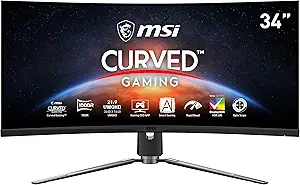
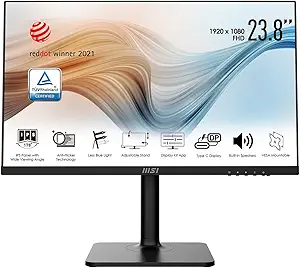
Dell vs MSI: Overview
Comparing Dell and MSI helps you determine which brand is best suited for your needs in Monitors. Both brands offer strong choices depending on your budget and key feature requirements.
Key Features & Comparison
Evaluate factors such as build quality, warranty, customer satisfaction, and total value before making your final purchase choice between Dell and MSI.
Affordability
When analyzing pricing structures, MSI frequently undercuts Dell in the mainstream gaming and entry-level display tiers. MSI heavily focuses on delivering aggressive price-to-performance metrics, packing high refresh rates (144Hz to 240Hz), Rapid IPS panels, and curved VA matrices into monitors that cost significantly less than comparably specced alternatives. For budget-conscious gamers and everyday home office users seeking modern aesthetics and responsive gaming credentials without high overhead, MSI represents a highly cost-effective gateway. However, this affordability can occasionally reflect in feature triage, where cost savings are achieved by omitting fully ergonomic stands, relying on external power bricks, or limiting USB-C power delivery capabilities on mid-range models.
Dell commands a pricing premium across much of its catalog, particularly within its professional P-series, high-end UltraSharp lineup, and dedicated Alienware gaming brand. While Dell's budget S-series monitors compete reasonably well at entry levels, buyers generally pay more per square inch and per hertz compared to MSI. Nevertheless, Dell justifies this higher initial expenditure by bundling superior connectivity solutions, such as high-wattage USB-C hub functionality, daisy-chaining DisplayPort outs, integrated KVM switches, and factory color-calibration. Consequently, while MSI is virtually unbeatable on raw cost-to-frame-rate ratios, Dell offers higher value retention and lower total cost of ownership for productivity-focused environments that require integrated peripheral hubs.
Customer Support & Warranty
Dell sets the corporate benchmark for display warranties and after-sales customer service, presenting a decisive advantage over most competitors. Most Dell UltraSharp, P-series, and Alienware monitors include a comprehensive 3-year warranty backed by their industry-leading Premium Panel Exchange. This guarantee ensures a free panel replacement during the limited warranty period even if only one bright defective pixel is found. Furthermore, Dell's Advanced Exchange Service minimizes operational downtime by shipping replacement units to users before receiving the defective hardware, a critical safeguard for enterprise clients, remote professionals, and mission-critical workflows.
MSI provides a standard limited warranty—typically ranging from one to three years depending on the monitor tier and region—but its support infrastructure is noticeably more consumer-grade and gamer-centric. While MSI has recently improved its OLED warranty policies to include three-year burn-in protection on select high-end QD-OLED models, its pixel-defect tolerances on standard LCDs are generally more restrictive than Dell's zero-bright-dot promise. Additionally, processing RMAs through MSI often requires users to ship the monitor to a regional service depot at their own expense or await standard turnaround times, lacking the seamless, rapid cross-shipping logistics that make Dell the preferred vendor for high-reliability environments.
Picture Quality
In picture quality and color precision, Dell reigns supreme within professional, design-oriented, and hybrid productivity contexts. Through its celebrated UltraSharp line, Dell utilizes advanced IPS Black and high-grade IPS panels capable of reaching up to 2000:1 contrast ratios, exceptional Delta E < 2 factory calibrations, and wide coverage across DCI-P3 and sRGB gamuts. These displays deliver remarkably uniform backlighting, consistent viewing angles, and natural color renditions out of the box, requiring minimal calibration for serious photo editing, video grading, and corporate visual tasks. Even under its Alienware umbrella, Dell leverages state-of-the-art QD-OLED panels that combine pure blacks with reference-grade luminance and color volume.
MSI prioritizes dynamic range, speed, and contrast tuning tailored heavily toward immersion and competitive gaming. In its LCD lineups, MSI relies extensively on high-contrast VA panels and Fast/Rapid IPS solutions designed to eliminate motion blur and ghosting rather than achieve absolute color accuracy. While colors are often vibrant, factory calibrations frequently trend oversaturated to accentuate games and multimedia rather than adhere strictly to creative industry standards. However, MSI has emerged as a powerhouse in the next-generation QD-OLED market with its MPG and MAG series, which rival Alienware's picture quality by offering infinite contrast ratios, near-instantaneous response times, and deep HDR performance, albeit often with more aggressive aggressive tuning and firmware feature suites.
Build Quality & Durability
Dell champions an understated, utilitarian, and exceptionally durable engineering ethos. Built predominantly to endure rigorous enterprise use, Dell displays feature heavy-duty, matte plastics, reinforced internal chassis structures, and some of the best stock monitor stands in the industry. These stands provide ultra-smooth, multi-directional adjustability (tilt, swivel, pivot, and height) with internal cable management channels and robust counterbalancing mechanisms. Dell's thermal management is similarly dependable, ensuring prolonged internal component longevity, silent passive heat dissipation, and structural integrity that resists flex, squeaks, and creaks over years of daily adjustment.
MSI monitors reflect an aesthetic and structural design language oriented toward modern gaming environments, featuring sharper angles, integrated RGB lighting accents, and aggressive profiling. While their top-tier offerings exhibit high structural rigidity, MSI's mid-range and budget brackets tend to incorporate lighter-gauge plastics and stands with broader, desk-consuming V-shaped footprints that occasionally lack full ergonomic articulation. Durability remains solid for standard desktop use, but MSI monitors generally feel less tank-like than Dell's professional units. For users planning to mount their displays on third-party VESA arms, MSI's chassis construction is more than adequate, but Dell maintains the upper hand in terms of factory stand mechanics and enterprise-grade structural fit and finish.