Dell vs Corsair: Overview & Brand Philosophy
The desktop display market features two radically different design philosophies embodied by Dell and Corsair. Dell is a historic titan in the computing space, offering an expansive, mature monitor portfolio that caters to virtually every tier of consumer, enterprise, and creative professional. Through its standard consumer lines, the renowned UltraSharp series, and its Alienware gaming subsidiary, Dell maintains a philosophy centered on ergonomics, color fidelity, panel consistency, and broad market accessibility. Their displays are designed to seamlessly integrate into high-productivity workspaces while scaling up to competitive esports arenas.
Conversely, Corsair entered the monitor arena relatively recently, approaching the market through the lens of performance gaming and hardware enthusiast culture. Rather than attempting to flood the market with budget office panels, Corsair’s philosophy prioritizes high-impact engineering, experimental form factors, and deep ecosystem integration. Known for its peripheral and PC component dominance, Corsair focuses on premium, enthusiast-grade panels—incorporating technologies like flexible OLEDs and ultra-high refresh rate gaming panels aimed squarely at gamers, streamers, and tech early adopters who demand cutting-edge visual experiences.
Key Differences & Technological Comparison
When evaluating panel technologies and internal engineering, the distinctions between Dell and Corsair become immediately apparent. Dell’s technological strength lies in its diverse supply chain relationships and calibrated precision. The brand’s UltraSharp series frequently pioneers advancements in IPS Black technology, which doubles conventional IPS contrast ratios to 2,000:1, offering deep blacks and exceptional viewing angles for creative professionals. Furthermore, via Alienware, Dell has mastered the implementation of Samsung Display’s Quantum Dot OLED (QD-OLED) panels, delivering monitors with unmatched color volume, near-infinite contrast, and high-frequency refresh rates protected by comprehensive anti-burn-in firmware.
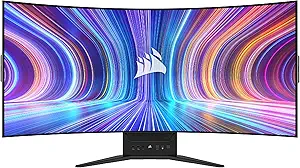
Corsair leans heavily into bleeding-edge display tech, notably utilizing LG Display's White-OLED (W-OLED) panels and innovative mechanical engineering. A prime example is the Corsair Xeneon Flex, which features a bendable OLED panel allowing users to manually adjust the curve from completely flat to an aggressive 800R radius. In addition, Corsair heavily integrates its iCUE software ecosystem, enabling unified RGB lighting control and on-screen display adjustments directly through the desktop environment. While Corsair focuses on extreme gaming agility—boasting 240Hz refresh rates, sub-millisecond response times, and multi-mount desktop solutions—Dell places greater emphasis on productivity connectivity, often equipping its enterprise displays with integrated KVM switches, high-wattage USB-C power delivery, and daisy-chaining DisplayPort features.
Pros & Cons Comparison
Dell Monitors
- Pros:
- Extensive catalog ranging from budget office displays to flagship QD-OLED gaming panels.
- Industry-leading factory color calibration, particularly in the UltraSharp and PremierColor tiers.
- Superior productivity connectivity including RJ45 Ethernet, high-wattage USB-C PD, and integrated KVM switches.
- Market-leading warranty coverage, including an Advanced Exchange Service and 3-year OLED burn-in warranties on Alienware models.
- Cons:
- Aesthetic designs for non-Alienware models are conservative and office-centric.
- OSD (On-Screen Display) controls can be clunky compared to modern software-based suites.
Corsair Monitors
- Pros:
- Daring, enthusiast-first engineering, such as bendable OLED displays and integrated desk-clamp setups.
- Seamless integration with the Corsair iCUE software suite for rapid settings adjustments.
- Purpose-built for gaming performance with premium refresh rates, rapid response times, and AMD FreeSync Premium/NVIDIA G-Sync compatibility.
- Exceptional industrial design and stand aesthetics that appeal to modern gaming and streaming setups.
- Cons:
- Highly limited catalog; virtually no options for budget or entry-level productivity users.
- High barrier to entry with predominantly premium, enthusiast-level pricing.
- Text clarity can lag behind traditional IPS panels due to sub-pixel layouts on select W-OLED models.
Performance, Durability & Value Analysis
From a durability and sustained performance perspective, Dell holds an advantage rooted in its decades of quality control refinement and enterprise deployments. Standard Dell panels are engineered for rigorous, all-day operation, routinely lasting through many years of continuous office use. In high-performance gaming segments, Dell’s Alienware QD-OLED models feature sophisticated heat management, including robust heatsinks and multi-stage pixel refresh cycles that minimize permanent image retention. Backed by standard 3-year warranties with zero-bright-dot policies, Dell represents an exceptionally low-risk investment for both corporate buyers and high-end consumers.
Corsair positions itself strictly in the upper value tier, meaning you pay a premium for hardware innovation and niche functionality. While the structural build quality of Corsair displays is remarkably stout—often featuring heavy cast-aluminum stands and Elgato multi-mount hardware integration—the long-term durability of flexible components (like the Xeneon Flex’s manual bending mechanisms) presents unique considerations compared to static panels. However, Corsair includes comprehensive 3-year burn-in and zero-dead-pixel warranties on its OLED lines, matching industry leaders and giving gamers peace of mind when investing heavily in their flagship monitors.
Final Verdict: Which Brand Should You Choose?
Choosing between Dell and Corsair ultimately depends on your primary computing use case, your budget flexibility, and how deeply you value specialized hardware features:
Choose Dell if: You are a creative professional, enterprise user, or general consumer seeking reliable, color-accurate displays with robust connectivity. Dell is also the premier choice for gamers who want top-tier QD-OLED performance combined with traditional form factors, industry-standard warranties, and strong value across multiple price points.
Choose Corsair if: You are a dedicated PC gamer, content creator, or tech enthusiast building a high-end battlestation. If you prioritize extreme immersion, desire groundbreaking form factors like adjustable-curve OLED panels, or are already heavily invested in the Corsair iCUE ecosystem, Corsair offers a distinctly focused, high-performance experience that Dell’s broader lineup doesn't seek to replicate.
Affordability
Dell commands a decisive advantage over Corsair in overall affordability due to its massive operational scale, diverse product segmentation, and ubiquitous market presence. Dell spans the entire pricing spectrum, offering budget-conscious consumers entry-level SE and S-series productivity panels starting well under $150, alongside mid-range Ultrasharp models and premium Alienware gaming displays. Because Dell engineers and sources panels in tremendous volume for corporate enterprises and general consumers alike, they achieve manufacturing efficiencies that keep entry-level price-to-performance ratios exceptionally low. Even within Dell’s gaming ecosystems, budget-focused options like the Dell G-Series provide robust refresh rates, FreeSync support, and dependable build quality without enforcing the high financial barrier typically associated with specialized gaming peripherals.
Conversely, Corsair does not participate in the budget or entry-level display market, instead positioning its monitor portfolio squarely within the premium enthusiast and high-end gaming tiers. With product lines such as the Xeneon series, Corsair targets power users by engineering displays equipped with cutting-edge OLED panels, rapid response times, bendable form factors (like the Xeneon Flex), and tight integration with their proprietary iCUE software ecosystem. Consequently, Corsair’s baseline pricing frequently begins where Dell’s mid-tier ends, often starting near or above $500 and soaring well past $1,500. While Corsair justifies these prices with aluminum stands, high-density quantum dot displays, and generous warranty packages including zero-dead-pixel guarantees, they offer virtually no options for users seeking simple daily functionality or cost-effective performance.
From an analytical standpoint, the practical trade-off between the two brands centers on accessibility versus specialized luxury. Dell excels in deliverable value across all price brackets, offering reliable color accuracy, solid ergonomic engineering, and extensive warranties that make even their lowest-priced models strong long-term investments. Corsair provides undeniably high-grade build quality and technical innovation, but its definition of value relies entirely on delivering enthusiast-grade specs rather than cost-conscious utility. For consumers where affordability is the primary purchasing metric, Dell is the undisputed victor, while Corsair remains a luxury investment strictly reserved for enthusiasts with expansive budgets.
Customer Support & Warranty
Dell sets an industry benchmark for enterprise-grade customer support and post-purchase assurance, particularly through its dedicated UltraSharp and Alienware gaming monitor lineups. Dell backs the vast majority of its professional and gaming displays with a three-year Advanced Exchange Service, which ensures a replacement unit is shipped out the next business day before the defective monitor is even returned, virtually eliminating operational downtime. A major technical advantage in Dell's favor is its Premium Panel Exchange policy, which guarantees a free screen replacement during the limited hardware warranty period even if only a single bright sub-pixel is discovered. Furthermore, Dell's OLED displays—predominantly found in its Alienware division—include explicit three-year coverage against burn-in, backed by comprehensive firmware-level mitigation protocols (such as pixel refresh and thermal cooling architectures) designed to reduce burn-in incidence over prolonged usage.
Corsair takes an aggressively competitive, gamer-centric approach to monitor support, offering a standard three-year warranty across its innovative Xeneon display portfolio. Corsair has notably engineered its modern OLED monitors—such as the bendable Xeneon Flex—with robust thermal dissipation and sophisticated image-retention algorithms, pairing these hardware safeguards with a comprehensive three-year "Zero Burn-In" and "Zero Dead Pixel" guarantee. Corsair’s pixel policy strictly mandates a replacement if even a single bright pixel or six or more dark sub-pixels are detected. While Corsair’s direct technical support channels, ticketing systems, and community forums provide responsive and enthusiast-friendly assistance, their standard RMA procedure generally requires shipping the display back for inspection before a replacement is dispatched, lacking the frictionless logistics of Dell's immediate advance shipping.
From a comparative analysis standpoint, the operational trade-offs center heavily on institutional logistics versus enthusiast accommodations. Dell offers an unmatched global supply chain, robust phone infrastructure, and enterprise-focused warranty mechanisms that make it the superior choice for professionals, remote workers, and enterprise fleets requiring absolute continuity. Conversely, Corsair matches Dell on high-stakes display coverage—such as pixel anomalies and OLED degradation—while tailoring its support experience to PC gaming enthusiasts who leverage Corsair’s unified iCUE software ecosystem. However, for users whose primary criteria are rapid hardware turnaround and minimal disruption, Dell’s seamless advance replacement programs give it a decisive logistical edge over Corsair’s standard retail-oriented RMA lifecycle.
Picture Quality
Dell and Corsair approach monitor picture quality with fundamentally different engineering philosophies, primarily dictated by their target demographics. Dell dominates the professional, productivity, and mainstream visual spaces, particularly through its UltraSharp lineup. These monitors are industry benchmarks for color precision, featuring factory-calibrated Delta E < 2 accuracy, expansive color gamuts covering near 100% of sRGB, Adobe RGB, and DCI-P3, and cutting-edge IPS Black panel technology. IPS Black significantly enhances traditional IPS limitations by doubling the contrast ratio to 2000:1, yielding deeper blacks and exceptional viewing angles critical for graphic designers, video editors, and colorists. Dell also integrates this disciplined panel tuning into its Alienware gaming division, producing class-leading Quantum Dot OLED (QD-OLED) displays that deliver infinite contrast ratios, pixel-level dimming, and remarkably vibrant, lifelike color reproduction with minimal banding or color bleed.
Conversely, Corsair’s monitor portfolio focuses almost exclusively on high-performance gaming and enthusiast-grade immersion, where picture quality is inextricably linked to contrast dynamism and motion clarity. Corsair leverages advanced OLED and Fast IPS technologies, most notably in their Xeneon series. In Corsair's OLED displays—including pioneering form factors like the bendable Xeneon Flex—the picture quality is characterized by inky, true blacks, intense specular highlights driven by aggressive HDR implementations, and an absence of backlight blooming. Corsair intentionally tunes its image processing for dramatic pop, high peak brightness, and hyper-saturated visuals that excel in dark-room gaming and cinematic consumption. However, Corsair's panels generally sacrifice the out-of-the-box color neutrality and sub-pixel text rendering sharpness found in Dell's productivity lineup, often exhibiting minor color fringing in text-heavy environments due to OLED subpixel layouts.
Ultimately, the trade-off in visual performance between the two brands centers on accuracy and versatility versus immersive contrast dynamics. Dell provides superior engineering consistency across varying price points, delivering unmatched color fidelity, uniform luminance distribution, and superior anti-reflective coatings that maintain image integrity in brightly lit office environments. Corsair delivers a visually arresting, high-contrast spectacle tailored for enthusiasts who prioritize absolute black levels, rapid response times without ghosting, and high-impact HDR rendering in media and gaming. For creative professionals requiring reference-grade fidelity, Dell remains the undisputed victor, whereas Corsair holds a distinct edge for consumers demanding an aggressive, high-contrast visual showcase built around modern gaming optics.
Build Quality & Durability
Dell has long been regarded as an industry benchmark for enterprise-grade engineering, structural rigidity, and long-term reliability. Across its diverse portfolio—spanning the entry-level S-Series to the professional-grade UltraSharp and high-end Alienware gaming monitors—Dell emphasizes heavy-duty internal chassis design, reinforced matte plastics, and exceptional thermal dissipation. The brand’s mechanical engineering shines brightest in its stands, which consistently feature internal steel counterweights, smooth hydraulic height-adjustment tracks, and robust pivot hinges that remain stiff and wobble-free even after years of daily adjustments. Alienware models augment this foundation with premium cast-aluminum support components and integrated, passive heatsinks that prevent thermal degradation on high-refresh OLED panels. Coupled with an exceptionally low out-of-the-box defect rate and an industry-leading Advanced Exchange Service with Zero Bright Dot guarantees, Dell’s approach to durability prioritizes low-maintenance longevity and predictable structural resilience.
Corsair takes a vastly different, enthusiast-driven approach to monitor design, leveraging its established expertise in PC hardware to deliver striking, metal-accented builds with modern aesthetics. Most prominent in Corsair’s Xeneon lineup is the extensive deployment of rigid, cast-aluminum desktop stands that offer exceptional structural stability without the utilitarian, plastic-heavy aesthetic of traditional monitors. Furthermore, Corsair demonstrates innovative durability engineering through its bendable Xeneon Flex ultrawide monitor, which employs integrated folding handles and a specialized multi-joint hinge system rated for thousands of flex cycles. Corsair also equips its high-performance panels with robust active or passive thermal modules to safeguard against the pixel burn-in often associated with high-brightness gaming. However, because Corsair is a newer entrant into the dedicated display market, its production volume is much lower, meaning historical reliability data over five- to ten-year spans remains less tested than Dell’s thoroughly vetted supply chain.
When weighing the practical trade-offs between the two brands, Dell emerges as the safer, more utilitarian choice for users who demand consistent quality assurance and long-term structural integrity. Its enclosures resist creaking, thermal expansion popping, and hinge fatigue better than nearly any consumer-tier competitor. Conversely, Corsair excels in providing premium, modern materials and high-end aesthetic value directly out of the box, avoiding the cost-cutting plastic cladding sometimes visible on Dell's mid-tier units. For consumers prioritizing proven operational lifespan, consistent warranty backstops, and ultra-durable adjustment mechanisms, Dell holds the competitive advantage; however, users who desire high-end metal architecture, aggressive gaming aesthetics, and innovative form factors will find Corsair's robust, boutique-style engineering exceptionally well-executed.